You each wrote three goals on the back of a receipt: travel more, save for a bigger flat, cook at home on weekdays. By March the receipt is in a kitchen drawer. Nobody brings it up, and the goals quietly turn into a small, shared embarrassment.
This post is for couples who want their new year couple goals to mean something past the first weeks. It gives you one evening a year with a fixed shape: each of you describes a picture of your life five years from now, you read last year’s note, and you write one new line each. The goals come out of the pictures. You need no app and no deck. A word on a napkin and an envelope are enough.
Why the receipt ends up in the drawer
A list of goals skips a step. “Travel more” is already an answer, and the question behind it wasn’t asked out loud. One of you may want travel because work feels small. The other may want it because the family visits take every holiday. The same line on the receipt hides two different wishes, so neither of you knows what would count as done.
A list also asks for agreement on the spot. At midnight, or over a late breakfast, it’s easier to write down whatever sounds good to both than to say a wish the other might not share. The goals end up safe and vague, and safe, vague goals are easy to drop.
A picture works the other way round. Asking “what does an ordinary Tuesday look like in five years?” brings out the reasons first: the commute, the kitchen, who’s at the table, how tired you are. Goals that grow out of that picture have a reason attached, and the reason is what you’ll remember in March.
The five-year evening, step by step
Pick a quiet evening in the first weeks of the year, after the parties and family visits are over.
- Open last year’s note, if you have one. Read it out loud without comment.
- Choose one word. Use a card, the online table, or a word one of you writes down.
- The first person describes an ordinary day five years from now, as seen through that word. Where you live, what you do in the morning, who calls you.
- The other listens and asks one follow-up. Then swap. The second person takes the same word to their own picture.
- Name what the two pictures share, and where they part. You don’t have to settle anything tonight.
- Each of you writes one line for this year that moves toward your picture. Seal both lines in an envelope with the date.
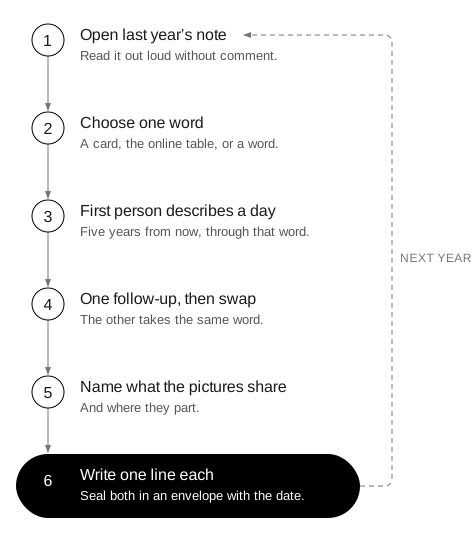
The envelope is the part that makes it yearly. Next year you open it at step 1 and hear what you wanted a year ago. Some lines will have happened. Some will look strange now. Both are useful: a line that no longer fits tells you the picture moved, and that’s worth a conversation of its own.
How to answer when your partner shares a hope
The listening half of step 4 matters as much as the talking half. When one of you says “I’d like to be working four days a week by then,” the reply shapes what comes next.
Research on good news points the same way. In four studies, Gable and colleagues looked at what happens when people share positive events. Sharing was linked to higher daily positive mood and well-being. The benefit was larger when the listener responded actively and constructively. In couples where a partner usually responded with enthusiasm, people reported more intimacy and higher daily marital satisfaction (Gable et al. 2004). The studies were about good events that had happened, not about plans, so they don’t prove anything about a five-year talk. They do describe the moment in step 4: one of you offers something hopeful, and the other decides how to meet it.
An active reply in practice is a follow-up instead of a verdict. “Four days, what would you do on the fifth?” keeps the picture open. “We can’t afford that” closes it before either of you knows what the fifth day is for. The money question is real, and it can wait until step 5.
The Thesis rule card has three follow-ups that fit any word:
What did that feel like? Who else was there? Has it always meant that to you?
For a picture of the future, the third one does the most work. A hope that has stayed the same for years means something different from one that showed up last month.
Three words for a five-year evening
A good word for this evening is wide enough to hold a whole ordinary day. These three from the Thesis deck fit.
Balance has Watch on its other side. It brings up a question a new year list can circle around: how the hours split between work, each other, family, and rest. Five years out, one of you may picture fewer hours at a desk, and the other more time with friends. The watch is a gentler start: a watch someone gave you, a first one, one that stopped.
Adulthood has Coin on its other side. It asks what being grown up looks like for each of you, five years from now. For one person that’s owning a home. For another it’s finally saying no to a parent. The coin side leads to money without starting there: a first wage, a jar of coins, an allowance.
Rest has Clock on its other side. A list of goals for the year can be all additions. This word asks what each of you wants less of, and what a slow Sunday would look like in five years. The clock opens stories about time: a kitchen clock, an alarm, a clock in a grandparent’s hallway.
The Thesis die adds another angle. It has six faces: MEMORIES, BODY, PEOPLE, VALUES, CHILDHOOD, FUTURE. Roll it before step 3 and look at the word from that side. On a night like this, a roll that lands away from FUTURE can still bring a hope into view.
Questions for the evening
If you’d rather start with a question than a word, these stay with the picture before the plan:
- Where do you wake up on an ordinary Tuesday five years from now?
- Who do you see every week then that you rarely see now?
- What do you want to be doing less of?
- What would you like to have learned by then?
- What does a good weekend look like in that life?
- Which part of today’s life would you want to keep exactly as it is?
- What would you like us to be known for among our friends?
- What’s one thing from last year’s note that still feels true?
- What scared you a little to say out loud tonight?
Use two or three per evening, not all nine. Follow each with one of the three rule-card questions, and let the answer run.
When your two pictures don’t match
Two pictures five years out will differ, sometimes a lot. One of you may see a city flat, the other a house near family. Step 5 asks only that you name the gap. Writing it down as “we see different places” is honest, and it gives next year’s evening something to start from.
The rules put the attitude in one line: “Every view is welcome, especially one that differs from yours.” A gap named calmly in January can be easier to work with than one found under pressure later. If a word lands somewhere painful, either of you can pass or turn the card to the object side. “A short answer is a full answer. You can always ask for more.”
Before the year turns
Find an envelope and write next year’s date on the front. Put the evening in both calendars for a quiet night in the first weeks of January. When the night comes, start with one word, and end the way a game of Thesis ends: each of you names one thing you found out about the other.
For a look back before you look ahead, see anniversary questions for the year you had. The three cards have their own pages: Balance, Adulthood, and Rest. For more on playing as two, see Thesis for couples. For the studies, see the research behind the deck. To see the cards and die, read the rules and the box. Related: different financial goals as a couple: retire early or enjoy now?.