A one-on-one works best when your direct report does most of the talking and brings the agenda. This guide gives you ten questions built on three words, Work, Success and Balance, plus a simple shape for the meeting and three follow-ups that keep the answer going. You can use them as they are, write one word on a sticky note, or draw a card from a deck.
What the research on one-on-ones says
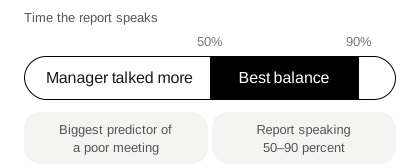
Steven Rogelberg studies one-on-one meetings, and his summary of the research has three findings a manager can use the same day. Nearly half of the employees in his research said their one-on-ones lacked substance. The biggest predictor of a poor meeting was a manager who talked more than the direct report. The best balance was the report speaking 50–90 percent of the time (Rogelberg 2024).
Two more findings shape the setup. Both managers and reports rated meetings highest when the report created the agenda, alone or together with the manager. And the research fits a weekly or every-other-week rhythm best. A longer gap makes feedback less timely (Rogelberg 2024).
Why the meeting drifts toward project updates
Updates are the easiest thing to ask about when a deadline is close. They have clear answers, they fit in a tracker, and they make the meeting feel useful to the person running it. Some reports have also learned that a one-on-one is a place to show progress, so they arrive with a list of tasks. A project board or a team stand-up can carry that list. The one-on-one is the slot for things a board can’t hold: what someone wants from their work, what drains them, and what they’d change.
A shape for the meeting
The steps below keep the report in charge of most of the time.
- Before the meeting, ask your report to add topics to a shared note. Their items go first.
- Open with Rogelberg’s question: “What would you like to talk about today?”
- Spend the middle on their topics. Ask one question from the list below if there’s time left.
- After each answer, ask one follow-up before you add your own view.
- Close with what each of you will do before the next meeting. Write it in the shared note.
Agree early on what goes into notes and what stays in the room. The rule card in Thesis says: “What is said at the table stays at the table.” In a one-on-one the manager holds more power, so say this part out loud. Anything personal stays out of reviews unless the report asks to raise it.
Ten questions built on three words
The questions below are grouped by word, so you can pick one word per meeting and stay with it. Each question invites a story about the report’s own experience.
Work
- What part of your work this week used the skills you’re proudest of?
- What took more energy than it was worth?
- Whose work made yours easier lately?
- What’s one thing I do that slows you down?
Success
- What would a good month look like for you right now?
- What would success on this project mean to you, apart from shipping it?
- What are you curious to learn next?
Balance
- Where are your hours going that you’d like back?
- What would make next week feel balanced?
- When did work last feel like the right size?
One question per meeting is enough. A question that lands can fill the rest of the meeting. A question that doesn’t land can wait for another week.
Follow up once before you answer
The rule card in Thesis gives three short follow-ups:
What did that feel like? Who else was there? Has it always meant that to you?
Huang and colleagues found that people who asked more questions, especially follow-up questions, were better liked by their conversation partners (Huang et al. 2017). In a one-on-one, a follow-up also keeps the talk time on the report’s side. Ask it, then wait.
Using a word instead of a question
Some reports freeze at a direct question from their manager. A single word on the table gives them room to choose the angle. Write “Work” on a sticky note, or draw a card from Thesis and let your report pick which side to read. Thesis has 50 double-sided cards: an idea on one side, an everyday thing on the other. Three of them fit a one-on-one well.
Work has Stone on its back. One report may talk about work as the weight they carry for the team. Another may talk about the thing they built that still stands. Both answers tell you where their effort goes.
Success sits behind Notebook. Ask your report to read it and then ask “Has it always meant that to you?” The answer often shows how their idea of success changed since they joined, which is useful before any talk about promotion.
Balance pairs with Watch. A report who’d rather not discuss hours can talk about the watch side instead, about time, rhythm or being late. A pass or a turn to the other side is a full answer.
If you’d like a second angle, the deck comes with a die that has six words: MEMORIES · BODY · PEOPLE · VALUES · CHILDHOOD · FUTURE. Look at the word from that side. Roll it once and let your report decide whether to use it.
For a remote one-on-one, share your screen with the online table and draw a card together.
Before your next one-on-one
Send your report one word from the list above, Work, Success or Balance, with the line “Bring a thought about this, if you like.” Then add Rogelberg’s opening question to the top of your shared note and keep the start of the meeting for their topics.
See the rules and the box. The three words have their own pages: Work, Success and Balance. For team sessions, see Thesis for teams and classes and team building card games for work. The research behind the deck explains where the words came from. For a class or a mixed-language team, see ESL questions about work-life balance. For a team retro, see retrospective ideas.