Opening up can work in small steps. You say one true thing that costs little, you watch what happens, and you take the next step only if the last one went well. A pass agreement made in advance lets either of you stop at any point. This post gives you five of those steps and one word to start with. You need no deck. A word written on a scrap of paper works.
It’s for people in a relationship who keep their feelings to themselves. Maybe you’ve been together for years and still don’t say when something hurts. Maybe you’re new to each other and every serious topic feels like a test. On marriage forums, some people in this spot describe the same thing: they want to share more, and the moment they start, something in them shuts the door.
What “not safe yet” can mean
In those threads, people don’t always spell out what “not safe” means. Some write that they’ve never had much openness in the relationship, so there’s no habit to fall back on. Some ask whether it’s better to deal with things alone. Whatever the reason, the risky part is the moment after you speak: whether the feeling will be brushed off, joked about, or met with silence.
This post is for those situations. If “not safe” means you’re afraid of how your partner will act toward you, a conversation format is the wrong tool. Talk to someone outside the relationship first.
Why the obvious advice doesn’t stick
The usual tip is “be vulnerable” or “tell them how you feel.” That asks for the biggest step first. If you’ve held back for years, a sudden full confession is a lot to carry, and the first awkward reaction can close the door again.
There’s also a gap between what people expect and what happens. In experiments by Kardas, Kumar, and Epley, people overestimated how awkward deep conversations would be. The talks went better and left participants more connected than they had predicted (Kardas et al. 2021). The participants were mostly strangers, and the authors found that people’s predictions were more accurate with close others, partners included. So the finding doesn’t promise that your partner will react well. It does show that the fear before a deep talk can be larger than the talk itself.
What makes a disclosure feel close also depends on the listener. In two diary studies, Laurenceau, Barrett, and Pietromonaco asked participants to rate each social interaction right after it happened, for one week in the first study and two weeks in the second. Intimacy came from both people disclosing, and how responsive the participant felt the other person was explained part of that link. Sharing emotions predicted intimacy more than sharing facts (Laurenceau et al. 1998). For opening up, that means two things: the feeling matters more than the report, and the listener’s reaction is part of the step.
Five small steps
These steps go from low cost to higher cost. Take one at a time, and stay on one as long as you like. Move on only when the last step felt all right to both of you.
- Agree how passing works. Before anything is shared, agree that either of you can pass without giving a reason, and that a pass isn’t discussed later. This is the safety rail for every step after it.
- Share a fact about the past. Pick something that happened long ago and is mostly settled: a room you grew up in, a teacher, a summer job. It costs little and gives your partner a chance to listen well.
- Add one feeling to the fact. Same story, one more sentence: what it felt like then. “I was the new kid and I ate lunch alone” becomes a feeling once you add “I felt invisible.”
- Share a feeling about the present, outside the relationship. Something about work, a friend, or your family. It’s closer to now, and your partner isn’t part of it.
- Share a feeling about the two of you. Start with a small one, and say it as your own experience: “When you check your phone at dinner, I feel far away.” Keep it to one sentence and leave room for a reply.
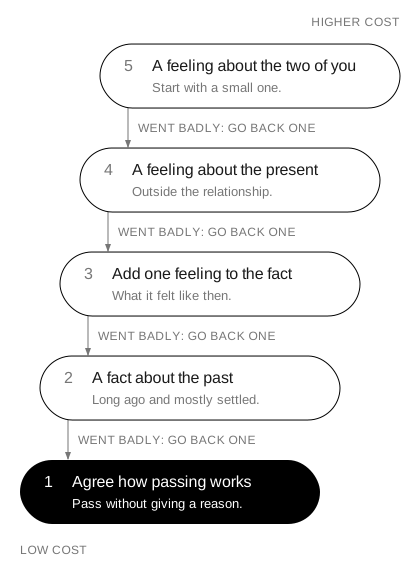
If a step goes badly, go back one. That’s the plan working. The aim is a string of small times when sharing went fine, so that the next step feels possible.
The listener’s part
Every step above has a second person in it. If your partner is the one who holds back, your reactions shape whether they take the next step. Two things help: ask one short question, and don’t fix or argue with the feeling.
The Thesis rule card has three follow-up questions that work after any small disclosure:
What did that feel like? Who else was there? Has it always meant that to you?
Ask one, then listen. For more on how to ask without pushing, see follow-up questions that keep a conversation going. If one of you is the type who goes quiet at the word “feelings,” see when your partner doesn’t like deep conversations.
Let a word go first
A word on the table gives you something to talk about that isn’t you yet. You can talk about the word and let the feeling come along when it’s ready. The rules put the pace in your hands: “Say as much or as little as feels right.” And: “A short answer is a full answer. You can always ask for more.”
Every Thesis card has two sides, an idea and an everyday thing. When the idea feels too close, pick the thing. That’s a smaller step you can take without passing.
These three cards from the deck fit people who are learning to open up.
Honesty has Radio on its other side. Talking about honesty in general is a step back from being honest about yourself: what honesty looked like in your family, a time someone was honest with you and it helped. Radio is gentler still. A song from the car as a kid can come with a memory and a feeling attached.
Trust has Window on its other side. Trust is the word under this whole post, and saying where your own trust comes from can be a first disclosure on its own. Window is a step back: a window you looked out of a lot, a view from a childhood room.
Privacy has Diary on its other side. It lets both of you say out loud that some things stay private, and that’s allowed. Hearing where your partner draws that line can make it easier to step over your own. Diary can lead to a story about what someone wrote down and never said.
When you’d rather start with a question
If a word feels too open, these questions sit around step 2 or 3. Each one asks for a small story with a feeling inside it:
- What’s a song that takes you back to a specific year?
- Who did you go to when you were upset as a kid?
- What’s something you were proud of that nobody noticed?
- Which room in your childhood home felt the safest?
- What’s a small thing that cheered you up this month?
- What did your family do when someone was sad?
- What’s something you used to be afraid of?
- When did someone listen to you well, and what did they do?
Use one at a time. Question 6 is worth a second look: the answer can explain where the holding back comes from.
Start tonight
Take step 1 and nothing else. Over dinner or on a walk, agree how passing will work. Then write Trust on a scrap of paper, or Window if that feels like enough, and leave it on the kitchen table for tomorrow. When you play, end the way a game of Thesis ends: each of you names one thing you found out about the other today.
If the distance has grown over years and feels like living with a roommate, see when your marriage feels like roommates. For more on playing as two, see Thesis for couples. The cards have their own pages: Honesty, Trust, and Privacy. For the studies, see the research behind the deck. The online table is free to use, and you can see the rules and the box.