A trainer says, “Let’s go around the room.” The person in seat four stops listening to seat one and starts rehearsing a fun fact. By the time their turn comes, they’ve heard nothing and say the safest line they can think of. A free pass at each turn changes that. Everyone is offered a turn in a fixed order, anyone can pass without a reason, and the round keeps moving. This guide is for team leads and trainers who want an opener people can opt out of, and who still want the room to talk. It works with a word on a sticky note, and the free online table covers the rest.
Why people look for a way out
The search for a way out of icebreakers starts with a cost. On a workplace Q&A board, one employee asked how to decline a department’s team-building day without damaging relationships. The worry was that saying no would read as preferring to work alone. On a UK parenting forum, people described dreading the introductions round at training courses and the “tell us about yourself” phase. Their objection was to being made to share, at work, things they’d tell colleagues only on a need-to-know basis.
Leaving the whole event is a big, visible act. So people often stay, sit through the round, and give the answer that reveals least. An opt-out that works at work has to be smaller than leaving the room. It has to fit inside a single turn.
What being called on does to an answer
Being put on the spot doesn’t only feel bad. It changes what a person can say. Cooper, Downing and Brownell interviewed 52 students in large college science classes about active learning. Of the 52, 31 said cold-calling or random calling raised their anxiety, and none said it lowered it. Students described their thinking going blank when called on. Some said they stopped putting themselves forward afterward (Cooper et al. 2018).
A meeting room is a different setting, and the study is about students. The pattern is still familiar to anyone who has watched a go-around at work. The person who feels watched says less, and says it worse. A pass removes the threat behind the turn. The turn still comes, but the person knows they can let it go by.
Waiting for volunteers has its own cost
Dropping turns altogether and waiting for volunteers creates a different problem. The same authors don’t recommend hearing only from students who volunteer, because it has been linked to inequities in whose voices get heard (Cooper et al. 2018). In an open floor, the same few people talk every time.
Group research points the same way. Woolley and colleagues studied 699 people working in groups of two to five. A group’s performance across many tasks was only weakly related to the average or highest intelligence of its members. It was more strongly related to members’ social sensitivity and to how evenly they took conversational turns (Woolley et al. 2010). A round that offers everyone a turn spreads the talking. A free pass keeps that round from becoming cold-calling. Together they sit between the two failures: nobody is forced, and nobody is skipped without being asked.
Consent changes how the same activity lands
Whether people chose to play shapes what they get from a game. Wharton researchers Ethan Mollick and Nancy Rothbard studied a sales game with several hundred salespeople. Players who embraced the game felt more positive about their company. For those who didn’t, the same game brought negative feelings and even lower performance (Wharton Magazine). An icebreaker is a small game. A pass at every turn lets each person consent one turn at a time, instead of all at once before the round starts.
How to set up an opt-out round
These steps are in the order you’d run them in a meeting or a training session:
- Agree on the pass before the first turn. The Thesis rules open with one line: “Before you start, agree together how passing works.” Say it out loud, with one sentence on what a pass looks like: the word “pass”, no reason given.
- Offer smaller exits than a full pass. A short answer counts. The Thesis rule card says: “A short answer is a full answer. You can always ask for more.” Someone can also ask to come back at the end of the round.
- Announce the order. Go clockwise or down the video call list. People who know when their turn comes can listen until then.
- Go first and keep it short. If you’re the manager or the trainer, your turn sets the length for everyone. Two or three sentences is enough.
- Answer a pass with “thanks” and the next name. No “are you sure”, no joke, no follow-up question. The first pass in a room shows everyone what the next one will cost.
- Put the round on the agenda with its length. Someone who wants to skip the whole opener can then join after it. That’s an opt-out too, and it costs them nothing in the meeting itself.
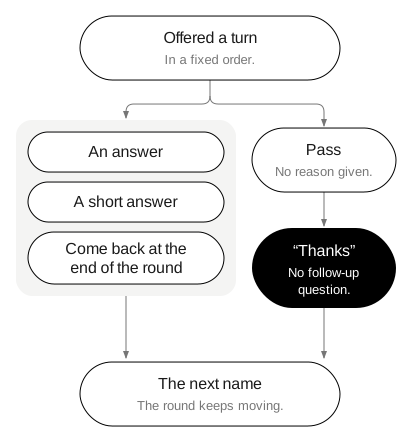
Some hosts worry that a free pass means everyone passes. The first pass is the test case. The room watches what happens to that person, and the host’s plain “thanks” answers the question for the rest of the session.
For a fuller setup of the pass agreement in support groups and workshops, see the right to pass in groups.
Three cards that suit an opt-out round
Each Thesis card has an idea on one side and an everyday thing on the other. The thing side is a built-in exit that’s smaller than a pass: a player can take it and talk about an object instead of their life.
Trust is on the back of Window. At work, Trust can lead to a colleague who covered for you, or a tool you’ve stopped double-checking. Anyone who’d rather not go there can take Window and describe the view from their desk or the window they look out of on calls. Both are full turns.
Fairness is on the back of Sweater. It’s a useful word for a team that splits work, because answers can turn to how tasks get shared. A player might pick Sweater and talk about the one they keep at the office for cold meeting rooms. That answer gives the room something without asking for anything private.
Belonging has Headphones on its back. For a new team or a training group, Belonging opens talk about the first week somewhere. Headphones gives a way out that can still be about work: what they listen to while they focus, or the signal headphones send to the rest of an office.
Try one round at your next meeting
With the deck or the online table, each turn follows the same steps. Draw a card, choose the idea or the thing, roll the die and look at the word from that side. The die has six plain words: MEMORIES · BODY · PEOPLE · VALUES · CHILDHOOD · FUTURE. The only instruction is “Look at the word from that side.” The others can ask one short question, and the rule card gives three examples: What did that feel like? Who else was there? Has it always meant that to you? A follow-up can be passed like the turn itself.
Before your next meeting, write the pass sentence into the invite next to the round’s length. Then say it again before the first turn, and go first. The cards above have their own pages: Trust, Fairness and Belonging. For more on running it at work, see Thesis for teams and classes, and the research behind the deck explains where the words came from. See the rules and the box. For the reasons behind the dread, see why people hate icebreakers.