The old group meets at the same bar a few times a year. Someone tells the story about the old road trip, everyone laughs at the same line, and someone calls you by a nickname nobody else has used in years. You go home a little flat. You like these people. You’re not sure they know who you are now.
That feeling has a name people search for: outgrowing friends. It can mean you’ve outgrown the person. It can also mean you’ve outgrown the format, the way the group talks when it’s together. The two feel the same from the inside, and they need different answers. This post helps you tell them apart and gives you one evening to find out which one you’re in.
What it looks like
Outgrowing a friendship shows up as small edits you make to yourself. You leave out the part of your week that matters most, because it won’t land. You laugh at a joke about who you were at 20, and you don’t correct it. The talk moves between old stories and quick updates, and the present gets a sentence each.
People who write about this online describe it in plain terms. One man on a forum for men over 30 wrote that a long friendship seemed to rest on the person he was in high school and his early twenties. Another described watching his friends’ lives move in different directions while it was happening. Neither had fallen out with anyone. The friendships were still running. They were running on old material.
Why it happens
On average, friendship circles get smaller across adulthood. A meta-analysis pooled 277 studies with 177,635 participants, from adolescence to old age (Wrzus et al. 2013). Social networks grew until young adulthood and then got smaller. Friendship networks decreased throughout adulthood, while family networks stayed about the same size. Life events such as becoming a parent or starting a job brought changes that looked like the ones that come with age.
So the cause can be impersonal. At 20, a group may share a schedule, a city and a lot of its days. Later, each person’s time can go to a job, a partner, children or a new country. The group meets less, and each meetup has to cover more. Old stories can be the one thing everyone still has in common, so they fill the evening.
Nostalgia holds old friends together
Talking about the past is a fair way for old friends to connect. In a series of studies on nostalgia, people’s nostalgic memories usually starred themselves with close others, held more positive than negative feeling, and often told of a hard time that was overcome (Wildschut et al. 2006). The same studies found that nostalgia strengthened social bonds and raised positive mood. Loneliness was one of its triggers.
The trouble starts when the past is the only topic. A group that only tells old stories keeps each member at the age the stories were made. You hear about the friend from back then, and they hear about you from back then. Nobody gets an update on the person in the chair.
Outgrown the friend, or the format
One way to tell the two apart is to change the format once and watch what happens. If the friendship opens up when the talk moves to the present, you’ve outgrown the format. If it stays closed, the friendship may have done what it was for.
A few signs point to the format:
- One to one goes better. Coffee with one friend feels closer than the group dinner.
- They ask, then the talk moves on. Questions about your life come, but nobody follows up.
- You hold back first. You leave things out before anyone has shown they don’t want them.
A few signs point to the friendship:
- Your news gets turned back. Changes in your life are met with jokes about who you used to be.
- Values pull apart. What you care about now is something they argue with or mock.
- Only one side reaches out. If that’s you, see always the one reaching out.
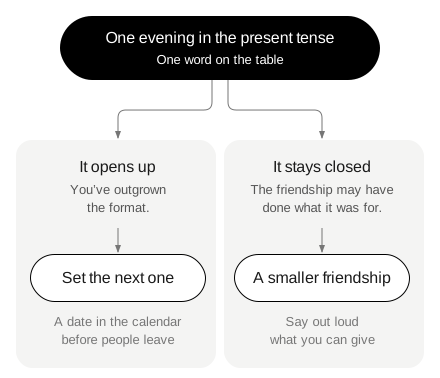
One evening in the present tense
The test needs a reason to talk about now. A word on the table gives one. It works for two old friends or the whole group of 2–6, at a kitchen table or on a video call. Write a word on a napkin, use the Thesis deck, or open the online table.
- Catch up first. Let the old stories go first.
- Put one word on the table. Each person picks a side of the card: the idea or the thing.
- Pick an angle. The die has six plain words: MEMORIES · BODY · PEOPLE · VALUES · CHILDHOOD · FUTURE. The only rule for them is “Look at the word from that side.”
- Answer for who you are now. A memory counts, as long as you say what it means to you today.
- Ask one follow-up before the next turn.
The rule card has three follow-ups that fit old friends well: What did that feel like? Who else was there? Has it always meant that to you? The last one is made for this situation. It asks a friend how they’ve changed, without asking them to explain themselves.
Two other lines from the rules help with a group that knows you too well. “Every view is welcome, especially one that differs from yours.” And “What is said at the table stays at the table.”
Questions for then and now
If you’d rather talk without a deck, these questions set the past next to the present. They’re sorted from light to deeper:
- What did you want at 20 that you don’t want now?
- What’s something you do now that would surprise you back then?
- Which story about you in this group is out of date?
- Who in your life now would we not recognize?
- What did you believe about adult life that turned out wrong?
- What’s harder for you this year than it was back then?
- What do you want from this group now?
- What would you like us to know about you that we don’t?
A few of these are enough for an evening. The third one can be hard to answer first, so the person who suggested the evening can go first.
Three cards for old friends
These three cards fit a friendship that started a long time ago.
Adulthood has Coin on its other side. The idea side asks what growing up meant for each person, and old friends may find they grew up at different times and in different ways. The coin side is lighter: a first paycheck, a shared rent split, the money everyone was short of at 20.
Nostalgia has Key on its other side. On this card the past is the topic on purpose, so the group can look at its own old stories together and ask why they keep coming back. The key side brings up the first apartment, the house where everyone met, a door nobody has keys to anymore.
Play has Laptop on its other side. An old group may have started with play: games, sports, nights out. A study of new friendships found that hours spent hanging out and joking around counted more toward friendship than hours spent working together (Hall 2018). This card asks what play looks like for each person now. The laptop side opens up the work that took over the evenings.
After the evening
If the evening opened something, set the next one before people leave. A date in the calendar is easier to keep than “let’s do this again.” New stories start with new evenings, and in a few years they’ll be the ones the group retells.
If it stayed closed, the friendship can be smaller without ending. A birthday call, a dinner now and then, a group chat you read with affection. Saying out loud what you can give can help. For more on that, see boundaries with friends. For what you want from friends at this point in life, see the meaning of friendship.
This week, send one old friend an invite for a weeknight with one word on the table. See the rules and the box, or play free on the online table. The cards above have their own pages: Adulthood, Nostalgia and Play. For more ways to play with a group, see Thesis for friends. The studies behind the deck are on the research page.