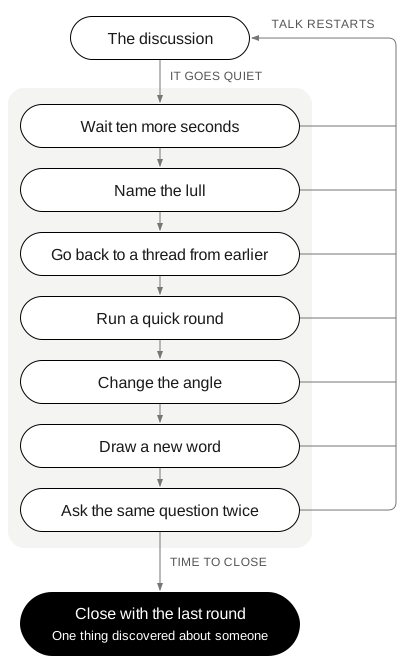
The last speaker finishes. Someone nods. Nobody picks it up, and you feel the silence stretch while the circle looks at the floor. A stalled group discussion can restart with a small, planned move: a longer pause, a thread from earlier, a quick round, or a new prompt. This guide gives seven of them in the order a host can try them, for support groups, peer circles, workshops and classes.
The moves work with any prompt. The examples use the Thesis card deck, because a fresh word is one of the moves. A word written on an index card works the same way.
Why the room goes quiet
A lull can have a few causes. The topic ran its course. The last share was heavy, and nobody wants to follow it with something light. Or the group is new, and each person is waiting to see who goes next. From the host’s chair these look the same, so the first moves are cheap ones that work for all three.
A host feels a strong pull to fill the silence. In her 1986 review, Mary Budd Rowe reported that teachers typically wait less than one second for a student’s answer after asking a question (Rowe 1986). The review is about classrooms, and it covers what changes when teachers learn to pause longer. A group host faces the same pull: the quiet feels long to the person who asked.
Move 1: Wait ten more seconds
Count to ten in your head before you say anything. Keep your eyes soft and your hands still. A quiet person may need that time to decide whether their thought is worth saying.
If someone starts to speak, let them finish without adding to it. If nobody does, you’ve lost ten seconds and learned that the room needs a different move.
Move 2: Name the lull in one sentence
Say what’s happening, plainly: “It’s gone quiet. That’s fine. Does anyone want to add to that, or shall we move on?” One sentence gives the group permission to sit in it or leave it.
Keep the tone flat and friendly. A joke at this point tells the group the silence was a problem. A plain question tells them it’s a normal part of the session.
Move 3: Go back to a thread from earlier
Something said early in the session may have more in it. In a thread on the Death Cafe forum, one reply describes using an open-ended question or two when talk stalls, drawn from themes people raised in their introductions (Death Cafe forum).
Keep a short note during the opening round: three or four phrases people used. When the room goes flat, read one back: “Earlier, someone mentioned their grandmother’s kitchen. Can we go back there?” Name the theme, not the person, so nobody feels put on the spot.
Move 4: Run a quick round
A quick round asks one short question and gives every person a turn in a sentence or two. SMART Recovery’s facilitator guidance for meetings where nobody brings an issue works this way: each question “can be answered quickly, going around the circle” (SMART Recovery). If a discussion starts mid-round, the guidance suggests finishing the circle first and then coming back to it.
These questions can work for a quick round:
- What’s one thing from today’s talk that stayed with you?
- What did you almost say earlier, and didn’t?
- Where were you sitting the last time you felt at ease?
- What’s something you’ve changed your mind about this year?
- Who taught you something you still use?
- What’s a small thing that went well this week?
- What would you like to hear more about from this group?
- What’s an object in your home you’d keep if you moved?
- What’s a question you’d like someone to ask you?
- What do you know now that you didn’t know a year ago?
Keep the answers short. “A short answer is a full answer,” as the Thesis table card puts it. A short answer from everyone puts every voice back in the room in a few minutes.
Move 5: Change the angle on the same topic
Sometimes the topic is fine and the angle is worn out. A new side of the same subject can restart it without starting over.
In Thesis, every card has an idea on one side and an everyday thing on the other. A player who has nothing more to say about the idea can turn to the thing. The die gives six more angles: MEMORIES · BODY · PEOPLE · VALUES · CHILDHOOD · FUTURE. The only instruction is “Look at the word from that side.” The online die works on a shared screen if the group meets on video.
Curiosity sits on the back of Sewing machine. It’s a good card for a flat room, because the word itself asks the group to lean in. A player can talk about something they wanted to understand as a child, or about a sewing machine in a relative’s home. The follow-ups on the rule card fit here: What did that feel like? Who else was there?
Move 6: Draw a new word
When a topic is done, a new prompt is the honest next step. Draw a card, read the word aloud, and give the group a few seconds before the first turn. A fresh word resets the room without anyone having to admit the last topic ran dry.
Play is on the back of Laptop. After a heavy share, it gives the next speaker a lighter way in without dismissing what came before. One person might talk about a game they played with siblings, another about the laptop they work on until late. Either answer can bring the energy back into the circle.
Move 7: Ask the same question twice
Go around once, then ask the same question again. SMART Recovery’s guidance uses this with a question about values: after everyone has answered, the group goes around a second time and looks at whether the answers changed (SMART Recovery).
The second round is where the talk can open. People have heard each other’s first answers, and they now have something to agree with or push against. Ask “What changed for you?” once both rounds are done.
When flat means finished
A lull can also mean the group is done for today. If a few moves don’t restart the talk, the room may be telling you it’s time to close. The Thesis rule card says: “Play for as long as it feels good.”
Close with the last round from the rules: “each player names one thing they discovered about someone at the table today.” It gives a quiet group a way to end on something said to each other. It also asks nothing new of a person who has run out of words.
Rest is on the back of Clock. It’s a fitting card near the end of a session. A player might talk about the last time they rested without guilt, or about a clock that ticked in a room they grew up in. The word gives the group a way to name that it’s tired without anyone saying “this is boring.”
You know your group, its purpose and its limits, and you decide which moves fit it. Thesis is a conversation format and makes no clinical claims.
Try the moves in one session
Pick two moves before your next session and write them on a card next to your notes: one cheap move, such as the ten-second wait, and one reset, such as a new word. Use them the first time the room goes quiet.
To practice, open the online table on a shared screen and play a few turns.
For more on running the game in a session, see Thesis for therapy groups. The cards above have their own pages: Curiosity, Play and Rest. You can play online for free, see the rules and the box, or read the research behind the deck. When the opposite happens and one person fills every silence, see how to handle someone dominating a group discussion. For prompts in a grief setting, see grief support group discussion questions. Related: cross-cultural classroom discussion: 6 moves for instructors.