In a round robin, the turn goes around the circle in a fixed order. In popcorn sharing, whoever is ready speaks next. For a sensitive group, the choice comes down to two risks. A go-around can put someone on the spot before they’re ready. Popcorn can let the same few voices fill the session while others stay silent. This guide helps hosts of support groups, grief circles, recovery meetings and workshops pick the order that fits the group in front of them, and switch when the group changes.
The steps work with any prompt. The examples use the Thesis card deck, whose rules use a fixed order. A word written on an index card works the same way.
What each order does in the room
A round robin answers the question “who’s next?” before anyone has to ask it. Each person knows when their turn comes. Nobody has to decide to break a silence. The cost is that the turn arrives whether or not the person feels ready.
Popcorn sharing leaves that question open. A person speaks when something lands for them, and the order follows the conversation. The cost shows up in who decides to speak. In an open floor, the people who find it easiest to start keep starting. A newcomer may wait for a gap that never feels right.
People in grief support groups describe both sides. One person in a bereavement forum wrote that they couldn’t open up at first with so many others sharing. Another said their group was kept small on purpose so everyone had a chance to talk. Both comments point at the same thing: a turn that is offered, and room to wait for it.
What a go-around gives a sensitive group
A fixed order spreads the talking. Woolley and colleagues studied 699 people working in groups of two to five. Groups that did well across many tasks had members with higher social sensitivity and a more even spread of conversational turns (Woolley et al. 2010). That study measured group tasks, not sharing circles. It still suggests that who gets the floor is linked to how a group works together.
A go-around also removes the cost of going first. A small-group leader writing for other leaders described meetings where none of the members wanted to be the first to speak. In a round robin, someone is first by position, and the host can take that seat.
Turns that come to everyone can also make speaking easier over time. Dallimore, Hertenstein and Platt compared college classes where instructors often called on students with classes where they rarely did. In the high-calling classes, more students answered voluntarily, the number grew over time, and students’ comfort with discussion rose (Dallimore et al. 2012). Calling on a student differs from a go-around with a pass, and a class differs from a support group. The finding suggests a structure that reaches everyone doesn’t have to shrink voluntary talk.
What popcorn sharing gives a sensitive group
An open floor lets a person speak when the words are there. In a grief or recovery group, a story can come in response to someone else’s. Popcorn lets it come at that moment, instead of several seats later.
It also lets a person stay quiet without a public act. In a round robin, staying silent means saying “pass” out loud. In popcorn, nobody notices a person who listens through a round. For someone in their first session, that can make it easier to stay.
The open floor needs a group that already talks. With strangers, popcorn can turn into a long silence and then the most confident person. With a group that knows its rhythm, it reads as conversation.
How to choose for the group in front of you
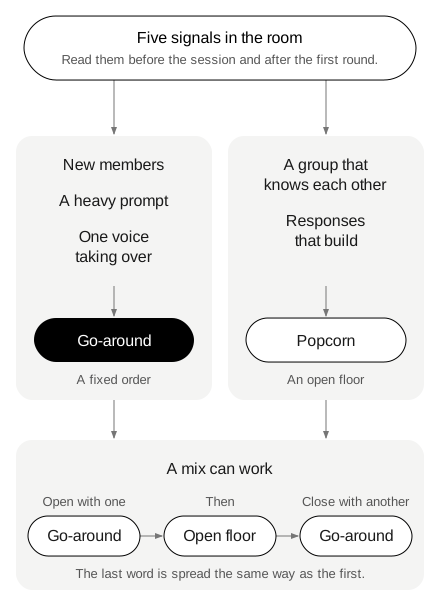
Five signals in the room can guide the choice. Read them before the session and again after the first round.
- New members. A go-around with a pass tells a newcomer when to speak and how to step back.
- A heavy prompt. A fixed order keeps one person from carrying the whole topic alone.
- One voice taking over. A go-around gives the floor back to everyone without naming anyone.
- A group that knows each other. Popcorn follows the conversation where it’s already going.
- Responses that build. When answers start to connect, an open floor lets the next one come in time.
A mix can work. Open with one go-around, so everyone has had a turn and knows the pass works. Then open the floor. Close with another go-around, so the last word is spread the same way as the first.
These questions help a host settle the order before a session:
- Is anyone new this time?
- How heavy is the prompt or topic?
- Has one person taken most of the time in recent sessions?
- How does a person pass in this group, and has anyone used it?
- Does the group sit in a circle where “next” is clear?
- Will the host go first, or wait?
- How long can the session run if everyone takes a turn?
- Do answers tend to build on each other here?
- Who stayed quiet last time, and what order were we using?
- Does the group want to choose the order itself?
How Thesis handles turn order
The Thesis rules use a fixed order: “Hand the die to the left.” The first turn is set too: “Whoever suggested the game goes first.” In a hosted group, that can be the host. Before the first draw, the group agrees on one more thing: “Before you start, agree together how passing works.” So the default is a round robin with a pass.
A group that prefers popcorn can play that way too. Put the die in the middle. Whoever is ready takes it, draws a card and chooses a side. The rest of the turn stays the same. The line “A short answer is a full answer. You can always ask for more.” works in either order.
Courage is on the back of Bicycle. It suits the first turn of a session, because the host can model what going first looks like. A host might talk about a time they spoke up, or about learning to ride a bicycle. Both answers show the group a turn of a size they can match.
Respect sits on the back of Blanket. It’s a good card for the moment a group switches from a go-around to an open floor. Answers about respect can turn to who gets heard. A player can also pick Blanket and talk about the one on the sofa at home, which keeps the turn light.
Community is on the back of Mirror. It fits the closing go-around, when the group looks at itself. Thesis ends with a last round in a fixed shape: “each player names one thing they discovered about someone at the table today.” A player who listened all session still has something to say there.
Try both orders in one session
The quickest way to see the difference is to play one round each way. Open the online table on a shared screen, go around once, then put the die in the middle for a second round.
The die has six faces: MEMORIES · BODY · PEOPLE · VALUES · CHILDHOOD · FUTURE. The only instruction is “Look at the word from that side.”
You know your group, its purpose and its limits, and you decide how far a game format goes in it. Thesis is a conversation format and makes no clinical claims. After the two rounds, ask the group which order felt easier to speak in, and use that one next time.
For a round at the start of a meeting, see how to run a check-in. For hosting sessions, see Thesis for therapy groups. The three cards above have their own pages: Courage, Respect and Community. You can play online for free, see the rules and the box, or read the research behind the deck. Related: check-out questions for group therapy and support groups.