A check-in round is one short turn per person at the start of a meeting, on one prompt, with a time limit and a pass rule said out loud. This guide is for facilitators who run it: how to count what it costs before you start, how to set it up in six steps, what to do with “What’s on your mind?”, and five meetings where the round is better left out.
What a check-in round costs
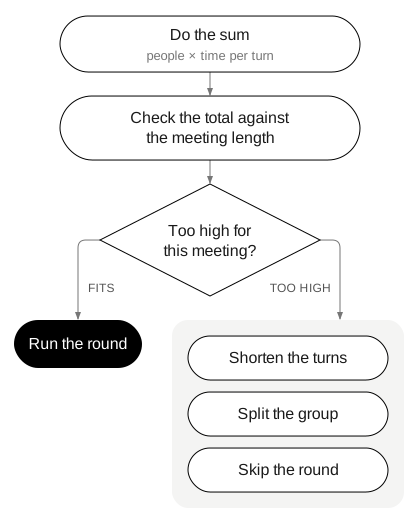
A round costs the number of people times the time each person takes. Every extra person adds a full turn, and all of it comes before the first agenda item. Halve the time per turn and the round takes half as long.
Do this sum before every meeting. The group size changes, the slot changes, and a round that fit a long workshop can eat a short planning call. A time limit per person is the only part of the round you fully control, so set it from the sum. If the number of minutes feels too high for this meeting, shorten the turns, split the group or skip the round.
What the round gives back
The minutes before the agenda already carry weight. In a survey of 252 working adults, small talk before a meeting predicted how effective people rated the meeting, even after the researchers accounted for good meeting procedures. The link was stronger for less extraverted people (Allen et al. 2014). It was a one-time survey, so it shows a link and not a cause. A check-in round is one way to give that talk a shape, so the quieter people get a turn too.
The round also tells the facilitator something. If a few people say they’re stretched thin, the agenda may need a shorter list. If someone says they have to leave early, the decision item can move up. A check-in that changes nothing in the meeting can start to feel like a formality.
How to run a check-in in six steps
The steps below are in the order you do them, from the invite to the first agenda item.
- Do the sum. Count the people, pick the seconds per person and check the total against the meeting length.
- Pick one prompt. Choose a word or a short question and put it in the invite, so people who need time to think have it.
- Say the frame. At the start, say the prompt, the time per person, the order and how passing works, in that order.
- Go first. Answer in the time you set. Your answer shows the length you mean better than the instruction does.
- Hold replies. During the round, nobody responds to an answer. Questions wait until everyone has spoken.
- Close with one line. Say what you heard that changes this meeting, then start the first agenda item.
The order in step 3 matters for the pass rule. If people hear the prompt before they hear that passing is fine, some may start planning an answer they don’t want to give. The Thesis rule card opens with the same agreement: “Before you start, agree together how passing works.” A pass can be a word (“pass”), a gesture or a line in the chat, and it needs no reason. For more on this, see how to let people opt out of icebreakers.
The trouble with “What’s on your mind?”
“What’s on your mind?” is a wide-open check-in prompt, and that’s both its use and its risk. It lets someone say they’re worried about a sick parent, or that the build broke this morning. It also invites the last thing that annoyed them, and a round of complaints can set the tone for the rest of the meeting.
The research on team meetings points in that direction. In 92 videotaped team meetings, more problem-solving and action planning went with higher meeting satisfaction, and better meetings went with higher team productivity. Criticizing and complaining had negative links to these outcomes, and those links were stronger than the positive links of the good interaction (Kauffeld and Lehmann-Willenbrock 2012). The study looked at whole meetings, not check-ins. Still, it’s a reason to give an open prompt a frame.
A narrower prompt keeps the openness and adds a direction. The questions below each fit in one turn:
- What’s on your mind that might affect how you’re here today?
- What do you need from this meeting to leave with less on your plate?
- What’s one thing from this week you’d like the group to know?
- What’s taking most of your attention right now?
- What would make this meeting useful for you?
- What’s one word for how you’re arriving?
- What did you finish since we last met?
- What are you looking forward to this week?
Pick one and keep it for a few weeks. The same prompt each time makes the answers easier to compare, and changes stand out.
When to skip the round
The five situations below are ones where the round costs more than it gives.
- The meeting is short. In a quick stand-up, even short turns for everyone can take a large share of the slot.
- The group met earlier today. People already know how the others are arriving. A second round repeats the first.
- Something urgent is on the table. In an incident call or a meeting about bad news, the facts may need to come first. A round can wait for the end, or for the next meeting.
- The group is large. In a big group, even a short turn adds up to minutes and gives each person about one sentence. Split into smaller groups or skip it.
- The answers have gone flat. When every answer is “fine, busy,” the prompt has stopped working. Change the prompt or drop the round for a few weeks.
Skipping the round doesn’t mean skipping the talk before the meeting. The authors of the pre-meeting study suggest that managers encourage people to arrive early enough to take part in it (Allen et al. 2014). On a video call, open the room a few minutes before the start and stay there yourself.
Using one word instead of a question
A single word lets each person choose the angle and the depth. Write it on the whiteboard or type it into the chat. Thesis has 50 double-sided cards: an idea on one side, an everyday thing on the other. These three work as a check-in word.
Silence has Tree on its back. In a busy team, Silence can bring out who hasn’t had a quiet hour all week, or who’s been too quiet in the channel. Tree is the lighter side: the view from someone’s window, or a walk at lunch.
Gratitude pairs with Fence. Gratitude works well before a retrospective, because answers can name a colleague’s help. Fence gives a different reading, about limits, a line someone held this week, or a garden.
Joy sits behind Chair. Joy suits a Monday check-in, since anyone can name one small good thing. Chair lets someone talk about where they’re sitting today, at home, on a train or in a new office.
The deck also has a die with six words: MEMORIES · BODY · PEOPLE · VALUES · CHILDHOOD · FUTURE. Look at the word from that side. For a check-in, one roll for the whole group keeps the round on one angle. If the printed die isn’t at hand, roll it on screen. The rule card has a line for the length of each turn: “A short answer is a full answer.”
For a remote group, share your screen with the online table and draw one card for the round.
A check-out to end on
The same round can close a meeting in less time than it opens one. The Thesis rule card ends play with a last round: “each player names one thing they discovered about someone at the table today.” For a meeting, one word or one sentence per person is enough, and a pass still counts.
Before your next meeting, count the people, multiply by the seconds per turn and write the total next to the agenda. If it’s more than you’d give any single item, cut the turns or skip the round this time.
See the rules and the box. The three words have their own pages: Silence, Gratitude and Joy. For more prompts, see check-in questions for team meetings and quick icebreakers for meetings. For more on running it at work, see Thesis for teams and classes. For the studies behind the deck, see the research page.