A quick icebreaker for a meeting fits in five minutes when it has one prompt, one turn per person and a fixed end. This post gives a minute-by-minute plan for that opener, built on a single word. You pick the word before the meeting, each person says a sentence or two about it, and the agenda starts on time. It works with a word typed into the chat, and the free online table adds a card and a die if you want them.
Why the first five minutes are worth planning
The minutes before the agenda already do some work. In a survey of 252 working adults, talk before a meeting predicted how effective people rated the meeting, and the link was stronger for less extraverted people (Allen et al. 2014). The study was a one-time survey, so it shows a link and not a cause. A planned opener gives that talk a shape, so quieter people get a turn instead of watching two colleagues chat.
Small talk has a cost too. In a three-week diary study, small talk at work brought positive social emotions and better well-being. It also pulled attention away from work (Methot et al. 2021). That’s the case for a hard stop. Five minutes keeps the good part and hands the attention back to the agenda.
What five minutes holds
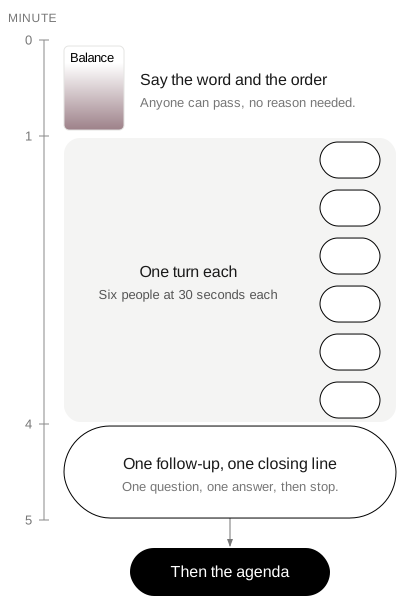
The plan splits the time into three parts. One minute to set up, three minutes of turns and one minute to close. With six people at 30 seconds each, the turns take three minutes. With four people, each person gets 45 seconds. The numbers matter because a round with no time per person stretches to fit whatever the first speaker does.
Before the meeting: pick one word
Choose one word for the whole team and put it in the calendar invite or the chat a few minutes before the start. People who need time to think get it, and nobody hears the prompt cold. With a word, each person decides which way to take it. One person talks about a project, another about a habit, and both answers fit.
Add one line under the word: “Anyone can pass, no reason needed.” The Thesis rules open with the same agreement: “Before you start, agree together how passing works.” Writing it in the invite means the pass is settled before anyone feels watched. How to opt out of icebreakers covers this from the side of the person who’d rather skip.
Minute 0–1: say the word and the order
Start the meeting by saying the word out loud, the time box and the order. “The word is Balance. Thirty seconds each, we go in the order of the call list, and anyone can pass.” Then go first yourself. Your answer can set the length for everyone after you, so keep it to two sentences.
A fixed order saves time. Nobody waits for a gap to speak, and nobody wonders when their turn comes. On a video call, paste the order into the chat.
Minutes 1–4: one turn each
Each person says a sentence or two about the word. The rule card puts the depth in one line: “A short answer is a full answer. You can always ask for more.” In a five-minute round, nobody asks for more during the turns. Hold questions until everyone has spoken.
Even turns are part of the point. In two studies with 699 people working in groups of two to five, a group’s performance across many tasks reflected one shared factor, and groups scored higher on it when conversational turns were spread more evenly (Woolley et al. 2010). The finding is a correlation from lab tasks, and a meeting opener is a small slice of a team’s week. Still, an opener where each person speaks for the same 30 seconds is one place a lead can make turns equal on purpose.
Minute 4–5: one follow-up, one closing line
Use the last minute for a single follow-up question to one person, if someone said something worth hearing more about. The rule card gives three examples: What did that feel like? Who else was there? Has it always meant that to you? One question, one answer, then stop.
Close with a line that moves the meeting on. “Thanks. First item: the release date.” Saying the first agenda item out loud marks the end of the round.
Words that fit the start of a meeting
Each Thesis card has an idea on one side and an everyday thing on the other. Either side works as the word for the round. The thing side can be easier when the team is new or the week has been heavy, because anyone can talk about an object without saying much about themselves.
Balance has Watch on its back. Before a planning meeting, Balance can bring out how people split their week between deep work and calls. Someone might pick Watch instead and talk about the time zone they keep an eye on, or a watch they inherited.
Success has Notebook on its back. It suits the start of a review or a kickoff, because answers can describe what “done” looks like for each person. The Notebook side gives a lighter route: the notebook on someone’s desk, or the list they keep for the week.
Work has Stone on its back. Work invites answers about a first job, a task someone enjoys or the part of the week that drags. Stone is open to many readings. People might talk about a stone they picked up on a trip, or something that feels heavy right now.
Larger teams and video calls
The deck is made for 2–6 players, and the five-minute plan fits that size best. With more people, the turns get shorter or the group splits. With 12 people at 15 seconds each, the turns still take three minutes, but each answer is one sentence. In a video call, breakout rooms of four to six can each take the same word for three minutes and return for the close.
On a call, the chat helps. People can type their sentence instead of saying it, and the lead reads a few aloud. If the team has a printed deck but the die is out of reach, roll it on screen. For more on running it at work, see Thesis for teams and classes.
When the round runs over
A round can run over in three ways. The first speaker talks well past the time box, a follow-up turns into a discussion, or people start replying to each other. The fix is the same each time. Thank the person, say the time, and go to the next name on the list. If a topic deserves more time, put it at the end of the agenda.
If the round keeps running over, cut it to fewer people per meeting. Half the team answers this week, the other half next week. A rotation keeps the five minutes and still gives everyone a turn.
Running it with the cards
With the deck or the online table, a turn follows the same steps. Draw a card, choose the idea or the thing, roll the die and look at the word from that side. The die has six plain words: MEMORIES · BODY · PEOPLE · VALUES · CHILDHOOD · FUTURE. The only instruction is “Look at the word from that side.” For a five-minute opener, draw one card and roll once for the whole team, so everyone answers the same word from the same side.
For your next meeting, pick one word, add it to the invite with the line “Anyone can pass, no reason needed,” and write down the order. The words above have their own pages: Balance, Success and Work. The research behind the deck explains where the words came from, and why people hate icebreakers covers the complaints this format is built around. See the rules and the box. For a weekly round, see check-in questions for team meetings.