A team check-in works when the question asks about the week people are in, takes one answer from each person and ends at a set time. This post gives team leads ten check-in questions built on three words, Rest, Enough and Balance, plus a short shape for the round and three follow-ups. The words also tell you something you can act on: who is tired, who has too much, and whose week has tipped. You can read the questions out, type one word in the meeting chat, or draw a card.
Why “How was your weekend?” runs dry
The weekend question asks about the part of life a meeting has the least to do with. After a few Mondays the answers repeat: “Good, quiet, you?” People who spent the weekend caring for someone, working a second job or doing nothing at all have to choose between a cover story and more detail than they want to give at work. In developer forums, some people describe weekend openers and trivia as fluff that delays the meeting. The question is friendly. It gives the lead nothing to work with, and the team learns that the check-in is a formality.
A check-in question about the working week keeps the friendliness and adds a use. If several people answer an Enough question with “too much this sprint,” the lead has a planning topic before the agenda starts.
What the research on pre-meeting talk shows
The minutes before the agenda count. In a survey of 252 working adults, small talk before a meeting predicted how effective people rated the meeting, even after the researchers accounted for good meeting procedures. The link was stronger for less extraverted people (Allen et al. 2014). The survey was taken once, so it shows a link, not a cause.
In a study where more than 150 employees recorded their daily work interactions over three weeks, small talk had two sides. On days with more of it, people felt more energized, seen and connected, and less burned out. Small talk also pulled their focus away from work (Methot et al. 2021). A check-in with a fixed end may keep the first effect and limit the second. More on the evidence behind the deck is on the research page.
A short check-in round
The steps below keep the round short and end it at a set time.
- Before the meeting, pick one word: Rest, Enough or Balance. Put it at the top of the agenda.
- At the start, say the word, the question and how passing works. The Thesis rule card puts it this way: “Before you start, agree together how passing works.”
- Go around once. Each person answers briefly.
- After an answer, one person may ask one follow-up. Then the next person speaks.
- Close with one line from the lead: what you heard that changes this meeting or this week.
- Start the agenda on time.
Answer first yourself the first few times, and keep it short. The length of the first answer can set the length of the rest. The rule card also helps here: “A short answer is a full answer.”
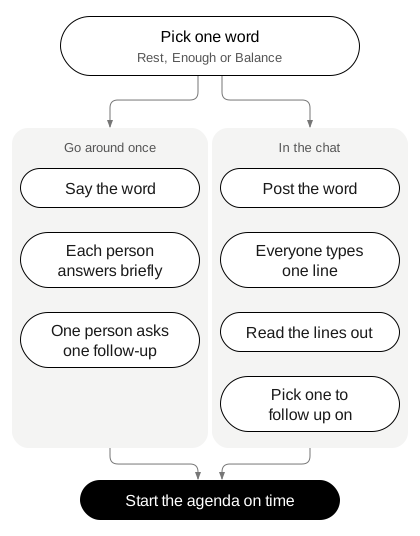
For a remote team, the same round works in the chat. Post the word, give everyone a moment to type one line, then read the lines out and pick one to follow up on.
Ten check-in questions built on three words
The questions below are grouped by word, so one word can carry a whole month of check-ins. Each asks about something the person did or noticed, which can be easier to answer than an opinion.
Rest
- When did you last stop work and not think about it?
- What gave you energy back this week?
- What would a real break look like during a workday here?
Enough
- What’s one task you’d call done enough right now?
- Where do you have more on your plate than you can carry this week?
- What did you finish lately that nobody saw?
- What do you have enough of this week: time, help or information?
Balance
- What took more of your week than you planned?
- What’s one thing that would make next week feel balanced?
- Which part of your work would you like more of?
One question per meeting is enough. Rotate words every few weeks so the answers stay fresh. When a question opens something that needs more time, note it and pick it up in a one-on-one. The post on one-on-one questions for direct reports has a shape for that conversation.
Three follow-ups that keep answers going
A check-in can stall after the first sentence. The Thesis rule card gives three short follow-ups that work in any meeting:
What did that feel like? Who else was there? Has it always meant that to you?
Limit the round to one follow-up per person. A second follow-up can turn a check-in into a conversation, and the agenda waits. Any answer counts, including a pass, because the card also says: “There are no right answers.”
Using a word instead of a question
A single word gives each person room to choose an angle. Write “Rest” on the whiteboard, or draw a card from Thesis and let each person pick a side to read. Thesis has 50 double-sided cards: an idea on one side, an everyday thing on the other. These three fit a team check-in.
Rest has Clock on its back. Some may talk about rest itself: the evening off, the walk at lunch. Others may pick the clock and talk about time, deadlines or the hour they start. Both answers show how the week is going without asking anyone to report on their private life.
Enough pairs with Photograph. The idea side invites a word on workload or on what counts as done. The photograph side lets someone show what they’d keep from the week. A person who’d rather stay off workload can take the photograph and still give a full answer.
Balance sits behind Watch. A team in a busy sprint can answer on the idea side with what tipped. The watch side brings time back in as rhythm: early mornings, late calls, the meeting that ran over.
The deck also has a die with six words: MEMORIES · BODY · PEOPLE · VALUES · CHILDHOOD · FUTURE. Look at the word from that side. For a short round, one roll for the whole team keeps everyone on the same angle.
For a remote meeting, share your screen with the online table and draw one card for the round.
For your next team meeting
Put the word Rest at the top of the agenda with question 2 under it: “What gave you energy back this week?” Agree how passing works before the first answer, then end the round at the time you set.
See the rules and the box. The three words have their own pages: Rest, Enough and Balance. For more ways to use the deck at work, see Thesis for teams and classes. For more on openers, see icebreakers that aren’t cringe. For a five-minute version, see quick icebreakers for meetings. For when to run the round at all, see how to run a check-in.