One of you wants a joint account. The other wants to keep their own. You’ve talked about it before, and each time it turned into a debate about bank apps, transfer dates, and who pays the streaming bill. The setup is the last step of this decision. The first step is what money means to each of you.
This post is for married couples deciding between joint and separate finances, or living with a setup that one of you has stopped liking. It gives you what research found, what each setup can protect, and one evening format to talk about values before you open a banking app. It doesn’t pick a winner. A word written on a napkin is enough to start.
Two people, two reasons
On marriage forums, threads about separate finances can show two sides describing the same arrangement in opposite terms.
One spouse writes that the monthly split feels like being a roommate who gets an invoice for the bills. Every transfer reminds them that the money is “mine” and “yours.” Another spouse writes that separate accounts are the reason they feel at ease: nobody comments on what they buy. A third asks whether splitting can work when one partner struggles to manage money.
Each of these people is describing something they want to protect. The first wants closeness. The second wants freedom from judgment. The third wants safety. An account structure is a way to hold those wishes, and it works better once both of you have named them.
What research found
The best evidence on the setup itself comes from one experiment. Jenny Olson and colleagues followed 230 engaged or newlywed couples who all kept separate accounts at the start. Couples were randomly assigned to merge into one joint account, keep separate accounts, or choose for themselves. Over two years, the separate-account group and the choose-for-yourselves group showed the usual decline in relationship quality. The joint-account group didn’t. They also reported more “financial harmony” (Olson et al. 2023). Of the couples left to choose, 72 percent kept separate accounts throughout.
The authors point to three reasons in the abstract: partners felt better about how they handled money, their financial goals lined up more, and they kept to communal norms, meeting each other’s needs without keeping score.
The same researchers add limits. The benefits were averages and may not reach every couple. A joint account means giving up some independence, and in a relationship where one partner controls the other, it can add risk. A partial setup, a joint account next to two personal ones, wasn’t linked to the same benefits, and the authors were cautious about that result. The study covered couples early in marriage.
A second line of research explains why the talk matters as much as the setup. Jeffrey Dew, Sonya Britt, and Sandra Huston used survey data from 4,574 US couples. Financial disagreements predicted divorce more strongly than other common disagreements. Feeling that money was split unfairly was linked to divorce through those disagreements (Dew et al. 2012). The data is correlational. It doesn’t show cause. It does suggest that fights about money and a sense of unfairness are worth talking about before they repeat.
Why the bank-app conversation stalls
The obvious advice is “sit down and make a budget together.” Couples can try it and end up arguing over a spreadsheet cell. The spreadsheet asks for a decision before either person has said what they’re afraid of losing.
Behind “I want my own account” there can be a story. A parent who had to ask for money. A first marriage where one card paid for everything. A childhood where money was never mentioned. Behind “I want one account” there’s another story: parents who pooled everything, or a sense that keeping track of who paid means keeping a distance. Those stories may not come up while you’re comparing account fees.
One evening before the choice
This format needs no numbers. Leave the budget for another night.
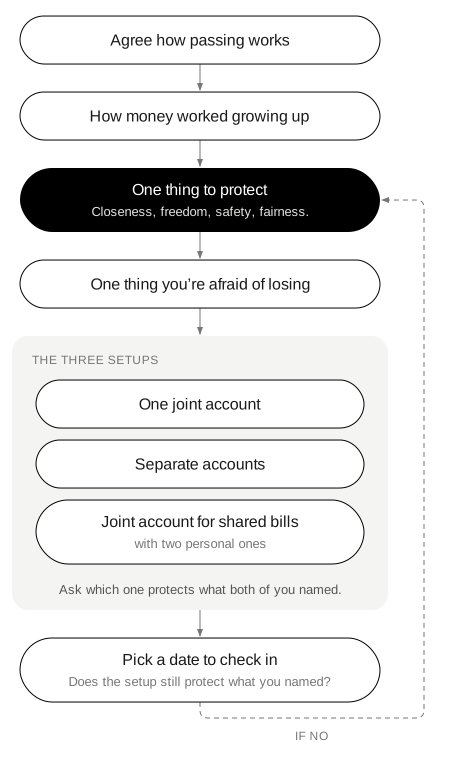
- Agree how passing works. Either of you can pass a question without a reason.
- Each of you says how money worked in the home you grew up in. Who paid, who decided, who worried.
- Each of you names one thing you want your money setup to protect: closeness, freedom, safety, fairness, or something else.
- Each of you names one thing you’re afraid of losing.
- Only then, put the three setups on the table: one joint account, separate accounts, or a joint account for shared bills with two personal ones. Ask which one protects what both of you named.
- Pick a date to check in. A setup can change.
If step 4 brings up something heavy, stop there. The rules of Thesis put it this way: “A short answer is a full answer. You can always ask for more.”
Questions for the evening
These questions keep the talk on values and stories. Pick a few, not all of them:
- What did your parents fight about, or stay quiet about, when it came to money?
- When did you first earn money of your own, and what did you do with it?
- What would you buy without asking anyone?
- When have you felt that a split of money or work was unfair?
- What does “our money” sound like to you?
- What does “my money” protect for you?
- Who would you call if you lost your income tomorrow?
- What would make you feel safe if one of us earned much less for a year?
- How much of your spending would you like to keep private?
- What does enough look like for you?
After an answer, the Thesis rule card has three follow-ups that fit:
What did that feel like? Who else was there? Has it always meant that to you?
Three words for this talk
A single word can open the same ground with less pressure than a list. These three cards from the Thesis deck sit close to this decision.
Money has Backpack on its other side. Money is the word you’ve been circling, so taking it head on can be a relief. The backpack is a gentler door: the first bag you packed to leave home, a school bag someone saved for, what you carry when you travel light.
Fairness has Sweater on its other side. Fairness can be the real question under “50/50 or pooled.” One of you may mean equal amounts. The other may mean equal effort, or meeting needs. The sweater can lead to a hand-me-down, or someone who knitted for the whole family.
Independence has Mug on its other side. It names what a personal account can stand for. Talking about it without the account in front of you shows what independence looks like for each of you. The mug is an easy start on a tired evening: a mug that belongs to only one person in the house.
To draw a word at random, use the online table below. Pick a side and roll the die. The faces are MEMORIES · BODY · PEOPLE · VALUES · CHILDHOOD · FUTURE. Look at the word from that side. “There are no right answers.”
After the choice
Whatever setup you pick, the conversation doesn’t end at the bank. Put the check-in date from step 6 in your calendar. On that night, each of you answers one question: does the setup still protect what you named? If the answer is no for one of you, start again at step 3 and leave the spreadsheet closed.
If the split already makes one of you feel like a roommate, see feeling like roommates in a marriage. For more on playing as two, see Thesis for couples. The research behind the deck lists the studies we use. To see the cards and the die, read the rules and the box, or start a game on the online table.