You finish the update and ask, “Any thoughts?” Nobody unmutes. A few seconds pass, and you hear yourself say, “Great, sounds like we’re aligned.” Maybe the team agrees. Maybe a few people had a concern and none of them wanted to be first. This guide is for team leads and facilitators who run meetings and seminars. It covers what a quiet room can mean, how long to wait, when to switch from talking to writing, and how to make Silence itself the topic of a short round. Every step works with a pen, and the free online table covers the round.
Why a few seconds feel so long
The urge to fill a pause is strong, and there’s research on why. Social psychologists at the University of Groningen ran two experiments. In one, 102 students read a scenario in which a speaker’s remark was either followed by a silence or not. Those who read the version with the silence felt more anxious, more rejected and less self-assured. In the other, viewers watched a six-minute video of three people talking. In one version a 4-second silence interrupted the talk. Viewers of that version reported less self-assurance and more feelings of rejection, though they didn’t consciously notice the pause (Koudenburg et al. 2011).
A meeting is a different setting, and the studies didn’t test one. Still, they fit what a host feels. The person who asked the question may read the quiet as a verdict. The people in the room may read it as time to think.
What a quiet room can mean
Silence after a question has several possible causes, and they look the same from the front. People may agree and see nothing to add. They may still be thinking. They may disagree and not want to say so in front of the person who proposed the plan. Or the question was too wide to answer on the spot: “Any thoughts?” asks for everything at once.
Reading the silence as agreement is a quick shortcut. If it’s wrong, the concern comes back later, in a side chat or a missed deadline. The steps below give each cause a way out. Time helps the thinkers. A narrow question helps the people who had nothing to grab. Writing helps the people who’d rather not go first.
Step 1: Ask a narrower question
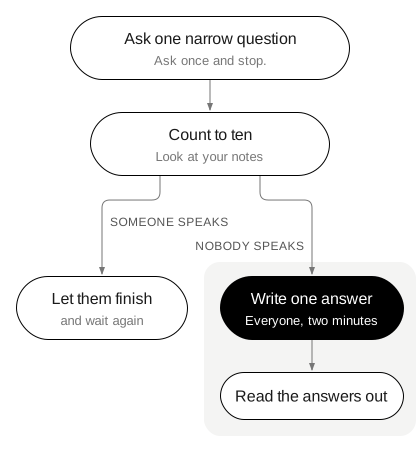
A wide question gets a quiet room. Replace “Any thoughts?” with something a person can answer from their own seat. “What would make this plan slip?” “Which part is least clear to you?” “If you had to cut one item, which one?” Each of these assumes there is an answer, so giving one may feel less like breaking ranks.
Ask once and stop. A second phrasing of the same question, added after a moment of quiet, gives people two questions to think about and resets their clock.
Step 2: Wait longer than feels right
The pause after a question can be shorter than it seems. In her review of wait-time research, Mary Budd Rowe reported that teachers typically wait less than one second for a student’s response. After a student stops speaking, teachers come in with the next question in less than one second too (Rowe 1986). The review is about classrooms. In a meeting the same pull can show up, because the person who asked is the one counting.
Pick a number before the meeting and hold it. Counting to ten in your head is a simple way to do it. Look at your notes, not at the faces, so nobody feels picked. If someone speaks before ten, let them finish and wait again before you answer. The second pause gives others a chance to add to what they heard.
Step 3: Switch to writing when the room stays quiet
If ten seconds pass and nobody speaks, change the format. Give everyone two minutes to write one answer in the chat or on a sticky note. Nobody talks, including you. Then read the answers out, or ask a few people to read theirs.
There’s a reason writing works when talking doesn’t. Diehl and Stroebe ran four experiments on brainstorming. Groups that brainstormed out loud were less productive than people who worked alone and pooled their ideas. Waiting for a turn to speak, which the authors call production blocking, accounted for most of that gap (Diehl and Stroebe 1987). In writing, nobody waits for a turn. In a meeting, the written round also lets a concern arrive without a face attached to it first.
Step 4: Say that silence is allowed
Some quiet is the point. A seminar after a hard reading, a team after a reorg, a retro after a bad sprint: people may need the minute more than they need a prompt. Say so in one sentence: “Take a minute. We’ll start when someone’s ready.” Then hold the minute.
Passing belongs here too. Before any round, agree how it works. The Thesis rules put it in one line: “Before you start, decide together how passing works.” In a team, the simplest version is that anyone can pass with no reason. If you lead the meeting, you’re the one who says it out loud.
Step 5: Run a round about Silence
A team may find it easier to talk about its habits when the habit is the topic of a round. A short word round about silence gives people a way to say how they use quiet at work: when they think best, what a long pause on a call means to them, or a time they stayed quiet and wished they hadn’t. Each Thesis card has an idea on one side and an everyday thing on the other.
Silence has Tree on its back. In a meeting round, Silence can be read as the quiet before a decision, a focus block in the calendar, or a call where nobody turned on their camera. The Tree side gives anyone who’d rather keep it light a way in: a tree they see on the way to work, a walk at lunch, a place they go to think.
Honesty has Radio on its back. For a team, Honesty can lead to the moment someone said what others were thinking. Someone might pick the radio and talk about the voice that kept them company on a commute, or the one station everyone in their family argued over.
Trust has Window on its back. Trust links to the same question as the quiet room: what makes it easy to speak first. The Window side can lead to an office view, a seat by the window, or a kitchen window someone remembers from childhood.
Running it as a card round
With the deck or the online table, each turn follows the same steps. Draw a card, pick the idea or the thing, roll the die and look at the word from that side. The die has six plain words: MEMORIES · BODY · PEOPLE · VALUES · CHILDHOOD · FUTURE. The only instruction is “Look at the word from that side.” The rules give each speaker the length: “Say as much or as little as you like. The others ask, gently.” Good follow-ups are short: What did that feel like? Who else was there? Has it always meant that to you? And one more line from the rules: “What is said at the table stays there.”
Questions about silence at work
The questions below work as a round on their own, with or without cards, and each one can be answered briefly:
- When do you do your best thinking during the workday?
- What does a long pause on a call usually mean to you?
- When did staying quiet in a meeting turn out to be the right call?
- What helps you speak first in a group?
- Where do you go when you need a few quiet minutes?
- What’s a meeting you’d turn into a written update?
- How long can a silence last before it feels awkward to you?
- What’s something a quiet colleague taught you?
Try it in your next meeting
Pick one question for your next meeting and write it down in its narrow form. After you ask it, count to ten. If the room stays quiet, give everyone two minutes to write. The cards above have their own pages: Silence, Honesty and Trust. To open the same meeting with a round, see check-in questions for team meetings. For more on running it at work, see Thesis for teams and classes. For the studies behind the deck, see the research page. See the rules and the box.