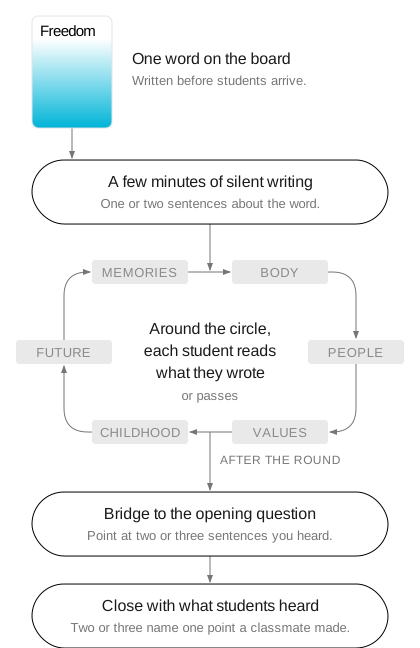
The first question of a Socratic seminar can land on a quiet circle. Two students answer, the rest wait, and a few minutes in the discussion belongs to those two. This guide is for college instructors who run text-based seminars and want every student to say one sentence before the real discussion starts. It gives a short opener in five steps: one word from the reading, a few minutes of silent writing, a round where anyone can pass, a bridge to your opening question, and a short close. A word on the whiteboard is enough. The free online table covers the card version.
Why the opening minutes matter
A seminar puts the talking on the students. Valeri Helterbran describes Socratic seminars in a teacher education program as a way to build thinking skills and student voice, and argues that thoughtful speaking has to be practiced (Helterbran 2007). The opener below gives everyone in the circle a first turn at that practice.
One account from an undergraduate course shows how this can build over a term. Rosemary Fisher and Susan Jones added Socratic Circles to seven classes with 219 third-year students. Five volunteers discussed a case in the middle of the room while the rest of the class watched. The average class had 31 students, so each student had 6–10 chances in the semester to join a circle. By the end of the semester, 70% of the cohort had volunteered at least once, and nearly half had volunteered three or more times. In the end-of-semester survey, negative comments about class length fell from 24% of 101 respondents to 6% of 81 (Fisher and Jones 2018). It’s a teaching essay from one course with no control group, so treat it as a lead. The authors’ own reading: watching the circle over several weeks made volunteering less stressful.
A single session can aim at a smaller version of the same thing. Every student speaks once at low stakes, then the text takes over.
Step 1: Pick one word that sits under the text
Before class, choose one plain word the reading argues about without always naming it. A reading on civil disobedience sits on Duty or Fairness. A novel about leaving home sits on Belonging or Freedom. A case on a company scandal sits on Honesty or Trust. Write the word on the board before students arrive. A single word leaves less to get wrong than a quote from the text.
Freedom has Compass on its back. In a seminar, the idea side pulls toward the argument: freedom from what, and for whom. The Compass side gives a student who hasn’t finished the reading a way in. They can talk about finding their way somewhere new, and that can lead back to the text’s question about choice.
Step 2: Give a few minutes of silent writing
Ask every student to write one or two sentences about the word. Keep the room silent, phones down. Writing first gives quiet students a sentence to read instead of a sentence to invent on the spot, and it can stop the first speaker from setting the answer for everyone.
To widen the range of answers, give each student an angle. Roll a die, or assign one of six words around the circle: MEMORIES · BODY · PEOPLE · VALUES · CHILDHOOD · FUTURE. The instruction is the one line from the Thesis rules: “Look at the word from that side.” Six students in a row will then read six different kinds of sentence about the same word.
Step 3: Run one round where anyone can pass
Go around the circle in a fixed order. Each student reads what they wrote. No replies yet, no follow-up from you. Agree on passing before the first turn, as the Thesis rules put it: “Before you start, decide together how passing works.” In a graded seminar, say plainly that a pass in the opener doesn’t count against participation.
Keep the round short: one sentence each, no speeches. Go first yourself with a short answer, so the length is set before anyone else speaks. The rule card says it this way: “Say as much or as little as you like.”
Honesty has Radio on its back. It suits seminars on ethics, journalism and law, where a text may ask when telling the truth costs something. The Radio side opens a different line: what a voice on air is trusted to say, and who decides what gets broadcast.
Step 4: Bridge to the opening question
After the round, point at two or three sentences you heard and connect them to the text. “Three of you wrote about trust as something you lose. Where does the author treat it that way?” The opening question now builds on what the room said, and the students who spoke in the round already have a stake in it.
The questions below work as openers after a word round. Each one points back at the reading:
- Where does the author use this word, or the idea behind it, without naming it?
- Which sentence from our round would the author agree with?
- Which sentence would the author push back on, and with what passage?
- Who in the text pays the cost of this idea?
- Has the meaning of this word changed between the start and the end of the reading?
- What does the author take for granted about this word?
- Which passage would you read aloud to someone who disagrees with the author?
- What question about this word does the text leave open?
During the seminar itself, short follow-ups keep students talking to each other. The Thesis rule card gives three: What did that feel like? Who else was there? Has it always meant that to you?
Trust has Window on its back. A seminar on institutions, medicine or friendship in literature can turn on trust. The Window side gives a concrete image to argue with: what you let others see, and what stays behind the glass.
Step 5: Close with what students heard
End the seminar with a short round. The Thesis rules finish the same way: “To finish, each player names one thing they discovered about someone today.” In class, ask two or three students to name one point a classmate made that changed how they read the text. It stays short, and it rewards listening as well as talking.
Running it with an inner and outer circle
The opener fits a fishbowl seminar too. Run the writing step for the whole room. Then do the word round in the inner circle only, while each student in the outer circle tracks one sentence they’d like to answer. When the circles switch, the outer group opens with those sentences. Fisher and Jones noted one problem with observers: they needed encouragement to stay focused on the discussion and off their devices. A sentence to track gives them a task.
Trying it with the cards
With the deck or the online table, each student draws a card, picks the idea or the thing, rolls the die and writes from that side.
For your next seminar, pick one word that sits under the reading and write it on the board before class. The cards above have their own pages: Freedom, Honesty and Trust. For more on running it with a group, see Thesis for teams and classes. For the studies behind the deck, see the research page. For the first session of a course, see first day of class icebreakers for college. See the rules and the box. Related: curiosity in the classroom: a seminar round on one word.