It’s the first Christmas since your dad died, or your best friend, or the aunt who always brought the red cabbage. The family sits down to eat. Everyone thinks about the person who’s missing, and nobody says the name. By dessert, the silence has become the loudest thing at the table.
This guide is for the person who wants to talk about them that day, with friends or family, without turning the meal into a eulogy. It gives one decision to make before the day, one set place for the memory, a few lines to start with, and a short game for after dinner.
The short answer
Tell people ahead of time that you’d like to talk about the person. Then give the memory one fixed moment: a toast, a dish they made, or a round of stories after the main course. A fixed moment tells everyone when it’s okay to speak, and the rest of the meal can stay a meal. Agree on passing, so anyone who’d rather listen can.
Why the table goes quiet
The quiet can come from care. A guest may be afraid of making you cry on Christmas, so they wait for you to go first. You’re waiting too, because you don’t want to bring everyone down. A table of careful people, and the name is never said.
Nobody at the table knows what you want unless you say it. Some people in grief may want the name spoken all day. Others may want one day off from it. Both are fair, and the guests can’t guess which one you are this year.
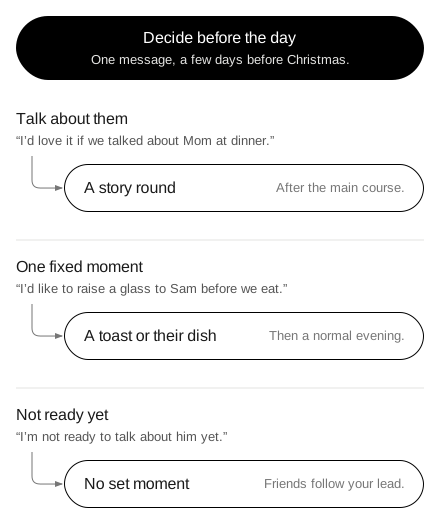
Decide before the day
Send one message a few days before Christmas. It takes the guessing away from everyone, including you. Here are three ways to put it, from most open to most limited:
- “I’d love it if we talked about Mom at dinner. Stories, funny ones too.”
- “I’d like to raise a glass to Sam before we eat. After that, a normal evening is fine.”
- “I’m not ready to talk about him yet. It helps to know you’re thinking of him.”
The third message is as useful as the first two. It saves your friends from tiptoeing all evening and lets them follow your lead.
Give the memory a set place
A memory with a set place feels safer than one that might come up at any moment. You can pick one of these:
- A toast. One sentence and their name, before the first bite. Short enough for anyone to manage.
- Their dish. Cook the thing they always made, and say so when it reaches the table. A recipe can start stories without anyone asking.
- The chair. Leave their seat empty or put something of theirs on it. Some families find this too hard; others want it there.
- A story round. After the main course, each person tells one memory of them. A pass is a full turn.
In three experiments, people who did a ritual after a loss, or recalled one they’d done, reported lower grief than those who didn’t. The effect ran through a greater sense of control, and it held for people who didn’t believe in rituals (Norton and Gino 2014). A toast at a fixed time is a small ritual of that kind. It gives a hard day one moment you chose.
What to say when you’re a guest
If someone else at the table lost the person, the same logic works in reverse. Ask them before the day what they’d like. If you didn’t, a short line at the table leaves room for both answers: “I keep thinking about Grandpa today. Is it okay if I say that?”
In a study of 105 bereaved young adults rating 16 ways of offering comfort, the strategies that focused more on the grieving person’s own feelings and point of view were rated as more helpful (Rack et al. 2008). At a Christmas table, that can mean a specific memory and a question beat a general line about time or reasons. “Remember when she burned the turkey and served pizza?” opens a door. “She’s in a better place” closes it.
Let people take part in their own way
Not everyone at the table wants the same closeness to the memory. A review of research on continuing bonds with the person who died found contradictory results across studies. The authors propose looking at whether the bond feels positive or negative and at what the relationship was like before the death (Root and Exline 2014). One brother wants every story told. A sister who argued with their father all year may want to sit this one out.
A pass rule covers that. Thesis puts it on the rule card: “Before you start, agree together how passing works.” A pass without a reason, or a switch to an easier topic, keeps the round open to everyone.
Questions about the person who died
These work for a story round, or for one quiet conversation in the kitchen. They’re sorted from light to deeper:
- What did they always bring, cook, or do at Christmas?
- What’s a gift they gave you that you still have?
- What would they have said about this table today?
- What’s a story about them that always makes you laugh?
- Where were you when you last spent a holiday together?
- What did you learn from them without them knowing?
- What’s one habit of theirs that you’ve picked up?
- What would you like to tell them about this year?
A few of these are enough for one evening.
Playing it after dinner
A card game gives the time after dinner a shape without forcing anyone into the subject. One player draws a card and picks a side: the idea or the everyday thing. The Thesis die has six plain words: MEMORIES · BODY · PEOPLE · VALUES · CHILDHOOD · FUTURE. The only instruction is “Look at the word from that side.”
The person who died may come up on their own, through a word like Family or a thing like Bread. Nobody has to steer toward them. Without the deck, the online table on a phone works the same way.
The rule card also says: “A short answer is a full answer. You can always ask for more.” For a grieving guest, one sentence about their mom is a full turn. The three follow-ups from the card fit here, one at a time:
What did that feel like? Who else was there? Has it always meant that to you?
Three cards for a first Christmas without them
Each of these cards opens the subject from a distance the player picks.
Joy has Chair on its other side. The chair side speaks to the empty seat without naming it: whose chair it was, where it stood, who sat in it at Christmas. The idea side is harder on this day, and also fair: what joy looked like when they were still at the table.
Death has Phone on its other side. The idea side is direct, so it suits a table that already decided to talk. The phone side is softer: a last call, a voicemail someone still keeps, the number nobody deleted.
Family has Bread on its other side. The bread side brings up kitchens, recipes, and who made what, which can be how a family remembers the person first. The idea side asks what family means now that the shape of it has changed.
Finish with the last round
When the evening winds down, end the way a game of Thesis ends: “When the group is ready to stop, finish with one last round: each player names one thing they discovered about someone at the table today.” On this day, someone may name a story about the person who died that they’d never heard before.
Today, write the message you’ll send before Christmas. Pick one line from above and add the person’s name. For the box and the full rules, see the rules and the box. The cards have their own pages: Joy, Death, and Family. For playing with a group, see Thesis for friends, and for the studies behind the deck, see the research. For an evening set aside for the dead outside Christmas, see how to remember someone who died. For the rest of the meal, see Christmas dinner conversation starters.