You notice a problem in the plan. The meeting moves on, and the sentence stays in your head. Later, someone else says it, or nobody does. This guide is for that moment. It covers why speaking up at work feels risky, seven steps that make the first sentence smaller, and a short card round where a team can practice on a word before the stakes are real. Everything here works with a sticky note, and the free online table covers the round.
Why the sentence stays in your head
Staying quiet is a common choice, and it has reasons. Milliken, Morrison and Hewlin interviewed 40 employees. Most had been in a situation where they were concerned about an issue and didn’t raise it with a supervisor. The reason mentioned most often was fear of being seen or labeled negatively, and of damaging relationships they cared about (Milliken et al. 2003). The authors start from the observation that employees often don’t feel comfortable speaking up to their bosses.
Part of the silence runs on rules nobody wrote down. Across four studies, Detert and Edmondson described implicit voice theories: taken-for-granted beliefs about when speaking up is risky or out of place. They found these beliefs widely held, and five of them added to the explanation of workplace silence (Detert and Edmondson 2011). That may be why the obvious advice, “say what you think,” can fall flat on its own. The fear is about the relationship, and the steps below protect it.
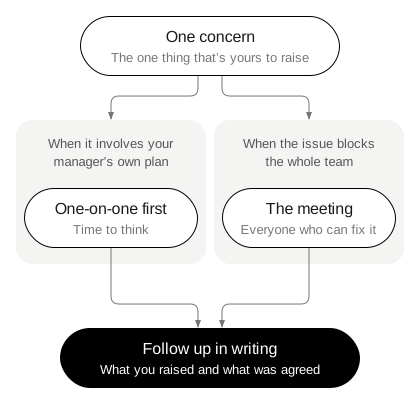
1. Pick the one thing that’s yours to raise
A list of concerns can read as a complaint. One concern can read as a contribution. Choose the issue you saw with your own eyes and that touches your work: a deadline that doesn’t add up, a customer email nobody answered, a step that gets skipped. Leave the rest for another week.
2. Write one sentence before the meeting
One shy colleague working in a second language described repeating every sentence in their head many times before saying it. Do that rehearsal on paper instead. Write one sentence that names what you saw and why it matters. “The test plan skips the payment page, and that’s where the last bug was” is enough. A written sentence can be shorter than the one in your head, and you can read it out if your mind goes blank.
3. Open with what you saw
Start from the observation, then the question. “I saw the launch date moved up. Does that still leave time for review?” gives others something to check instead of someone to argue with. Detail keeps the point about the work. It also lets a colleague add what they know without anyone losing face.
4. Choose the room
The same sentence lands differently in a one-on-one and in a meeting. A private word with your manager gives them time to think and can protect the relationship. A meeting puts the issue in front of everyone who can fix it. When the concern involves your manager’s own plan, a one-on-one first can be the smaller risk. When the issue blocks the whole team, the meeting may be the right room.
5. Say it early
A point raised early has the rest of the meeting to be discussed. The same point at the end of the meeting can sound like a delay. If the agenda allows, ask at the start for a moment on your item. If you’re on a call, a line in the chat (“I have one risk on the timeline”) holds your place until there’s a gap.
6. Leave room for a full answer later
The urge to come with a complete solution can keep good points unsaid. A concern with no fix is still useful information. Say what you know, say what you don’t, and offer to look into it: “I’m not sure of the cause yet. I can check the logs by Thursday.” That keeps the sentence honest and gives the group a next step.
7. Follow up in writing
A short message after the meeting turns a remark into a record. A short note works: what you raised and what was agreed. It also gives a quieter colleague a chance to reply who didn’t speak in the room. If nothing was agreed, the message is the place to ask who owns it.
What a team lead changes
The steps above are for one person, and the room around them matters as much. In a study of 51 work teams at a manufacturing company, Amy Edmondson described team psychological safety as a shared belief that the team is safe for interpersonal risk taking. It was associated with learning behavior, which in turn linked it to team performance (Edmondson 1999). In 23 neonatal intensive care units, Nembhard and Edmondson found that leader inclusiveness, meaning words and actions that invite and appreciate others’ contributions, predicted psychological safety and helped teams past status differences (Nembhard and Edmondson 2006). Both are field studies of existing teams, so they show links and not causes. In practice, inclusiveness can be one line: “Who sees a problem with this?” followed by a pause long enough for someone to answer.
Practicing on a word first
Speaking up can feel easier on a topic with no stakes. A round on one word lets a team practice saying a half-formed thought out loud, where a wrong answer costs nothing. Each Thesis card has an idea on one side and an everyday thing on the other. The rule card sets the tone: “There are no right answers.”
Courage has Bicycle on its back. At work, Courage can be read as the first time someone disagreed with a boss, a call they put off, or a small “no” that changed a project. The Bicycle side gives anyone who’d rather keep it light an easy way in: learning to ride, a commute, a fall that didn’t stop them.
Honesty has Radio on its back. On a team, Honesty can bring up feedback: the time someone told the truth about a deadline, or heard it. The Radio side lets a person talk about a voice they trust, a program they grew up with, or the noise in an open office.
Failure has Washing machine on its back. A team that can talk about Failure for a few minutes has rehearsed the hardest part of speaking up. Someone might talk about a launch that went wrong and what they’d raise earlier now. Someone else might pick the washing machine and talk about the first time they ran one alone.
Questions to think through before you speak up
These questions work alone on paper before a meeting, or as a round in a team retro:
- What did you notice this week that nobody mentioned?
- Who would you tell first, and why that person?
- What’s the smallest true sentence about the problem?
- What do you know for sure, and what are you guessing?
- What’s one thing you’d want a colleague to tell you sooner?
- When did someone’s question save a project you worked on?
- What would make it easier to raise an issue in your team?
- When did you speak up and it went better than you expected?
Running it as a card round
With the deck or the online table, each turn follows the same steps. Draw a card, choose the idea or the thing, roll the die and look at the word from that side. The die has six plain words: MEMORIES · BODY · PEOPLE · VALUES · CHILDHOOD · FUTURE. The only instruction is “Look at the word from that side.” The others can ask a short question. The rule card gives three examples: What did that feel like? Who else was there? Has it always meant that to you?
The rules open with “Before you start, agree together how passing works.” At work, a pass costs nothing and needs no reason. Keep the round to one word per person, then go back to the agenda.
For your next meeting, write your one sentence on a sticky note and put it next to your laptop. The cards above have their own pages: Courage, Honesty and Failure. For more on running it at work, see Thesis for teams and classes. For the sources behind the deck, see the research page. See the rules and the box. For a longer conversation with colleagues, see why deep conversations at work feel riskier than they are.