A friend gets engaged. A former classmate buys an apartment. A younger colleague becomes your manager. You’re happy for each of them, and later that evening you lie awake feeling you’ve missed out on something nobody told you about.
This guide is for that evening. It turns the comparison into a conversation with one person you trust, so the feeling has words and somewhere to go. You can use the Thesis deck, the free online table, or a word written on the back of a receipt.
The short answer
Say the comparison out loud to someone who answers with their own version. Two things can happen in that talk. You may hear that the other person carries a similar feeling. And you can find out what the envy points at: something you want for yourself, or something you want taken from them.
Private comparison runs on one-sided data. You see other people’s announcements and your own whole day. A conversation adds the missing half: the doubts behind someone else’s good news.
Why everyone seems to be doing better
The feeling that others are fine and you aren’t has a measurable side. Alexander Jordan and colleagues ran four studies on how people judge their peers’ emotions. Participants underestimated how often peers had negative emotions and overestimated how often peers had positive ones. They also saw their own bad feelings as more hidden than their good ones (Jordan et al. 2011).
The same studies linked the gap to how people felt. Lower estimates of others’ negative experiences went together with more loneliness, more rumination, and lower life satisfaction. The authors suggest people may feel more alone in their difficulties than they are. A friend’s engagement post shows the ring. It rarely shows the fight about money the week before.
Two kinds of envy
Envy is part of comparison, and researchers describe it plainly. Richard Smith and Sung Hee Kim reviewed the research and defined envy as an unpleasant, often painful emotion. It mixes feelings of inferiority, hostility, and resentment, and it starts when someone else has something you want (Smith and Kim 2007). Their review also separates envy with hostility from a benign form without it.
Niels van de Ven, Marcel Zeelenberg, and Rik Pieters studied that split in the Netherlands, the US, and Spain. Benign envy moved people to improve their own position. Malicious envy moved them to pull the other person down (van de Ven et al. 2009). Dutch has a separate word for each kind. English and Spanish use one word, and the two experiences still showed up as distinct.
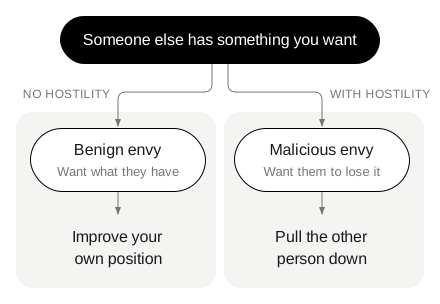
This split gives a conversation its first useful question. Do you want what they have, or do you want them to lose it? The first answer names a goal. The second names a hurt that needs talking about. Both are worth saying.
Why the obvious advice doesn’t hold
The usual tips are to count your blessings, mute the accounts, and stop scrolling. Each one deals with the trigger. None of them touches the question underneath, which is what you want and whether you already have enough of it. Muting a feed hides the trigger. The comparison keeps running in your head with yesterday’s data.
Talking works on that question. A friend can ask which part of the other person’s life you’d take, and which part you’d leave. Sometimes the “whole life” you envied turns out to be one detail: a flat with a balcony, a job title, a partner who calls back.
Ten questions to ask a friend
Ask these one at a time, with one person, at a table or on a walk. Answer with a story where you can. Then swap: the friend answers the same question.
- Whose news this year made you quiet for a moment?
- Which part of their life would you take, and which part would you leave?
- Do you want what they have, or do you want them not to have it?
- Who did your family compare you with when you were a child?
- When did someone else’s success make you try harder?
- What does “behind” mean to you, and behind whom?
- What do you have now that you wanted five years ago?
- Which of your own good news did you keep quiet about, and why?
- What would be enough, in one concrete picture?
- Who do you think compares themselves with you?
Question 10 turns the comparison around. The person across the table may name something of yours they’ve envied for years. A feed doesn’t show you that half of the data.
Three words for the conversation
The Thesis deck has words that open this topic without asking anyone to confess. Each card has an idea on one side and an everyday thing on the other. You choose which side to talk about.
Jealousy has a Kitchen table on its other side. The idea side suits a direct talk about who you’ve envied and what it felt like. The Kitchen table side is gentler. It brings up the table you grew up at, who was praised there, and who was compared with whom. For some players, the comparison may have started at that table, years before any feed.
Competition has a Bench on its other side. The idea side opens stories about races you entered without choosing them: grades, salaries, weddings, first homes. The Bench side brings up waiting, watching, and sitting out. Either side lets the player ask whether the race they feel behind in is one they want to run.
Enough has a Photograph on its other side. Comparison has no finish line, and Enough asks where yours is. Some players answer with a number, some with a picture of a room, some with a face. The Photograph side brings up a moment when life already felt like enough, and who was in the frame.
Try it at the table
A game gives the talk a shape, so nobody has to start with “I’ve been feeling jealous.” A few people after dinner is enough. Before you start, agree how passing works. The Thesis rules open with “Before you start, agree together how passing works.”
Then take turns:
- Draw a card. Choose a side: the idea or the thing.
- Roll the die.
- Look at the word from that side. Say as much or as little as feels right.
- The others ask what they’re curious about, gently, without judging.
- Hand the die to the left.
The die has six faces: MEMORIES · BODY · PEOPLE · VALUES · CHILDHOOD · FUTURE. The only instruction is “Look at the word from that side.” For Jealousy, the same word reads differently each time the die lands.
The rule card gives three follow-up questions: What did that feel like? Who else was there? Has it always meant that to you? For comparison, the third one matters most. It shows whose standard you’ve been measuring yourself by, and when you picked it up. “There are no right answers.” That line helps on a topic where the comparison already feels like a test you’re failing.
What to do this week
Pick one person you trust. Tell them one comparison from the last month, and name the detail you’d take from the other person’s life. Ask them question 10 from the list. Listen to their answer without arguing it down.
If you play, end the way every game of Thesis ends: each player names one thing they discovered about someone at the table today. “Sometimes one word is enough.”
See the rules and the box, or open the free online table. The words above have their own pages: Jealousy, Competition, and Enough. For playing with a few close people, see Thesis for friends. For the studies behind the deck, see the research page. For a related blind spot about how others see you after a talk, read about the liking gap.