A friend’s mother died a few weeks ago. You sent a message on the first day, came to the funeral, and since then you’ve said nothing. Each day the silence gets harder to break, because now the first message also has to explain the gap.
This guide is for that gap. It explains why friends go quiet, what grieving people say helps, and how to start a conversation about the person who died. It ends with one thing you can send today.
The short answer
Say the name of the person who died, ask one open question, and let your friend decide how far to go. A short message that names the loss does more than a long one that avoids it. The words matter less than showing up again later.
Why friends go quiet
From the outside, silence looks like respect. You don’t want to remind your friend of the loss, say the wrong thing, or take up space. From the inside, it can read differently: as friends drifting away after the funeral.
Tognela and colleagues interviewed 16 bereaved parents in Australia about the support they got from people around them (Tognela et al. 2025). Parents described friends who went silent, changed the subject, or withdrew. They read that silence as the friend’s discomfort, and it felt like being left. The authors describe supporters who were “fearful of saying the wrong thing.”
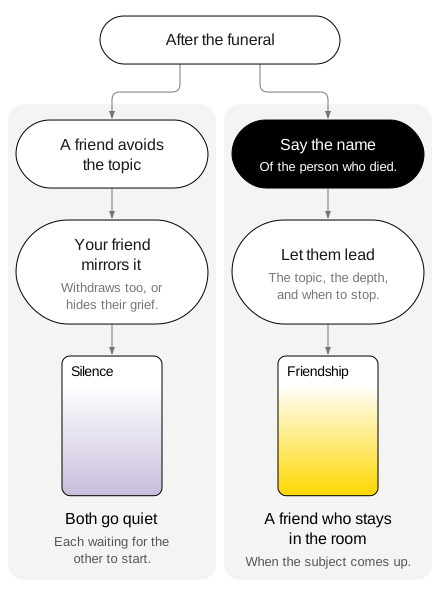
The same study found that support worked in both directions. When a friend avoided the topic, parents could mirror it: they withdrew too, or hid their grief to spare the friend. The authors call this reciprocal regulation. Two people can end up protecting each other into silence, each waiting for the other to start.
Why the silence grows over time
The early days bring flowers, food, and messages. Later, support thins out while the grief stays. Utz and colleagues followed 328 recently widowed adults aged 50 and older over about the first 18 months after the death (Utz et al. 2014). Both social support and loneliness declined over that time. Loneliness was more closely correlated with support from friends than with support from family. The authors suggest that support from friends appears to work best when it’s easy to reach and gives the bereaved person room to talk.
That second part is the friend’s job. Family may handle the practical side. A friend can be the person who asks about the one who died and listens to the answer.
What grieving people say helps
The parents in the Tognela study described the same few things as helpful, and the same few as painful. Their list is a good starting point for any friend.
- Say the name. Parents said hearing their child’s name mattered. When nobody said it, it was as if the child had never been there.
- Let them lead. Parents valued friends who stayed with them without pressure. Your friend decides the topic, the depth, and when to stop.
- Make a specific offer. “Ring me if you need me” leaves the work with the grieving person. “I’m free Thursday evening, can I bring dinner?” doesn’t.
- Skip the lines that close the topic. Platitudes, unasked-for advice, and hints that it’s time to move on all signal that the subject is finished.
The fear of saying the wrong thing can come from imagining a script. Grieving people describe something simpler: a friend who stays in the room when the subject comes up.
How to start the first conversation
A first message after a long gap can be short. Name the gap, name the person, and leave a door open: “I’ve been thinking about your mom and I didn’t know what to say, so I said nothing. I’m sorry. I’d love to hear about her whenever you want.” That’s enough.
People can underestimate how welcome a message like that is. In preregistered experiments, Liu and colleagues found that people who reach out to someone in their social circle underestimate how much the other person appreciates it, and the gap is larger between people who aren’t close (Liu et al. 2023). The study wasn’t about grief, but the worry is the same one: that the message will be unwelcome.
When you meet, ask about the person, not only about the grief. These questions open space without pushing. Use one or two, and let the answer set the pace.
- What was she like when you were little?
- What’s a story about him that you tell often?
- What do you miss most on an ordinary day?
- What did people get wrong about her?
- Is there something of his you kept?
- What would she have said about this week?
- Which days are the hardest right now?
- What has helped, even a little?
- Is there anything you wish people asked you?
- Would you rather talk about him tonight, or about something else?
The last question matters. Some days your friend will want to talk for a long time. Some days they’ll want a film and a pizza and no questions at all. Both are a full answer.
Using one word as a way in
Sometimes the hardest part is the first sentence. A single word on the table can carry it. You can use the Thesis deck, the free online table, or a word written on a napkin.
Death has a Phone on its other side. The idea side is for when your friend wants to talk about the loss directly. The Phone side is often easier: the last call, a voicemail they’ve kept, a contact they can’t delete. A story about a phone can say more about a person than a sentence about death.
Friendship has a Ball on its other side. It fits a conversation about the friendship you share with the grieving person, or about the friends who stayed and the ones who drifted. The Ball side can bring up games, childhood, and lighter memories, which some days is what your friend needs.
Silence has a Tree on its other side. It names what the two of you might have been doing for weeks, and gives you a way to talk about it. The Tree side leaves room for a quieter story: a place your friend goes to think, or a tree planted for someone.
The die gives six angles on any word: MEMORIES · BODY · PEOPLE · VALUES · CHILDHOOD · FUTURE. “Look at the word from that side.”
Before you start, agree together how passing works. With a grieving friend, make passing easy and visible. “A short answer is a full answer. You can always ask for more.” The rule card’s follow-up questions fit here: What did that feel like? Who else was there? Has it always meant that to you? “What is said at the table stays at the table.”
What to do today
Write to your friend. Use the name of the person who died, admit the silence if there was one, and suggest one specific time. Then put a reminder in your calendar for a month from now, and write again.
See the rules and the box or open the free online table. The cards above have their own pages: Death, Friendship, and Silence. For playing with a few close people, see Thesis for friends. For the studies behind the deck, see the research page. If the loss you’re facing is still ahead, see how to talk to your parents about death.