A friend asks what you’d do differently, and you know the answer. Then the sentence comes out as “I wish I study more” or “If I would know,” and the story gets lost in the grammar. English has four short patterns for regret, and each one carries a different kind of regret.
This guide gives you those four patterns with examples, four mistakes that change the meaning, and ten questions to practice out loud. You can practice alone with a notebook, with a partner, or with a word card on the table.
The short answer
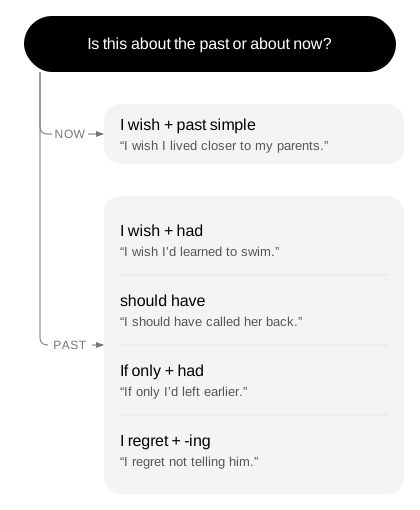
English has four common patterns for regret:
- I wish + had + past participle for a past you’d change: “I wish I’d learned to swim.”
- should have + past participle for a choice you judge now: “I should have called her back.”
- If only + had + past participle for the same wish, said with more feeling: “If only I’d left earlier.”
- I regret + -ing for a plain, adult statement: “I regret not telling him.”
Pick one, add a time and a place, and you have the first line of a story. The rest of this page shows when each one fits.
Four patterns for regret
Each pattern below has a form, a meaning, and two examples. Read the examples out loud. The contractions are how the sentences sound in conversation.
I wish. For the past, use had + past participle: “I wish I’d studied music.” “I wish I hadn’t sold my bike.” For something in the present that you’d change, use the past simple: “I wish I lived closer to my parents.” The tense moves one step back from the time you mean. That step back is what tells the listener this is a wish and not a fact.
Should have. This one judges a past choice: “I should have taken the job in Lisbon.” The negative is “shouldn’t have”: “I shouldn’t have said that.” In speech, “should have” sounds like “should’ve,” and that’s why some people write it as “should of.” The written form is always “should have.”
If only. “If only” works like “I wish,” with more emotion in it: “If only I’d listened to my grandmother.” It can stand alone as a full sentence, with no second half.
I regret. Follow it with -ing or “not -ing”: “I regret moving so far from home.” “I regret not learning my father’s language.” It’s direct and calm, and it fits a serious conversation. Be careful with “I regret to tell you,” which is a formal way to give bad news, not a personal regret.
Going one step further: the third conditional
A regret can come with a second thought: what would be different now. The third conditional carries that thought. “If I had taken the job, I would have met different people.” Both halves are in the past.
When the result is in the present, English mixes the two times. “If I had taken the job, I would live in Lisbon now.” The first half uses “had + past participle,” the second is “would + verb.” This form fits when the old choice still shapes life today.
Psychologists have a name for these “if only” and “what if” thoughts: counterfactual thinking. Neal Roese reviewed the research on it and describes counterfactuals as thoughts about alternatives to past events. The research he reviews links them to bad feelings, which can set them off automatically, and finds they target likely causes of what went wrong (Roese 1997). So the grammar of regret is also the grammar of looking for a cause.
Mistakes that change the meaning
Each of these four mistakes has a short fix.
- “I wish I study more.” For the past, it’s “I wish I’d studied more.” For the present, it’s “I wish I studied more” (meaning: I don’t study enough now).
- “If I would know, I would come.” “Would” doesn’t go in the “if” half. Say “If I’d known, I would have come.”
- “I wish I would have gone.” You’ll hear this in American speech, and some teachers and exams mark it wrong. “I wish I’d gone” is the safe form.
- “I regret to not go.” After “regret,” use -ing: “I regret not going.”
A good test is to say the sentence and ask one thing: is this about the past or about now? The answer tells you which tense to use.
What people regret, and what to talk about
Mike Morrison and Neal Roese ran a telephone survey with a nationally representative sample of Americans. Each person described one regret that stood out. Romance was the most common topic, and regrets about things people didn’t do lasted longer than regrets about things they did (Morrison and Roese 2011). Other common areas were family, education, career, finances, and parenting (ScienceDaily 2011).
Each topic has its own phrases. For love: “to ask someone out,” “to break up,” “to lose touch.” For education: “to drop out,” “to switch majors.” For work: “to turn down an offer,” “to quit.” A regret about something not done fits “I wish I’d” and “I regret not.” A regret about something done fits “I shouldn’t have.”
Ten questions to practice
These questions use the patterns above. Answer each one with a full sentence first, then add one detail: a year, a place, or a person. Pick the ones that feel comfortable, and skip the rest.
- What’s something you wish you’d learned as a child?
- Which small task from last week should have been done sooner?
- Is there a place you wish you’d visited when you had the chance?
- What’s something you said once and wish you hadn’t?
- Which school subject do you wish you’d taken more seriously?
- What’s a skill you wish you had now?
- If you had chosen a different job, where would you live now?
- What’s a chance you’re glad you took?
- What do you wish someone had told you at 18?
- Is there a person you wish you hadn’t lost touch with?
Questions 7 and 10 need the harder grammar. Try them after the first five feel easy.
Practice with a word card
A single word can start a regret story without a direct question. With Thesis, each card has an idea on one side and an everyday thing on the other, and you choose the side you’d rather talk about.
Regret has a Lamp on its other side. The idea side asks for the grammar on this page right away: “I wish I’d…,” “I should have….” The Lamp side can be gentler for a learner. A lamp in a grandparent’s house, a desk lamp from an exam year, a lamp left behind in a move: a story about an object can bring the regret in on its own, at the speaker’s pace.
Nostalgia has a Key on its other side. Nostalgia and regret sit close together, and the difference makes good practice. Nostalgia uses “used to” and “I miss”: “We used to spend summers by the lake.” Regret uses “I wish I’d.” Telling one story both ways shows the difference better than a rule does.
The Thesis die adds a direction. Its six faces are MEMORIES · BODY · PEOPLE · VALUES · CHILDHOOD · FUTURE, and the only instruction is “Look at the word from that side.” A regret about what’s ahead uses “I don’t want to regret…” instead of the past forms.
With a partner, take turns. Draw a card, choose a side, roll the die, and talk. The listener asks one of the follow-ups from the rule card: What did that feel like? Who else was there? Has it always meant that to you? “A short answer is a full answer. You can always ask for more.” That line can help in a second language, where one clear sentence is already a success.
What to do today
Write one regret in each of the four patterns: one “I wish,” one “should have,” one “if only,” and one “I regret.” Make all four about the same event. Read them aloud and notice which one sounds most like you. Then tell that version to one person and let them ask one follow-up.
If you’d like a word to start from, open the free online table, or see the rules and the box. The cards above have their own pages: Regret and Nostalgia. Courage is a good next word for the stories about chances not taken. For using this in a class, see Thesis for teams and classes. For the studies behind the deck, see the research page. To keep a conversation going past the first answer, read how to have deep conversations. Related: how to talk about regret without getting stuck in it.