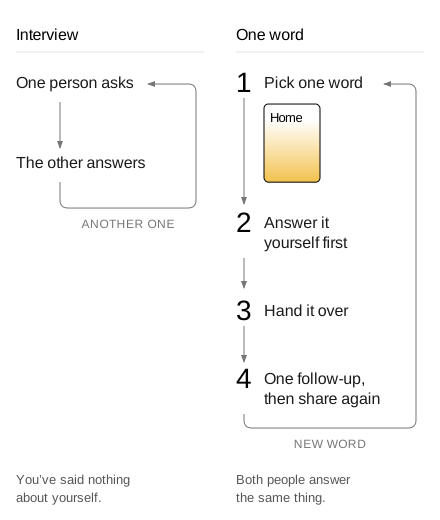
You finally ask a friend something that matters. She answers, you ask another one, she answers again. Soon she’s talked about her father, her job and her fears, and you’ve said nothing about yourself. It went deep, and it felt like an interview.
This guide shows how to have deep conversations that go both ways. It has four steps, ten questions to start from, and a way to practice with one word on a card. You can use the Thesis deck, the free online table, or a word written on a napkin.
The short answer
A deep conversation feels like an interview when one person asks and the other answers. It feels like a conversation when both people answer the same thing. The simplest way there: pick one word as the topic, answer it yourself first, then hand it over and ask one follow-up about what you hear.
A word works better than a list of questions because nobody owns it. A question comes from you and points at the other person. A word sits on the table between you, and each of you says what it brings up.
Why deep questions turn into interviews
Asking deep questions is easier than answering them. In a pilot study by Michael Kardas, Amit Kumar and Nicholas Epley, 188 online participants imagined a talk with a stranger and picked five of 20 questions that ranged from shallow to intimate. People who imagined only asking or listening picked more intimate questions, on average, than people who imagined having to answer (Kardas et al. 2021). The study used strangers and imagined talks, so it shows a tendency in that setting.
That pull can explain the interview. The asker gets the interesting part, learning about someone, and skips the risky part, telling. The answerer may notice the imbalance and start giving shorter answers. Neither person planned it.
The same paper also found that the risk is smaller than it feels. In their experiments, conversations between strangers felt less awkward and created more connection than participants expected. People especially overestimated how awkward deep talk would be compared with shallow talk. The main reason was that they expected the other person to care less about what they shared than the other person did (Kardas et al. 2021). In two final experiments, people who imagined a caring partner, or who were told that strangers care more than people expect, leaned toward deeper questions. For more on that finding, see why deep conversations feel awkward.
Four steps for one deep conversation
These steps fit a walk, a long dinner or a late drive. They work with one friend or with three.
- Pick one word as the topic. Choose an idea like Home, Friendship or Honesty, or an everyday thing like a Spoon or a Radio. Say it out loud and agree that it’s the topic for a while.
- Answer it yourself first. Tell a short, specific story the word brings up: a place, a year, a person. Going first shows the depth you mean and gives the other person something to answer.
- Hand it over. Ask what the word brings up for them. Then wait. A pause of a few seconds is part of the answer.
- Ask one follow-up, then share again. Pick up something they said and ask for more of it. When the story ends, add a piece of yours that connects. Then move to a new word.
The follow-up in step 4 does most of the work. In three studies of live conversations, Karen Huang and colleagues found that people who asked more questions, especially follow-up questions, were better liked by their partners. The effect ran through being seen as more responsive. In speed-dating conversations, people who asked more follow-up questions were more likely to get a second date (Huang et al. 2017). A follow-up shows you heard the last sentence. A new question from your list can sound like you were waiting for your turn. The follow-up questions guide has more on how to phrase one.
Sharing after the follow-up keeps the balance. Two questions in a row from the same person start to sound like an interview again.
Ten questions that start from a word
A word on its own can be enough. When someone wants a nudge, these questions open a word without making it heavy. Swap the word in the brackets for the one on the table, and answer each one yourself as well.
- Where were you the first time [word] mattered to you?
- Who taught you what [word] means?
- What did [word] look like in your family growing up?
- When did [word] last surprise you?
- What’s a small thing that means [word] to you?
- When did you have too little of [word]?
- Has [word] changed for you in the last few years?
- Which person do you think of first when you hear [word]?
- What would [word] look like in ten years?
- What story about [word] have you never told?
Pick one or two per evening. A list read in order turns back into an interview.
Practice with a card
The Thesis deck puts this format on the table. Each of the 50 cards has an idea on one side and an everyday thing on the other. The die has six faces: MEMORIES · BODY · PEOPLE · VALUES · CHILDHOOD · FUTURE. The only instruction is “Look at the word from that side.”
Before you start, agree together how passing works. Then take turns:
- Draw a card. Choose a side: the idea or the thing.
- Roll the die.
- Look at the word from that side. Say as much or as little as feels right.
- The others ask what they’re curious about, gently, without judging.
- Pass the die to the left.
Everyone answers the same card, so nobody plays only the interviewer. The rule card gives three follow-ups that fit every word: What did that feel like? Who else was there? Has it always meant that to you? It also says “A short answer is a full answer. You can always ask for more.”
Three words to start with
These three words suit friends. Each has a side that goes deep and a side that’s easier to start with.
Home has a Spoon on its other side. Home can go far: a country left behind, a childhood kitchen, the place that stopped feeling like home. The Spoon is a softer start. Ask whose spoon it was, what was in the bowl, and who was cooking.
Friendship has a Ball on its other side. Talking about Friendship with a friend turns the conversation toward the two of you, which can be a lot on a first try. The Ball side starts with a schoolyard or a team, and the story about this friendship can come later on its own.
Honesty has a Radio on its other side. Honesty brings up times someone told the truth or didn’t, and those stories run deep fast. The Radio side gives an easier way in: a song that was always on, a car trip, a voice from the kitchen. If the word lands too close, choose the other side, or pass.
What to try this week
Pick one friend and one word, for example Home. Tell your own Home story first, and keep it short. Ask what Home means to them, then ask one follow-up about something they said. When they finish, add one more piece of yours.
To play with a group, open the free online table or see the rules and the box. The cards above have their own pages: Home, Friendship and Honesty. For playing with a few close people, see Thesis for friends. For the studies behind the deck, see the research page. For couples, see deep questions for couples.