You want to ask a friend something that matters. The question is ready, and then you hold it back. It might sound intrusive. It might come out too intense. The talk goes back to work and weekend plans, and it stays there.
This post explains where that feeling comes from, using one set of experiments on deep talk between strangers. It shows what the researchers did, what they found, and where the finding stops. It ends with a small way to try one deeper conversation this week.
The short answer
Deep conversations feel awkward mostly before they happen. In a series of experiments by Michael Kardas, Amit Kumar and Nicholas Epley, people expected deep talk with a stranger to be more awkward than it turned out. They were especially prone to overestimate the awkwardness of deep talk compared with shallow talk. The main reason: they expected the other person to care less about what they shared than the other person did (Kardas et al. 2021).
In one line: people overestimate how awkward a deep conversation will be, because they underestimate how interested the other person will be.
What the researchers did
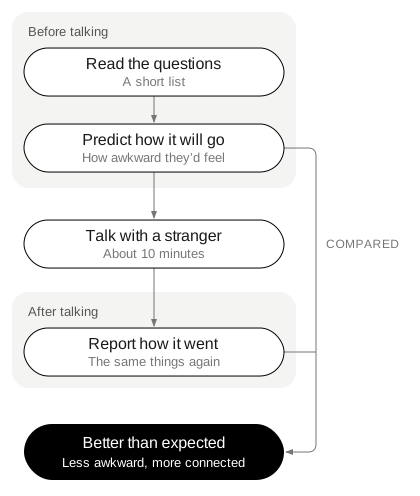
The setup was plain. Participants read a short list of questions, predicted how the conversation would go, talked with a stranger for about 10 minutes, and then reported how it went. The predictions and the experiences used the same scales, so the two could be compared.
The samples varied. They included financial executives at a conference, employees of a financial services firm, international MBA students online, university students, community members, and online participants. In one experiment, 178 master’s students were split into two groups. One group got shallow questions, such as “How did you celebrate last Halloween?” and “What is the best TV show you’ve seen in the last month?” The other group got deep ones, such as “For what in your life do you feel most grateful?” and “Can you describe a time you cried in front of another person?”
Before talking, participants rated how awkward they’d feel, how much they’d enjoy it, how strong a bond they’d feel, and how much they’d like their partner. After talking, they rated the same things again.
What they found
The conversations went better than expected. Across the experiments, people felt less awkward, more connected and happier than they had predicted. The gap was larger for the deep questions. When participants had both a shallow and a deep conversation, they felt more connected to the deep conversation partner.
The cause was a wrong guess about the listener. People expected their partner to be less interested in their answers, and to care less, than the partner turned out to be. In the first experiment, with 50 executives, that underestimate helped explain why they overestimated the awkwardness. The awkwardness people dread is partly a guess about the other person’s face while they talk.
Close relationships were different. When people predicted deep talks with close friends, family or partners, their predictions were more accurate. With people whose care is already known, there’s less to guess.
Why the guess changes what we talk about
Expectations steer topic choice. In the last two experiments, people picked questions to discuss. Those who imagined a caring partner wanted to discuss deeper questions than those who imagined an indifferent one. Those told that people tend to underestimate strangers’ care picked more deep questions than those told the opposite.
So the barrier works quietly. Nobody decides to stay shallow. Each person guesses the other won’t care much, picks the safer topic, and the safer topic confirms nothing either way. Participants in several experiments also said they’d like to have deep conversations with strangers more often than they do.
A second line of research looks at everyday life. Jessie Sun, Kelci Harris and Simine Vazire had 256 people wear an audio recorder for a week and report their mood several times a day. More social interaction went with greater well-being. Deeper conversation and more self-disclosure were generally linked to well-being too, though those links were stronger in self-reports than in observers’ ratings (Sun et al. 2020). It’s a correlation, so it shows what goes together, without saying what causes what.
Where the finding stops
The experiments had a built-in safety net. Both people knew they were in a study and both knew the questions were coming. The authors say so themselves, and they give an example: asking about the last time someone cried is received differently in a supermarket line than in their lab. They also think the gap may hold in daily life, and they call for tests there.
That matters for how to use the result. It doesn’t say any deep question works anywhere. It says that when both people have agreed to talk, the conversation tends to go better than the person asking expects. An agreed format, a shared question, or a card on the table gives the same kind of net.
A small way to test it
The study suggests a simple experiment of your own. Pick one person you’d like to know better. Agree first that this is a conversation with a little more depth, and that either of you can skip a question. Then take one word and let each person say what it brings up.
A word works well here because nobody has to invent the deep question. The word asks it, and each person chooses how far to go. The Thesis die gives six angles on any word: MEMORIES · BODY · PEOPLE · VALUES · CHILDHOOD · FUTURE. The only instruction is “Look at the word from that side.”
The rules start with the same safety net the study had: “Before you start, agree together how passing works.” Then one line covers the fear of saying too much: “A short answer is a full answer. You can always ask for more.” The rule card also gives three follow-ups for any word: What did that feel like? Who else was there? Has it always meant that to you? Asking one of them is the signal the study found people underestimate: the listener cares.
For more on agreeing how passing works, see the right to pass in groups.
Three words to start with
These cards fit a first deeper conversation. Each has an idea on one side and an everyday thing on the other.
Gratitude has a Fence on its other side. One of the deep questions in the study was about what you feel most grateful for, so this word sits close to the research. If the idea feels too big for a first try, choose the Fence: a fence you painted, a neighbor on the other side of one, a garden you weren’t allowed into. The story can arrive at gratitude by itself.
Curiosity has a Sewing machine on its other side. The study found people underestimate how curious the listener is. This card puts curiosity on the table as the topic. The Sewing machine side can bring up who made things in a family, and who taught whom.
Trust has a Window on its other side. The authors note that starting a meaningful conversation signals trust in the listener. Talking about trust out loud makes that signal visible. The Window side is lighter: a view from a childhood room, or a window someone always left open.
What to do this week
Write one word on a piece of paper, or draw a card. Ask one person if they’d talk about it for ten minutes, with passing allowed. Before you start, write down how awkward you expect it to be, from 0 to 10. Afterward, write down how it was. “There are no right answers.”
See the rules and the box, or open the free online table. The words above have their own pages: Gratitude, Curiosity and Trust. For playing with a few close people, see Thesis for friends. The research behind the deck lists the studies the deck draws on. For a set of questions for long-term couples, see deep questions for couples. For a way to start one, see how to have deep conversations.