Someone you loved has died, you live in Germany, and a hospice nurse or a church notice board mentions a “Trauercafé.” A Trauercafé is an open meeting for bereaved people. The ones in this guide are run by hospice services, some with a church parish. The three flyers below list meetings of two hours, once or twice a month, and you can come without joining anything. You don’t have to talk. This guide explains what happens there, what the German words on the flyer mean and how to go when your German is basic.
The word splits in two. “Trauer” means grief or mourning. “Café” means what it says, although not every Trauercafé serves coffee.
What a Trauercafé is
A Trauercafé is a drop-in gathering for people grieving the death of someone close. A 2010 article by the Protestant news service epd describes it as open, with no further obligations. The same article says cafés like it exist across Germany, run by churches, municipalities and associations (evangelisch.de 2010).
The organizer in that article, Elke Hutzenlaub, who runs the café with volunteers from the hospice association in Konstanz, put the main rule in one line: “Aber nur wer will, man muss nicht reden.” In English: only if you want to, you don’t have to talk. She also set out what the café doesn’t try to be. “Wir wollen keine Abhängigkeiten verstärken, keine Psychotherapie oder Seelsorge ersetzen.” That means the café doesn’t aim to create dependencies or to replace psychotherapy or pastoral care. A Diakonie staff member quoted in the same article calls it a complement to the grief support hospices already offer.
A Trauercafé is for grief after a death. A Death Cafe is a different format. Its official guide calls it “straightforward and open discussion about death” and says it “is not a bereavement support or grief counselling setting” (Death Cafe guide). If you want to talk about death in general, in English, see Death Cafe Berlin: how to host one in English.
Four real examples
Each Trauercafé sets its own schedule and format. The flyers below show how much they vary. Dates change from year to year, so check the current flyer or call before you go.
- Berlin-Wannsee. The Diakonie Hospiz Wannsee ran its 2024 Trauercafé on the first Thursday of each month, from 4:00 to 6:00 p.m., at the church by the Immanuel hospital. The flyer promises a protected space “zum Erzählen, Weinen, Lachen und Gemeinschaft haben”: for telling, crying, laughing and company. Each meeting starts with a short talk on a theme, then time to talk with people in a similar situation. The flyer asks you to register (“Anmeldung”) and to give a donation if you can (Diakonie Hospiz Wannsee flyer).
- Potsdam-Babelsberg. A hospice service in Potsdam runs its “Café für Trauernde” on the second and fourth Monday of each month, from 5:00 to 7:00 p.m. Its flyer calls it an open offer for anyone looking for a place to be with their grief after a death (Hoffbauer-Stiftung flyer).
- Cologne. A Catholic parish and a hospice association run a Trauercafé on the second Wednesday of each month, from 2:30 to 4:30 p.m., with coffee and cake. The flyer says trained conversation partners are there, the visit is free and needs no registration. It’s open to all grieving adults, “unabhängig von Herkunft, Religion, Nationalität oder Lebensweise”: regardless of origin, religion, nationality or way of life (Cologne flyer).
- Konstanz. The café in the 2010 article met every Thursday at 7:30 p.m. and served no coffee or cake on purpose. Each evening opened with a short story read aloud, and longer conversations sometimes followed.
All four are tied to a hospice service, and two of them to a church. The Cologne flyer names religion as no condition for coming. If a church setting makes you hesitate, ask the contact person how the meeting runs before you go.
The German words on the flyer
The flyers above share a small set of words. Knowing them makes a flyer readable.
- Trauernde, Hinterbliebene: bereaved people, the ones left behind.
- Hospizverein, Hospizdienst: a hospice association or service.
- Trauerbegleiter, Trauerbegleiterin: a grief companion, someone trained to accompany bereaved people.
- Seelsorge: pastoral care, offered by a church.
- Anmeldung, ohne Anmeldung: registration, or no registration needed.
- unverbindlich: no commitment, come once or come every time.
- kostenfrei: free of charge.
- Spende: a donation.
- Impuls: a short opening talk, reading or thought.
- geschützter Raum: a protected space, a setting meant to feel safe.
Going when your German is basic
The flyers above are written in German, and the conversations are likely to be too. That doesn’t rule you out. It changes how you prepare.
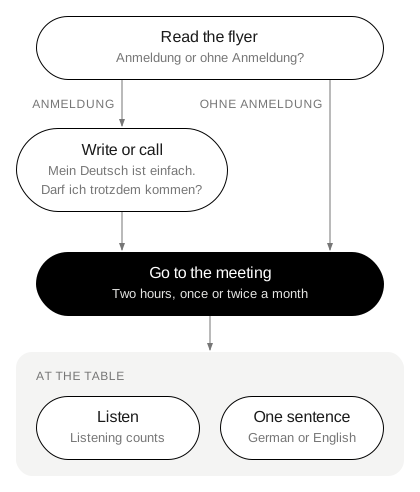
Write first. Each flyer above lists a phone number, and two of them add an email address. An email gives you time to write and gives the organizer time to reply. Three short sentences are enough: “Ich habe vor Kurzem einen nahestehenden Menschen verloren. Mein Deutsch ist einfach. Darf ich trotzdem kommen?” That says you recently lost someone close, your German is basic, and you’d like to know whether you can still come. Some organizers may speak English, and some may know of a group that meets in English.
Plan to listen. The pass is built into the format. You can sit through a whole meeting, hear how others speak about their loss and say nothing. For someone working in a second language, listening is a full way to take part.
Prepare one sentence. If you want to say something, prepare one sentence about the person you lost: their name, who they were to you, when they died. One sentence in German or in English is enough to be known at the table.
Let grief speak in your first language too. A Trauercafé in German offers company and a fixed date. Some things about the person you lost may come easier in the language you shared with them. Those conversations can happen elsewhere, with a friend, a counselor or another group.
Practicing with a friend in English
Saying anything about a death can be hard the first time, and harder in a second language. A friend who speaks English can help you practice before the first visit. A word on a napkin works: write “death” or the person’s name, and take turns saying as much or as little as feels right.
The Thesis card deck has a few words that fit this kind of practice. Each card has an idea on one side and an everyday thing on the other, so there’s always a second way in.
Death sits on the back of Phone. For someone grieving far from family, the phone can be where the news arrived and where the calls home still happen. A player can talk about the death, or about a phone call they remember. Both are full turns.
Silence is on the back of Tree. It’s a useful word before a first Trauercafé, where silence is part of the format. A player might talk about the quiet after a loss, or about a tree near the place they grew up.
Community is on the back of Mirror. It opens a conversation about who shows up after a death, and who’s missing when you live abroad. It can also help you decide what you hope to find at a Trauercafé: company, information or a place to listen.
The rules start with the pass: “Before you start, agree together how passing works.” The table card adds: “A short answer is a full answer. You can always ask for more.” If you want to try a round with one friend, the online table is free.
The die has six faces: MEMORIES · BODY · PEOPLE · VALUES · CHILDHOOD · FUTURE. The only instruction is “Look at the word from that side.”
Your next step
Look up the nearest hospice association (“Hospizverein”) or your district’s church parish and ask whether a Trauercafé meets nearby. Send the short email above. Then put the date in your calendar and decide in advance that listening counts.
The three cards above have their own pages: Death, Silence and Community. You can play online for free, see the rules and the box, or read about Thesis for therapy groups. For other places to meet people in English, see English-speaking events in Berlin.