You live in Berlin, your days run in English, and you’d like to talk about death with people who speak it too. A search for a Death Cafe in the city turns up a handful of past listings and no date you can go to. The simplest fix is to host one. This guide covers the parts that are specific to an English-speaking Death Cafe in Berlin: who it’s for, the listing, the room and the language at the table. For the full hosting checklist, see how to host a Death Cafe.
Thesis is not part of Death Cafe, and a card game has no place on a Death Cafe table. It appears once near the end, as a way for two co-hosts to practice beforehand.
What has already happened in Berlin
English-speaking Death Cafes have run in Berlin before, and their listings are still on the official site. They show two ways to set one up.
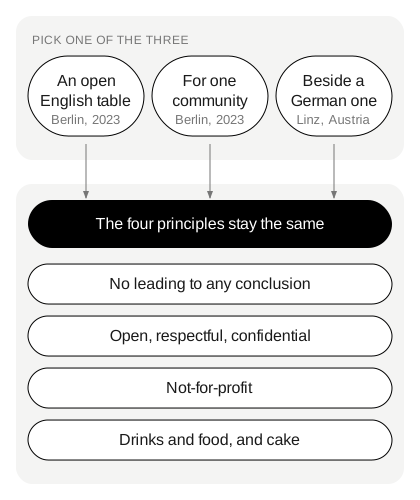
- An open English table. On May 3, 2023, Mat and Danny hosted an “English Death Cafe in Berlin”, from 3:00 to 5:00 p.m., for free. The listing describes them as British undertakers and part of the Berlin-based collective memento. People talked about death and dying in English over cake and tea (Death Cafe listing).
- A table for one community. On September 8, 2023, Raf Beck hosted a Queer Death Cafe Berlin at Villa Lützow, from 6:30 to 8:30 p.m., also free. The listing, written in English, calls it “a safe space for queer people to talk openly with each other about death.” It explains why: some queer relationships go unseen by family, friends and colleagues, which makes grieving in public harder (Death Cafe listing).
A third pattern comes from Linz, Austria. A host who ran a monthly German-language Death Cafe added an English session for people who “might feel more comfortable talking about death in English than in German” (Death Cafe listing). If a German Death Cafe already meets near you, an English evening beside it is a third option.
Step 1: Decide who it’s for
Pick one of the three patterns above before you plan anything else. The choice shapes the listing, the venue and who turns up. An open English table draws newcomers, long-term residents and visitors. A community table draws people who share one part of their life and want to talk about death from inside it.
Whichever you choose, the four principles stay the same. The official guide lists them: no intention of leading people “to any conclusion, product or course of action”, an “open, respectful and confidential space”, a not-for-profit basis, and drinks and food, “and cake” (Death Cafe guide).
Local versions of the format are part of its history. Researchers interviewed 49 Death Cafe organizers in 34 countries. They found a tension between adapting the model locally and keeping it aligned internationally (Richards et al. 2020). An English Death Cafe in Berlin is a local adaptation. Keeping to the four principles is how it stays aligned.
Step 2: Find a co-host
The guide asks for “a minimum of 2 Death Cafe people at the event, especially if the Death Cafe is in a domestic setting.” A co-host can greet people at the door, keep the tea going and take a second table if more people come than expected.
For an English table, a co-host who also speaks German helps. They can answer a venue manager, read a German reply to your listing, or help a guest who reaches for a German word mid-sentence.
Step 3: Choose the room and the time
The guide says Death Cafes have run in “people’s homes, cafes and restaurants.” In Berlin, a café that closes early, a community room or a friend’s flat all work. Ask the venue for a corner where people can talk without a group at the next table listening in.
The two Berlin examples took two hours each, one on an afternoon and one on an evening. An afternoon may suit people with children or early shifts. An evening may suit people who work office hours. Pick the slot your likely guests can make, then keep it for the next event too.
Step 4: Write the listing in English and say who it’s for
Post your event on the official site. The guide says that when you post a Death Cafe, you’ll be asked to sign up, which means agreeing to its terms. Write the title so it carries the city and the language, the way the 2023 listing did: “English Death Cafe in Berlin.”
In the description, say who the evening is for, as the queer and Linz listings did. Then give the practical lines: date, time, address, step-free access if there is any, and food. On money, the guide is direct: “Death Cafes never have a ticket price or exclude those who can’t afford to donate.” Write “free” or “donations welcome.”
Step 5: Keep the English plain
At an English table in Berlin, some guests may speak English as a second or third language. A few habits keep everyone in the conversation:
- Speak a little slower than usual and use short sentences, especially in the introduction.
- Allow words from other languages. If someone says “Trauer” or “Abschied”, let them, and ask what it means to them.
- Give time to finish. A pause can mean someone is still finding a word.
- Check before you rephrase. Ask “Did I get that right?” rather than finishing a guest’s sentence for them.
Step 6: Open, let the group lead, close
The opening follows the official model: explain what a Death Cafe is, set the ground rules, and ask people to introduce themselves. After that the group talks about whatever comes up. The guide says the model doesn’t include “specific topics, set questions” or guest speakers. For more on running the evening, see how to host a Death Cafe.
When it’s over, debrief with your co-host and write the evening up, as the guide suggests. The two Berlin listings from 2023 are still on the official site, and they’re part of how the next English-speaking host in the city finds a model.
Before the first one: practice with your co-host
Hosting is easier after you’ve talked about death out loud yourself. Sit down with your co-host before the first evening and take turns with one word each. Thesis works for this. So does a word written on a napkin.
Death is card 11 in Thesis, with Phone on the other side. For two co-hosts, the word side is the conversation you’ll be hosting. The Phone side can get there another way: a call home from Berlin that brought news, or a number you haven’t deleted.
Home sits on the back of Spoon. At an English table in Berlin it may come up, because some guests may live far from where they grew up. Talk with your co-host about where you’d want to be buried, or about a spoon from a kitchen you left behind. Either side is a full answer.
The rule card asks you to “agree together how passing works” before starting. After each answer, the three example follow-ups fit: What did that feel like? Who else was there? Has it always meant that to you?
Your next step
Choose one of the three patterns, message the person you’d like as a co-host, and pick a date. Then write the listing title first: city, language and who it’s for.
For a practice evening, see the rules and the box or play online. The cards above have their own pages: Death and Home. Belonging is another word that may come up at an English table. For playing with people you know, see Thesis for friends. For the evening itself, see Death Cafe conversation starters. Related: death café or grief group? How to choose what to host.