A Death Cafe is a group of people, often strangers, who meet to eat cake, drink tea and talk about death. The format comes with an official guide on the Death Cafe website, and it answers most first-timer questions. This checklist follows it step by step, in the order you’ll do things: sign up, find a co-host, set up the room, open, let the group lead, close. Thesis is not part of Death Cafe. Where a card game fits around your hosting, and where it doesn’t, is covered near the end.
What a Death Cafe is, in the organization’s words
The official site describes it as “a group directed discussion of death with no agenda, objectives or themes.” Its aim is “to increase awareness of death with a view to helping people make the most of their (finite) lives.” It is “a discussion group rather than a grief support or counselling session” (Death Cafe). The site counts 24,894 Death Cafes in 100 countries since September 2011.
Hosts who sign up agree to four principles. A Death Cafe runs on a not-for-profit basis, in an accessible, respectful and confidential space, with no intention of leading people to any conclusion, product or course of action, and with drinks, food and cake. Those four lines shape every decision below.
1. Read the guide and sign up
The guide is on the official how-to page. People who sign up to its principles can use the name Death Cafe for their events and post them on the site. The guide also asks hosts not to use the name for events that don’t follow it.
Hosts in many countries keep to the same guide. Researchers interviewed 49 Death Cafe organizers in 34 countries. They found a tension between adapting the model to local needs and keeping it aligned internationally (Richards et al. 2020). Reading the whole guide before you plan anything is the simplest way to stay on the aligned side.
2. Find a co-host
The guide asks for “a minimum of 2 Death Cafe people at the event, especially if the Death Cafe is in a domestic setting.” A second person can greet late arrivals, refill the tea and step in if one conversation needs more attention. The facilitator’s job, in the guide’s terms, is to make people feel safe talking about death, keep the guidelines respected and handle problems when they come up.
Decide before the day who facilitates which table and who looks after the room. Agree on what each of you does if one guest takes over the talk.
3. Pick the venue and the date
The guide says “a pleasant environment helps people relax and talk about death.” Its venue list includes homes, cafés, community spaces and parks. Confirm the date at least a month ahead so you have time to post the event and let people find it.
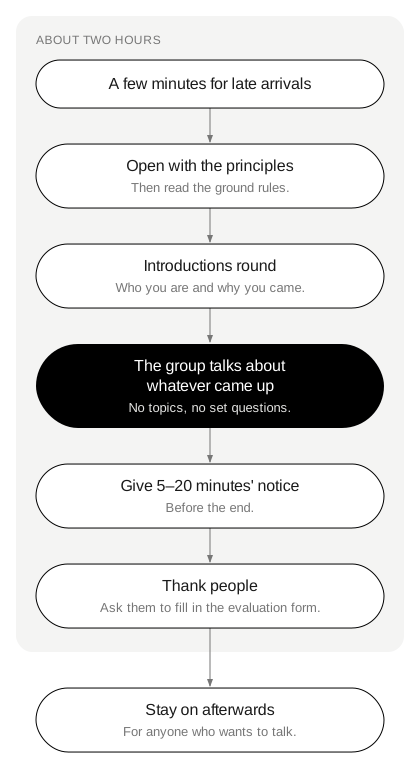
Plan for about two hours. The guide gives that as the average length and notes that one hour can also work. Leave a few minutes at the start for people who arrive late.
4. Choose the format and the group size
The guide describes two formats.
- Café model. One facilitator stays with one group. The guide puts the ideal size at 6–12 people, with 3 as a minimum and 20 as a maximum.
- Salon model. Groups of 4–8 facilitate themselves. The facilitators give an introduction and move between tables when needed. This suits larger events.
In a first-timer thread on the official forum, one host suggests splitting 8 people into two groups of 4 so everyone gets time to speak. If 12 people turn up and only one facilitator is free, two tables of 6 under the salon model may work better than one long table.
5. Plan food and money
Refreshments are one of the four principles. Potluck, homemade, bought from the venue or catered all count. The guide prefers vegetarian food with a vegan option, and the host is responsible for food safety.
The event is free, or you ask for a donation of no fixed amount. In the guide’s words, “Death Cafes never have a ticket price or exclude those who can’t afford to donate.” Mention the donation once at the start and once at the end.
6. Open with the principles and the ground rules
Start by explaining what a Death Cafe is, its principles and any donation plans. Then read the ground rules. The guide names “listening when people are talking, respect for others’ views and confidentiality.” Hosts on the forum report that guidelines set at the start mean less steering later, and one host describes stepping in gently when someone talks too long or interrupts.
Ask before taking any photos, and tell people before any filming or recording. Feedback can appear on the official site, but no information is linked to any particular person.
7. Go round once, then let the group lead
The guide’s opening is an introductions round: each person says who they are and why they came. Hosts on the forum open the same way. Some answer first themselves, briefly, so the others hear how long an answer can be.
After that round, the group talks about whatever came up. There are no topics, no set questions and no guest speakers. The guide is direct: “We ask you not to have these.” Guest speakers and information materials are “actively discouraged.”
Silence will come. Let it sit for a moment before you speak into it. If the group-directed talk has been tried and the room seems to want more structure, the guide allows a facilitator to offer an open question. Its limit: “Please don’t ask more than 3.”
8. Close, then write it up
Give 5–20 minutes’ notice before the end. Thank people and ask them to fill in the evaluation form the guide provides. Stay on afterwards for anyone who wants to talk, and debrief with your co-host.
The last step is the write-up. Post your Death Cafe to the official site, so the next first-time host can read how yours went.
Where Thesis fits, and where it doesn’t
The Death Cafe model has no set questions, themes or materials, so a card game doesn’t belong on a Death Cafe table. If you’d like to run an evening with cards, give it its own name and its own description, so guests know what they’re coming to.
Thesis is useful one step earlier. Before your first Death Cafe, sit down with your co-host and talk about death yourselves. You’ll answer the introductions round first on the day, and it helps to have said something out loud before. Strangers often expect this kind of talk to be harder than it turns out. In experiments by Kardas, Kumar and Epley, conversations between strangers felt less awkward and created more connectedness than participants expected, and people overestimated the awkwardness of deep conversations most of all (Kardas et al. 2021).
Death is card 11 in Thesis. Its other side is Phone. For two co-hosts, the word side opens the conversation you’ll be hosting. The Phone side can lead to the same place by another road: a voicemail someone kept, a number still saved, the call that brought the news. Either side is a full answer.
Silence sits on the back of Tree. It’s a useful word to try before hosting, because the pauses at a Death Cafe are part of the talk. Ask each other how long a silence feels comfortable, and what you’ll do with your hands while it lasts.
The rule card asks the table to “agree together how passing works” before starting, and the same agreement suits a practice evening. After an answer, the three example follow-ups fit too: What did that feel like? Who else was there? Has it always meant that to you? The rule card adds: “A short answer is a full answer.”
If you don’t have the box, the free online table draws a card for you.
Your next step
Open the official guide, read it once from start to finish, and send one message to the person you’d like as your co-host. Then pick a date a month out.
For a practice evening, see the rules and the box or play online. The cards above have their own pages: Death and Silence. Regret is another word hosts may hear at the table. For an evening of the game with people you know, see Thesis for friends. The research behind the deck explains where the words came from. If you also facilitate other groups, see group therapy icebreakers for adults, and for a talk closer to home, how to talk to your parents about death. For prompts and when to hold them back, see Death Cafe conversation starters.