A Death Cafe is an open conversation about death for anyone who wants to have one. A grief support group is a regular meeting for people who are living with a loss. The two can share a room, a host and even some of the same people, but they answer different needs. If the people you have in mind want to talk about mortality in general, host a Death Cafe. If they’re carrying a recent loss and want company through it, host a grief group. This guide helps you tell which one you’re looking at, and what each asks of you as a host.
What each format is for
Death Cafe describes itself in plain terms. It’s “a group directed discussion of death with no agenda, objectives or themes,” and its aim is “to increase awareness of death with a view to helping people make the most of their (finite) lives.” The same page calls it “a discussion group rather than a grief support or counselling session” (Death Cafe). At the time of writing, the site lists 24,996 Death Cafes in 100 countries since September 2011.
A grief support group starts from the other end. The people in the room share a loss, and the group exists to keep them company while they live with it. It can meet on a schedule, with the same members each time. Peer groups for bereavement have been studied as part of the wider family of mutual help groups. A review of 12 studies of mutual help groups for mental health problems, bereavement among them, found 7 with positive changes, 5 with no difference between members and non-members, and none with negative effects. The authors called the evidence “limited but promising” (Pistrang et al. 2008). That supports offering a group. It doesn’t support promising an outcome.
Five differences that decide the format
The two formats differ in five concrete ways. Each is a decision a host makes before the first evening:
- Who comes. A Death Cafe is open to anyone curious about death, bereaved or not. A grief group is for people with a loss, sometimes one kind of loss.
- What the talk is about. A Death Cafe has no set topic. A grief group’s talk keeps returning to the loss and the life around it.
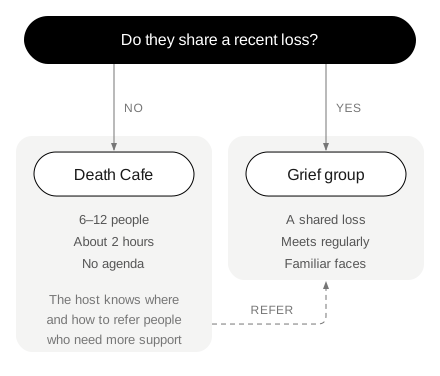
- How often it meets. A Death Cafe can be a single event. A grief group can meet regularly, with familiar faces.
- Size and length. The official guide puts the ideal Death Cafe at 6–12 people, with 3 as a minimum and 20 as a maximum, and gives about 2 hours as the average length (Death Cafe guide). A grief group’s size and length are the host’s call.
- What the host holds. At a Death Cafe, the host keeps the talk open and on topic. In a grief group, the host keeps a steady room for people who come back with the same loss each time.
When a Death Cafe is the right call
A Death Cafe fits when the interest comes before the loss. Think of a library audience after a talk on end-of-life planning, or friends who keep circling back to the subject at dinner. They want to talk about what death means, how they’d like their own to go, and what it changes about how they live.
The official guide is clear about who it doesn’t suit. It says the format “doesn’t work for people who, for whatever reason, aren’t able to discuss death comfortably and openly,” and that it’s “not a bereavement support or grief counselling setting.” It asks hosts to “Ensure you know where and how to refer people who need more support” (Death Cafe guide). It asks hosts to have good group facilitation skills and doesn’t insist on a formal qualification.
In practice, someone in fresh grief may still arrive. In a forum thread on the Death Cafe site, one host describes guests who took over the room. A facilitator who replies sets ground rules at the start, steers the talk back, and invites quieter people in. The same reply adds that one guest with a painful story needed a grief support group more than a Death Cafe (Death Cafe forum). If guests like that keep arriving at your events, some of them may be looking for a grief group.
When a grief group is the right call
A grief group fits when the people you have in mind already share a loss and want to come back to the same room. The questions on the table are personal: how the week went, what the anniversary was like, who to tell.
Members of a UK bereavement forum describe what made a group fit or not (Sue Ryder Online Community). One found a group that was more like group counseling than a social meeting, and planned to try a different one. Another found a group for everyone grieving wasn’t right, and moved to one for people who had lost a partner. A third found a monthly group helpful at first, where people could talk or sit in silence, then later didn’t want life to center on grief. Each of these is a host’s decision: how social the group is, who it’s for, and how it lets people move on.
That last point has a basis in research. The dual process model describes grieving people moving between loss-oriented and restoration-oriented stressors, and counts respite from grief as part of adaptive coping (Stroebe and Schut 1999). A grief group can make room for both: time on the loss, and time on ordinary life.
Questions to settle before you choose
Answer these about the people you expect to come:
- Do they share a recent loss?
- Is the loss of one kind, or mixed?
- Do they want one evening, or a regular place?
- Would they come to talk about their own loss, or about death in general?
- Can you be there every session for the next few months?
- Do you know where to refer someone who needs more than a group?
- Would a newcomer be able to sit and listen for a whole session?
- Is the room set up for tea and talk, or for a quiet circle?
If the first four answers point to a shared loss and a regular place, start a grief group. If they point to curiosity and one evening, start a Death Cafe. You can also run both, on different nights, with different names, so people can tell what they’re signing up for.
Where a card can help in either format
Thesis is a card deck for conversation. It has 50 double-sided cards for 2–6 players, with an idea on one side, an everyday thing on the other. In either format, a host might use one card as an opening round, then put it away. A word on an index card works the same way.
Death sits on the back of Phone. At a Death Cafe, Death is the topic everyone came for, and it can open the first round. In a grief group, Phone may be the easier side: a saved voicemail, a number still in the contacts. Every card has two sides, and a player can choose either.
Loneliness is on the back of Perfume. It suits a grief group well into its sessions, when members know each other. Perfume can bring back a person through one smell, which may be enough for a first turn.
The rules start with “Before you start, agree together how passing works.” That line works in both formats. So does “A short answer is a full answer. You can always ask for more.” You know your group and its limits, and you decide whether a card belongs in it. Thesis is a conversation format and makes no clinical claims.
To try a round before your first session, open the online table:
The die has six faces: MEMORIES · BODY · PEOPLE · VALUES · CHILDHOOD · FUTURE. The only instruction is “Look at the word from that side.”
Your next step
Write down the names of five people you’d invite and answer the first four questions for them. Then pick the guide that matches: how to host a Death Cafe or how to run a grief support group. If your guests are spread out, see the online Death Cafe guide, and for a grief group’s sessions, grief support group discussion questions.
The two cards above have their own pages, Death and Loneliness. For a session about ordinary life, see Rest. For running the game in a group, see Thesis for therapy groups. You can play online for free, see the rules and the box, or read the research behind the deck. Related: death Cafe Berlin: how to host one in English. Related: how to end a support group session after a heavy share.