An online Death Cafe can work, and its weak point is the pause. Two hosts have run one on video every month since August 2021. In one session they split 16 guests from the US and Canada into two groups, one host in each. One guest’s feedback asked for more space between comments: the talk was lively, and it was hard to find a way in (Death Cafe write-up). This post is for a host who wants to take a Death Cafe online and keep that space. The steps below run in the order you’ll do them, from setup to the last minute of the call.
Who goes online, and what stays the same
Some of the people asking live far from a venue. In a thread on the official forum that opened in 2014, an end-of-life doula in rural California asked about online Death Cafe communities. Her area was spread out, and she expected an online format to be less personal but open to more people (Death Cafe forum).
The official how-to guide doesn’t mention online events. It assumes a venue with refreshments. Its principles still carry over to a call: not for profit, a respectful and confidential space, no push toward any conclusion or product, and something to eat and drink. Online, each guest brings their own. Gail Rubin, who wrote about moving her Death Cafe onto video in April 2020, put it plainly: “you have to provide your own refreshments” (Rubin 2020). Put that line in the invitation, so people arrive with a cup in hand.
1. Set up the call so the first minutes are quiet
A call can be noisy before anyone speaks. Hosts who ran Death Cafes on video in 2020 posted their setups online. Four habits come from those pages.
- A separate meeting link. Rubin advises a meeting ID made for the event, with a password, in place of a personal meeting ID posted in public.
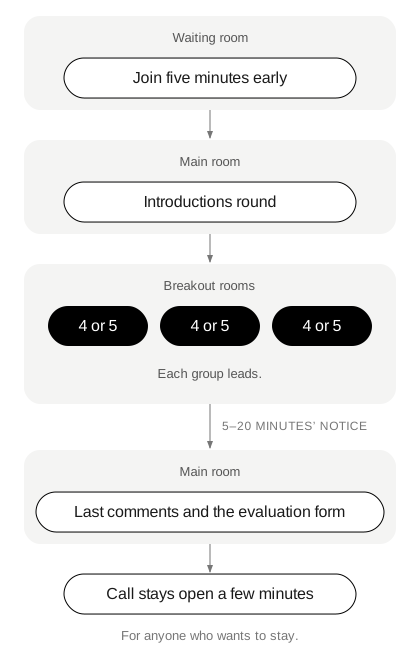
- A waiting room. One listing asked guests to join five minutes early and wait in the waiting room until the start (Death Cafe listing).
- Muted entry. The same listing muted everyone on entering or leaving a room, to cut down on feedback and extra sound.
- A computer over a phone. Another listing recommended joining from a computer, where everyone is visible at once (Death Cafe listing).
Say in the invitation that the call isn’t recorded. The guide asks hosts to tell people before any filming or recording, and a call makes recording easy. If you’re new to the software, Rubin suggests a practice session before the event.
2. Plan rooms of four or five
Size is the first lever on pauses. In freely forming conversations, data from several settings point to an upper limit of about four people who can interact in one spontaneous conversation (Dunbar et al. 1995). A room of 16 on one screen is four times that size.
The guide’s salon model already splits a large event into self-facilitating groups of 4–8. For a call, plan breakout rooms of four or five, plus a host or co-host who can drop in. With 16 guests and two hosts, that’s three or four rooms in place of two rooms of eight. If you have only one facilitator, keep the whole group together for the introductions round and open rooms after it.
3. Name the pause out loud
People in conversation keep the gaps between turns short. A study of 10 languages found that speakers avoid overlapping talk and minimize silence between turns, and that the average gap in each language falls within about 250 ms of the cross-language mean (Stivers et al. 2009). So a longer pause, one that lets a quieter guest in, may not happen on its own. On a call it has to be agreed.
After the guide’s ground rules (listening, respect for other views, confidentiality), add one line about the pause. A version that works: “When someone finishes, we’ll let it be quiet for a moment before the next person speaks.” Then model it. After the first answer in the introductions round, stay silent for a few breaths before you thank the speaker.
Give guests a way to signal without cutting in. Rubin lists two: a real raised hand on camera or the call’s raise-hand button. Agree which one your group uses. A guest who takes the floor too often can be handled the same way as at a table, with a gentle word and a turn offered to someone who hasn’t spoken.
4. Go round once in the main room
The guide’s opening is an introductions round: who you are and why you came. On a call, the host calls each name in turn, since guests can’t read who is next from the table. Rubin’s version adds one more line after the round: is there an issue anyone wants to raise right away.
Answer first yourself, briefly. Guests hear how long an answer can be, and they hear the pause you leave after it. Then open the breakout rooms and let each group lead. The guide has no topics, no set questions and no guest speakers.
5. Close in the main room
The guide puts the average Death Cafe at around 2 hours. Bring everyone back before the end. The guide asks for 5–20 minutes’ notice, then thanks and the evaluation form, which you can paste into the chat. Rubin closed by asking whether anyone had a question or comment they hadn’t said yet.
Leave the call open for a few minutes for anyone who wants to stay, and debrief with your co-host after the last guest leaves. Then post your write-up to the official site. The feedback line that opens this post came from one of those write-ups.
Where Thesis fits, and where it doesn’t
Thesis isn’t part of Death Cafe, and the model has no set questions or materials, so a card doesn’t belong in the breakout rooms. It fits a practice call. Before your first online Death Cafe, get on a call with your co-host and test the pause. Open the free online table, share your screen, and take turns with one word each.
Silence is card 16, with Tree on its other side. On a call, the word side tests the thing this post is about: how long a quiet moment lasts before one of you fills it. Try it once each. The Tree side goes elsewhere: a tree outside the window behind your camera, or one at a place where someone is buried.
Belonging is card 44, and its object is Headphones. For two hosts setting up a call, the object side is close at hand. Who wore these headphones last, and what were they listening to? The word side points to where a guest who joins alone from a kitchen far away might feel they belong.
The rule card asks the table to “agree together how passing works” before starting, and the same agreement suits a call. After an answer, use the three example follow-ups: What did that feel like? Who else was there? Has it always meant that to you? The rule card adds: “A short answer is a full answer.”
Before your first call
Write the pause line into your opening notes, word for word. Then book a short practice call with your co-host, share the table above, and time one silence between you.
For the cards and rules on paper, see the rules and the box, or play online with your co-host. The words above have their own pages: Silence and Belonging. Death is the word at the center of every Death Cafe. For a game evening with people you know, see Thesis for friends, and for the studies behind the deck, see the research page. For an in-person event, see how to host a Death Cafe. For the pass agreement in more detail, see the right to pass in groups.