A tradition is something handed to you by people who came before, that you keep doing on purpose. The Sunday call to your mother, the cake on a birthday, the way your town marks the first snow. The meaning of a tradition sits in that last part: on purpose. Once you know why you keep one, you can decide whether to keep it, change it, or let it go.
This post explains what the word holds, why some traditions feel alive and others feel like a chore, and how to sort your own. It ends with a way to talk it through with one or two people, using a single word.
The short answer
Tradition means handing something down. The English word comes from the Latin verb trādō, built from trāns (“across”) and dō (“give”). Its meanings include “to hand over,” “to bequeath,” and “to hand down to posterity.” The same verb also meant “to betray” (Wiktionary).
Both senses fit what traditions do to people. A tradition hands you something: a dish, a song, a way to mark a day. It can also hand you an obligation you never chose. Living with traditions can mean telling those two apart.
Many traditions are younger than they look
Many traditions are younger than they look. Historians Eric Hobsbawm and Terence Ranger edited a book on this in 1983. Its description says that many traditions people think of as ancient were invented comparatively recently. The case studies include Welsh and Scottish “national culture” and British royal rituals of the 19th and 20th centuries (Hobsbawm and Ranger 1983).
This matters for a single tradition too. If a nation’s traditions were made by people at a certain moment, so were your family’s and your friends’. Someone started the birthday breakfast. Someone decided the holiday happens at one house. Each tradition had a first time, and the person who started it was making a choice. You can make one too.
Why some traditions feel empty
A tradition can keep its form and lose its meaning. Family researchers draw a line between the two. Barbara Fiese and colleagues reviewed 32 publications covering 50 years of research on family routines and rituals. They describe routines as observable practices, and rituals as symbolic representations of collective events (Fiese et al. 2002). A routine is what you do. A ritual is what it stands for.
That line can help explain a tradition you dread. Nothing changed in what you do. The meaning wore off, and what’s left is the routine. The dinner still happens, but nobody at the table could say what it’s for.
A review of ritual research makes a similar split. Nicholas Hobson and colleagues describe three functions of rituals: regulating emotions, regulating performance goal states, and regulating social connection. For each one they look at two kinds of mechanism: the physical features of the ritual, and its psychological meaning (Hobson et al. 2018). In those terms, a tradition with its meaning gone is left with the physical half.
Keep, change or let go
Three questions help sort one tradition at a time. Take a tradition you have mixed feelings about and answer them in order, with a story where you can.
- Who handed it to you? Name the person, or the place, and the first time you remember it.
- What did it stand for then? Say it in a sentence: “It meant we were all home,” “It meant Grandpa was in charge.”
- Does it stand for that now? And if it does, is that still something you want?
The answers point to one of three moves. If the old meaning still holds and you want it, keep the tradition as it is. If the meaning holds but the form doesn’t fit your life, change the form: the long trip becomes a video call at the same hour, the big dinner becomes a picnic. If the meaning is gone, or was never yours, you can let it go, and maybe keep one small piece as a marker.
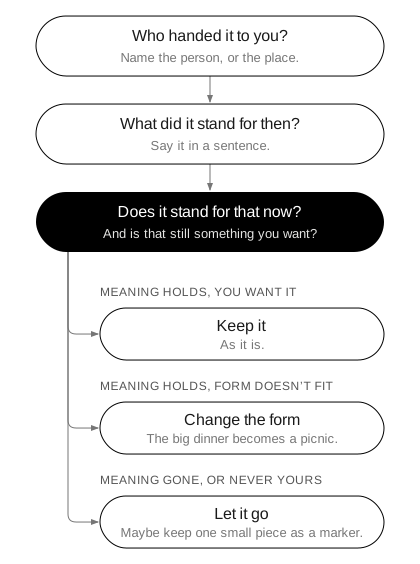
Changing the form keeps the part that matters. A tradition that moved country with you can stay the same in meaning and look nothing like it did. For more on that, see what home means after moving abroad.
Letting go is harder to say out loud, because the person who started the tradition may hear it as a verdict on them. A story softens it. “It used to mean we’d all be together. Now we see each other other ways, and I’d like to keep that part.” The tradition ends; what it stood for doesn’t have to.
Questions to ask about tradition
These questions work for one person with a notebook, or for two or three people talking. Answer with a place, a year, and a person where you can.
- Which tradition in your life is the oldest, and who started it?
- Which one did you start yourself?
- Which tradition do you keep mostly for someone else?
- What tradition from someone else’s life would you like to borrow?
- Which tradition have you already let go of, and when did you notice?
- What did a tradition feel like the year it went wrong?
- Which small habit of yours would someone else call a tradition?
- What would you like someone to keep doing after you?
- Which tradition changed its form and kept its meaning?
- What does tradition mean to you, in one sentence, after the other nine?
Questions 2 and 5 can be the hardest to answer. It’s easy to miss that you founded a tradition, or the day one ended. Both answers show that traditions are made and unmade by ordinary people, on ordinary days.
One word for the table
A single word can open the same conversation without a list. The Thesis deck has a card for it.
Tradition has a Fridge on its other side. Choose the idea when you want to talk about what was handed to you and what you’d hand on. Choose the Fridge when a smaller story is easier: the photo that’s been on the door for years, the jar nobody is allowed to throw out, the note in a handwriting you miss. A fridge holds traditions nobody has named yet.
Belonging has Headphones on its other side. A tradition can be a way of saying “we’re the ones who do this.” Talking about Belonging next to Tradition shows which group a tradition ties you to, and whether you still want to be tied to it. The Headphones side brings up the music that marks a group, from a family car to a friend’s kitchen.
The Thesis die has six faces: MEMORIES · BODY · PEOPLE · VALUES · CHILDHOOD · FUTURE. The only instruction is “Look at the word from that side.” Rolling it with Tradition can give a different story each time, which suits a word that carries both the past and what comes next.
Try it with someone
A tradition looks different when someone else hears the story of it. Two or three people after dinner are enough. Before you start, follow the rule on the box: “Before you start, decide together how passing works.”
- Draw a card. Pick a side: the idea or the thing.
- Roll the die. Look at the word from that side.
- “Say as much or as little as you like. The others ask, gently.”
- Hand the die to the left.
Three follow-up questions fit every word: What did that feel like? Who else was there? Has it always meant that to you? For Tradition, the third one does the sorting. It asks whether the meaning has held.
“There are no right answers.” One person may keep every tradition they were given. Another may have dropped most of them and started a few of their own. Both are ways of choosing. “What is said at the table stays there.”
What to do this week
Pick one tradition you keep. Write its name on a scrap of paper and answer the three questions: who handed it to you, what it stood for, and whether it stands for that now. Then tell the story to one person, and let them ask one follow-up.
To close, each person can name one thing they discovered about someone today. “Sometimes one word is enough.”
See the rules and the box, or open the free online table. The cards above have their own pages: Tradition, Belonging, and the close neighbor Home. For playing with a few close people, see Thesis for friends. For the studies behind the deck, see the research page.