You’ve known a friend for years and you still haven’t told them about your father’s drinking. With another friend, you said too much after a few glasses of wine and spent the next morning replaying it. Both feel like mistakes, and they pull in opposite directions. One says you keep too much in. The other says you let too much out.
What to share with friends comes down to three checks: whose story it is, whether you want this person to know it, and whether there’s room for it right now. This guide walks through those checks, explains why holding back can feel safer than it is, and sets up a format where each person at the table decides how deep to go. It works with the Thesis deck, the free online table, or one word written on a napkin.
Privacy and secrets are different things
A private thing is something you choose not to bring up. A secret is something you work to keep hidden. Your salary, your therapy appointments and the name of your first crush can all be private without being secrets. Nobody is harmed when you leave them out of a dinner conversation.
Secrets cost more. In ten studies covering more than 13,000 secrets, Slepian et al. 2017 found that people’s minds wandered to their secrets far more often than they had to hide them in a conversation. Thinking about a secret more often was linked to lower well-being, separately from how often people had to conceal it. So the weight of a secret sits less in the moment of hiding and more in carrying it around between meetups.
This is a useful line for friends. Privacy needs no defending. A secret that keeps coming back to you on the bus home is a candidate to share with someone.
Three checks before you tell
These checks take a few seconds, and they work in the order you’d ask them.
- Is it mine to tell? A friend’s affair, a sibling’s diagnosis or a colleague’s layoff belongs to them. Your feelings about it belong to you. You can share how it’s affecting you without handing over their story.
- Do I want this person to know it next year? Disclosure doesn’t come back. If the answer depends on how the friendship goes, wait, or share a smaller piece first.
- Is there room for it now? A loud bar, a big group with people you met tonight, or a friend who’s in the middle of their own crisis can all make a heavy story land badly. The same story fits better on a walk, one to one.
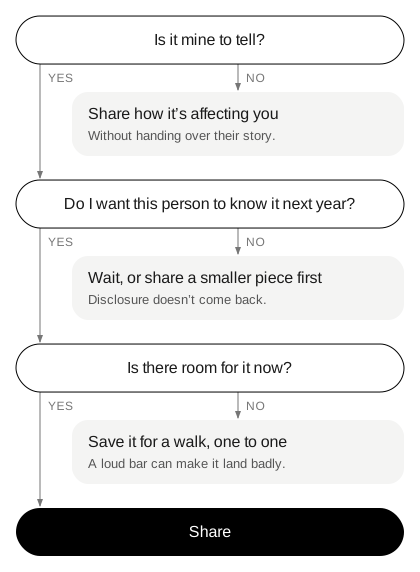
If all three answers are yes and you still hesitate, the hesitation may be about how you’ll look. That part is worth a closer look.
Why holding back feels safer than it is
Telling a friend something hard can feel like a risk to how they see you. The research points the other way. In seven studies, Bruk et al. 2018 found that people judged their own moments of vulnerability, like confessing feelings or asking for help, more negatively than they judged the same moments in others. When someone else showed vulnerability, people focused more on its benefits. The authors call this the beautiful mess effect.
Disclosure also builds the friendship itself. A meta-analysis by Collins and Miller 1994 found three links: people who disclose more intimately tend to be liked more, people disclose more to those they already like, and people come to like those who have disclosed to them. The effects varied by study design, type of disclosure and the discloser’s gender, so this is a tendency, not a rule.
This may explain a friend group where the talk stays on sports, work and plans. Each person may wait for someone else to go first, because their own story feels heavier from the inside than it would sound to the others. If you want to know why a long friendship still feels distant, see why don’t I feel close to my friends.
What oversharing looks like
Oversharing is less about the topic and more about the fit. A detail can be fine with one friend and too much with another. Three signs suggest the fit is off:
- The other person goes quiet and changes the subject. They may not have had room for it.
- You shared someone else’s story. That breaks the first check, whatever the intent.
- You told it to fill a silence. A story told to stop a pause can come out longer than you meant.
None of these call for an apology tour. A short line the next day works: “I said a lot last night. Thanks for listening.” Then the friend can bring it back up or let it rest.
Questions about privacy for friends
These questions let friends talk about privacy itself, which is lighter than sharing a private thing. They go from light to deeper:
- What’s something you’d tell a stranger on a train but not a friend?
- What did your family keep private when you were a kid?
- Who’s the first person you’d call with bad news, and why them?
- What’s a topic you used to keep to yourself and now talk about easily?
- What’s private for you that others share without thinking?
- Have you ever regretted telling a friend something?
- Have you ever regretted not telling one?
- What do you need from a friend before you tell them something hard?
- What’s the difference for you between private and secret?
- What would you want a friend to do with something you told them?
Pick two or three. The answers can show how a friend handles trust.
A format where everyone sets the depth
A card game takes the decision out of the open. Nobody has to announce “I want to talk about something serious.” The card picks the word, and each person picks how far to go with it.
Thesis has 50 double-sided cards: an idea on one side, an everyday thing on the other. The die has six faces: MEMORIES · BODY · PEOPLE · VALUES · CHILDHOOD · FUTURE. The only instruction is “Look at the word from that side.” The rules then say: “Say as much or as little as you like. The others ask, gently.”
Passing is agreed before the first card. The box says: “Before you start, decide together how passing works.” A friend can skip a card with no reason, or turn it over to the thing side and talk about a lamp instead of regret. The rules also set the frame for anything that comes up: “What is said at the table stays there.” For a group where some people don’t know each other yet, see a party where guests don’t know each other.
Three cards for what friends keep and share
Each of these cards opens the topic from a different side.
Privacy has Diary on its other side. The idea side lets friends talk about where their own line sits, without crossing it. The diary side can be easier: a diary you kept at 14, one you read that wasn’t yours, one a parent left behind. Those stories show how each person learned what’s theirs to keep.
Trust has Window on its other side. It fits the second check: who you’d want to know a thing next year. Trust can be easier to describe through a specific moment, a time someone kept quiet for them or didn’t. The window side brings up flats, views and who could see in.
Shame has Letter on its other side. Some players may turn it over, and that’s fine. The letter side can carry the same weight more lightly: a letter never sent, one kept in a drawer, one read too late. A short answer here is a full answer, and a follow-up like What did that feel like? gives room without pushing.
Start with one small thing
Next time you meet a close friend, share one thing that’s private but not heavy: something you’re unsure about at work, or a memory you’ve never mentioned. Then see what comes back. A small piece shows you how this friend holds it.
To try it with a word, open the online table or see the rules and the box. The cards above have their own pages: Privacy, Trust and Shame. For more ways to play as a group, see Thesis for friends. For the studies cited here and others, see the research behind the deck. Related: being honest with friends about yourself.