You sit at a family dinner and laugh a beat after everyone else. Your friend group has a chat full of jokes from a trip you missed. At the new job, weeks in, you still wait for someone to say you can sit down. After a move, the old city feels far and the new one hasn’t let you in. The same sentence fits every room: I don’t belong here, or anywhere.
This post explains where that feeling can come from, using three studies on belonging and how people read each other. It also gives ten questions and one small test you can run this week, with a friend, a word on a scrap of paper, or the Thesis deck.
The short answer
The feeling of not belonging can be a reading of the room, and the reading can be off. In studies, people underestimated how much others liked them after a talk. Small, everyday contacts are linked to a sense of belonging, and they’re easy to drop when you feel out of place. A hard week in a new place can also look like proof that you don’t fit. One study framed that kind of week as common and temporary, and it changed how students read it.
None of this says the feeling is wrong. Some rooms don’t fit, and some families don’t make space. It says the feeling is information worth checking before it becomes a conclusion about you.
You may be liked more than you can tell
Erica Boothby, Gus Cooney, Gillian Sandstrom and Margaret Clark studied what people think others thought of them after a conversation. Across strangers in a lab, first-year students sharing dorms, and members of the public at a workshop, people underestimated how much their partners liked them and enjoyed their company. The researchers called it the liking gap. Among the dorm mates, it lasted for months while they formed new relationships (Boothby et al. 2018).
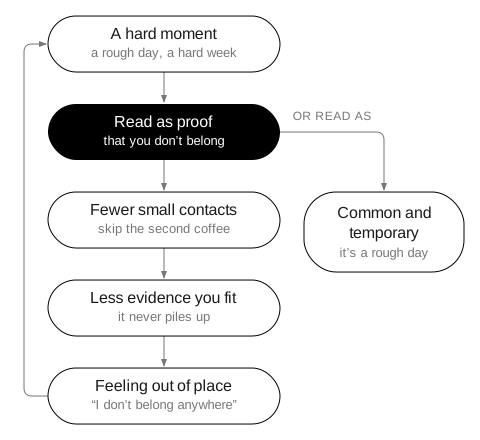
That gap matters for belonging. If every talk ends with “they were being polite,” the evidence that you fit never piles up. You keep the awkward pause and drop the part where someone laughed at your story. In a friend group, that can look like waiting to be invited, because asking feels like imposing.
Small contacts count
Belonging is also linked to small contacts. Gillian Sandstrom and Elizabeth Dunn tracked students’ daily social contact. On days when students talked with more classmates than usual, they reported more happiness and more sense of belonging. Two more studies in the same paper looked at all daily interactions and found that contact with weak ties, people at the edge of a network, was linked to social and emotional well-being too (Sandstrom and Dunn 2014).
Weak ties are the barista, the neighbor on the stairs, the colleague from another team. They’re also easy to cut when you feel you don’t fit. Skipping the office lunch or the second coffee after a meetup feels like protecting yourself. It also removes the small contacts that are linked to belonging.
A hard start can look like a verdict
Gregory Walton and Geoffrey Cohen ran a brief exercise with 92 first-year college students. The exercise framed social difficulty in the first year as common and temporary, and the students put that message into their own words. Over three years, it raised the grades of African-American students in the study and halved the minority achievement gap. The researchers traced the effect to one change: students stopped reading hard moments on campus as proof that they didn’t belong (Walton and Cohen 2011).
The study was about students, not about families or offices. The same reading can happen there too. A first month at a job, a first year in a new country, a family visit after a long time away: each one has rough days. Read as a verdict, a rough day becomes “I don’t belong anywhere.” Read as a stage, it’s a rough day.
Why the obvious advice doesn’t land
“Put yourself out there” assumes the problem is effort. It may not be. If you already show up and read every pause as a no, more events add more pauses to read. What helps more is one conversation where you say the thing out loud and hear what the other person saw.
That’s harder than it sounds, because the sentence “I feel like I don’t belong” can sound like a complaint or a request. A word gives you a way in. You talk about what Belonging meant at 12, or in your first apartment, and the other person answers with their own story. Sometimes you find out the other person has felt it too.
Ten questions about belonging
These work on paper or with one other person. Answer with a place, a year and a name where you can.
- Where did you last feel you belonged without thinking about it?
- What did belonging look like in your family when you were a child?
- Who made you feel welcome somewhere new, and what did they do?
- When did you first feel like an outsider?
- Which group do you still miss, and what did it give you?
- What do you do to fit in that you’d rather stop doing?
- Which small contact in your week would you notice if it disappeared?
- Who do you think likes you less than they probably do?
- Where have you belonged that you didn’t notice at the time?
- What would a place need for you to feel you belong there?
Look at questions 5 and 9 together. The answers can show that belonging has happened before, which makes “anywhere” less true.
Look at the word from six sides
The Thesis die has six faces: MEMORIES · BODY · PEOPLE · VALUES · CHILDHOOD · FUTURE. The only instruction is “Look at the word from that side.” Roll it, or pick a face, and say what Belonging brings up from there. One word read six ways can show where belonging has been in your life and where it’s missing.
Belonging has Headphones on its other side. The idea side suits a talk about families, friend groups and the places that fit. The Headphones side is a gentler way in: the music you played on the bus to a school where you didn’t fit, or the headphones you wear in an open office to have a room of your own. Both sides end up in the same place.
Community has a Mirror on its other side. Choose it when the feeling is about a group: a neighborhood, a team, a church, an expat circle. The Mirror side turns the talk toward how you see yourself in that group, which can be harsher than how the group sees you.
Friendship has a Ball on its other side. It’s the word for a friend group where you feel at the edge. The Ball brings up teams, playgrounds and who got picked, and that can be where the feeling started.
Try it with one person
Pick one person you’d like to belong with more: a sibling, a friend from the group, a colleague. Ask them to play. Two players are enough.
Before you start, agree how passing works. The rules open with “Before you start, agree together how passing works.” Then take turns:
- Draw a card. Choose a side: the idea or the thing.
- Roll the die.
- Look at the word from that side. Say as much or as little as feels right.
- The others ask what they’re curious about, gently, without judging.
- Hand the die to the left.
The rule card gives three follow-up questions: What did that feel like? Who else was there? Has it always meant that to you? “A short answer is a full answer. You can always ask for more.”
What to do this week
Write the word Belonging on a piece of paper. Keep one small contact you’d usually skip: the second coffee, the hallway chat, the reply in the group chat. Then tell one person one story about a place where you felt you belonged, and ask for theirs.
Afterward, end the way every game of Thesis ends: name one thing you discovered about the other person. It’s a small piece of evidence against “anywhere.”
See the rules and the box, or open the free online table. The cards above have their own pages: Belonging, Community and Friendship. For playing in a small circle, see Thesis for friends. See also the research behind the deck. If the first deep question feels too awkward to ask, read why deep conversations feel awkward. Related: how to feel like you belong in a new country when you moved alone.