Someone at a family dinner mentions a funeral, a will, or a song they’d want played. Soon someone else says “Let’s not be morbid,” or “There’s plenty of time for that.” The subject closes, and nobody brings it back.
This post explains why that happens, using surveys and two studies. The short answer: families delay the talk because it feels too soon, and because each person is protecting the others. The numbers suggest the people across the table may be waiting for someone else to go first. At the end there’s one small way to open the subject without a plan or a form.
The short answer
Families delay the talk for two reasons: the timing never feels right, and nobody wants to upset anyone. Both reasons sound kind, and both keep the talk on hold.
In a January 2018 survey of 1,004 US adults, 68% had not talked with loved ones about their wishes for end-of-life care. A primary reason given was that it felt “too soon.” In the same survey, 53% said they’d feel relieved if a loved one started the conversation (The Conversation Project 2018). The two numbers sit side by side: a large group hasn’t talked, and a large group would welcome being asked.
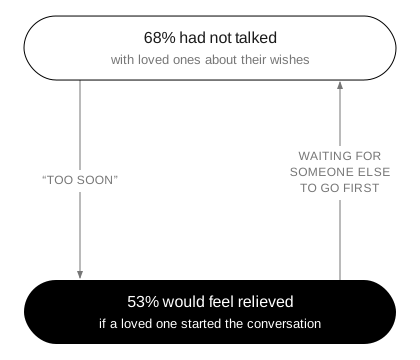
“Too soon”: the reason with no expiry date
“Too soon” works as a reason at any age. At 30 it’s obvious. At 60 it still holds, because nobody is ill. When someone does get ill, the same words come back in a new form: now isn’t the time to bring up something sad.
The 2018 survey shows how wide the gap between belief and action was. Five years earlier, in 2013, more than 90% of Americans surveyed said the conversation was important, but only 27% had had it. By 2018 the share who had talked rose to 32% (The Conversation Project 2018). People agreed on the value of the talk for years and still waited for a start.
The same press release names one of the roadblocks: the belief that raising the subject would make loved ones anxious. That belief is the second reason.
“Too morbid”: protecting each other
“Too morbid” can mean “this will make someone sad, and I don’t want to be the one who did it.” Research on families facing serious illness describes the same move. Amy Zhang and Laura Siminoff interviewed 37 patients with stage III or IV lung cancer and 40 caregivers from 26 families. About two thirds of the families (65%) had communication problems. The avoidance was linked to three things: avoiding distress, a desire for “mutual protection,” and a belief in positive thinking (Zhang and Siminoff 2003).
Mutual protection is the key phrase. The parent stays quiet to spare the children. The children stay quiet to spare the parent. Each side thinks the silence is a gift, and both end up guessing what the other wants. The study was small and about cancer, not healthy families, so it describes a pattern rather than measuring how common it is.
How death compares with sex and money
Surveys from Britain put death next to other hard family topics. In a 2012 ComRes survey for the Dying Matters Coalition, 71% of the public agreed that people in Britain are uncomfortable discussing dying, death and bereavement. Yet when asked about their own circle, 25% said they’d feel uncomfortable discussing dying with people close to them. For comparison, 39% said the same about sex, and 23% about money (Dying Matters / ComRes 2012).
That gap between “people are uncomfortable” and “I’d be uncomfortable” matters. In this survey, far more people saw discomfort in others than in themselves. The same survey found that 82% would be concerned about being a burden on those close to them if they were dying. The UK figures are from 2012, so read them with the year.
What happens to the mood
The fear behind “morbid” is that the talk will leave everyone low. One study tested this directly. Lauren Van Scoy and colleagues had 70 healthy volunteers, in 18 groups of families, friends, or strangers, play a conversation game about death and dying. Players rated the conversations as satisfying, with a mean of 6.1 on a seven-point scale, and the authors reported no negative effects on emotional state right after the game (Van Scoy et al. 2016).
The study had no comparison group, and volunteers who sign up for a game about death may be readier than an uncle at Thanksgiving. It does show that a structured talk about death doesn’t have to end in gloom. More numbers and their limits are on the research page.
Questions that open the subject gently
A first talk doesn’t need wills or medical forms. These questions start with memories and values, which is where “too soon” and “too morbid” have the least grip. Pick one, and let the answer run.
- What’s the first funeral you remember going to?
- Who in our family talked about death openly, and who never did?
- What did your parents tell you about death when you were a child?
- Which goodbye do you still think about?
- What would you want people to say about you at your funeral?
- Is there a song you’d want played?
- What’s something you’d want us to know, in case it ever came to that?
- Who would you want nearby if you were seriously ill?
- What do you worry we’d get wrong?
- Why do you think our family never talks about this?
The last question names the silence itself. It can be easier to answer, because it asks about the family, not about anyone’s death.
One word instead of the big talk
A single word can carry the subject without the pressure of “we need to talk.” The Thesis deck has 50 double-sided cards, each with an idea on one side and an everyday thing on the other. Three of them fit this conversation.
Death has a Phone on its other side. The phone holds the call that brought bad news, a voicemail someone saved, a number nobody deleted. A relative who’d say “too morbid” to the idea side may still talk about the phone, and the story reaches the same place on its own.
Silence has a Tree on its other side. Silence is the word for the family habit this post describes. Asking what silence meant in your house growing up, and what was left unsaid, brings up the “mutual protection” without anyone having to name it. The Tree side opens a gentler route: a garden, a grave, a tree planted for someone.
Duty has a Ticket on its other side. Duty sits under “I don’t want to be a burden”: who takes care of whom, and who feels they owe what. The Ticket side brings up trips, visits home, and the drives made when someone was ill.
How to play it at a family table
The Thesis rules open with “Before you start, agree together how passing works.” That agreement answers “too morbid” ahead of time: anyone can step back from a card. “A short answer is a full answer. You can always ask for more.”
The die has six faces: MEMORIES · BODY · PEOPLE · VALUES · CHILDHOOD · FUTURE. The only instruction is “Look at the word from that side.” The rule card gives three follow-up questions: What did that feel like? Who else was there? Has it always meant that to you?
What to do this week
Write the word Death, or Silence, on a scrap of paper. At the next family meal, put it on the table and ask one question from the list above. If someone says it’s too soon, agree, and ask the last question instead: why does this family never talk about it.
For a fuller plan with a parent, read how to talk to your parents about death. See the rules and the box, open the free online table, or see Thesis for friends. Each card has its own page: Death, Silence, and Duty. “Sometimes one word is enough.” Related: questions about death and dying: 10 to talk through while there’s time.