Loneliness hurts because it works like an alarm. Researchers who study it describe a signal that tells you a connection you need is missing, and the signal is built to be unpleasant enough to act on. In one brain-imaging study, being left out of a simple ball-tossing game raised activity in a brain region that also shows up in research on physical pain.
This page is for anyone who wants to know where that ache comes from. It covers what the research says about the pain, what the global numbers count, and whether loneliness is rising. It ends with one small thing to try with one other person.
The short answer
Loneliness is the feeling that your connections fall short of what you need. It isn’t the same as being alone. Louise Hawkley and John Cacioppo make that point in their review: loneliness and being alone are different things (Hawkley and Cacioppo 2010). A person can sit at a full table and feel it. Another can spend a quiet week alone and feel fine.
The pain has a job. In Hawkley and Cacioppo’s account, loneliness raises vigilance and feelings of vulnerability, and it also raises the desire to reconnect (Hawkley and Cacioppo 2010). The hurt is a push back toward others.
Why rejection registers like pain
Naomi Eisenberger, Matthew Lieberman and Kipling Williams scanned people while they played a virtual game of catch. At some point the other players stopped throwing them the ball. During that exclusion, the anterior cingulate cortex was more active, and its activity tracked how distressed people said they felt. The authors note that this parallels findings from research on physical pain (Eisenberger et al. 2003).
The study was a lab game, and a ball game isn’t a lonely year. It shows something narrower: being left out, even by strangers on a screen, registers as distress. That helps explain why a missed invitation or an unanswered message can sting more than the event seems to deserve.
Why the brain keeps the alarm on
John Cacioppo, Stephanie Cacioppo and Dorret Boomsma argue that loneliness “serves a variety of adaptive functions in specific habitats” (Cacioppo et al. 2014). Their paper also reviews evidence on how far loneliness is heritable. In this view, the feeling had adaptive value over evolutionary time, painful as it is in everyday life.
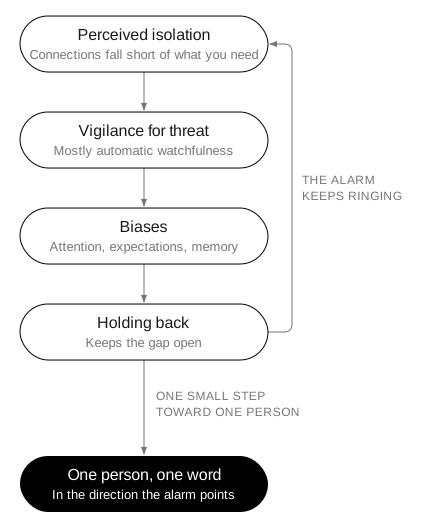
The same alarm has a cost when it stays on. Hawkley and Cacioppo describe how perceived isolation raises “vigilance for threat.” The review links this mostly automatic watchfulness to poorer sleep. It also describes biases in attention, in confirming what people already expect, and in what they remember (Hawkley and Cacioppo 2010).
That watchfulness is part of why the obvious advice, “reach out,” is hard to follow. A lonely mind can scan for signs of rejection, find some, and hold back. Holding back keeps the gap open, and the alarm keeps ringing.
What the numbers count
Global figures exist, and each one counts something slightly different. The World Health Organization’s 2025 commission reports that 1 in 6 people worldwide is affected by loneliness. It links loneliness to more than 871,000 deaths a year, about 100 every hour. Between 17% and 21% of people aged 13–29 reported feeling lonely, with the highest rates among teenagers. About 24% of people in low-income countries reported loneliness, around twice the rate of about 11% in high-income countries (WHO 2025).
A Meta-Gallup survey in 142 countries and territories, with fieldwork from June 2022 to February 2023, found that 24% of people aged 15 and older reported feeling fairly lonely or more. Young adults aged 19 to 29 reported the highest rate, 27%. Adults aged 65 and older reported the lowest, 17% (Gallup 2023). In the United States, the 2023 Surgeon General’s advisory, as summarized by the AHRQ, says about one in two adults reported experiencing loneliness before the COVID-19 pandemic (AHRQ summary of the Surgeon General’s advisory 2023).
The health numbers explain why the topic gets attention. A 2010 meta-analysis of 148 studies with 308,849 participants found that people with stronger social relationships had 50% greater odds of survival (Holt-Lunstad et al. 2010). A 2015 follow-up linked loneliness to 26% greater odds of death, social isolation to 29%, and living alone to 32% (Holt-Lunstad et al. 2015). These are associations across studies. They don’t show that loneliness alone causes the deaths.
Is loneliness rising
The answer depends on who is measured and how. A cross-temporal meta-analysis pooled 345 studies and 124,855 emerging adults who filled in the same loneliness scale between 1976 and 2019. Loneliness rose over those 43 years. The rise came to 0.56 standard deviations on that scale. The authors write that the “loneliness epidemic” framing seems exaggerated, while young adults still deserve attention (Buecker et al. 2021).
Time-use data point the same way for how Americans spend their days. An analysis of the American Time Use Survey from 2003 to 2020 found that social isolation increased, while time with friends and shared leisure decreased. For young Americans, time with friends fell steeply (Kannan and Veazie 2023). Time alone isn’t loneliness, but fewer hours with friends leave fewer chances to feel known. For one place where that shows up, see the remote work loneliness statistics.
The WHO lists poor health, low income and education, living alone, inadequate community infrastructure and public policies, and digital technologies among the causes. It also calls for vigilance around excessive screen time and negative online interactions for young people (WHO 2025).
Talk about the feeling, not the statistics
The numbers say a lot of people share the ache. They don’t make it easier to say “I’ve been lonely” to someone across the table. A word on a card can do part of that work, because the talk starts with the word instead of with a confession.
Loneliness has Perfume on its other side. The idea side is direct: a lonely evening, a new city, a full room where nobody asked a question. The Perfume side comes in sideways. A smell can bring back a person who was there or a time when nobody was.
Belonging has Headphones on its other side. Belonging is the other half of loneliness: where you’ve felt you fit, and what made it so. Headphones can mean a way to shut the room out or music shared on one pair of earbuds. Both stories say something about how close the person wants others to be.
Friendship has a Ball on its other side. The Ball side links back to the study above: a game of catch, who threw to whom, who got left out in the schoolyard. The idea side opens talk about the friends who stayed and the ones who drifted.
Eight questions about loneliness
These questions work alone with a pen, or with one person you trust. Answer with a scene where you can: a place, a year, a face.
- When did you first notice you felt lonely?
- Where were you the last time you felt lonely in a crowd?
- Who did you used to call without a reason?
- What does being alone feel like on a good day?
- What makes a room feel like one where you belong?
- Which small habit makes you feel connected to someone?
- What would you like a friend to ask you more often?
- Who might be waiting for you to reach out first?
The Thesis die adds another angle. Its six faces are MEMORIES · BODY · PEOPLE · VALUES · CHILDHOOD · FUTURE. “Look at the word from that side.”
One small step tonight
Pick one person and one word. Write Loneliness, Belonging or Friendship on a scrap of paper, or open the free online table. Agree first how passing works: “Before you start, agree together how passing works.” For how a pass protects the person speaking, see the right to pass in groups.
Say as much or as little as feels right. “A short answer is a full answer. You can always ask for more.” The other person asks one of the follow-ups from the rule card: What did that feel like? Who else was there? Has it always meant that to you?
A card game isn’t treatment, and loneliness that weighs on daily life is worth raising with a doctor. One conversation is a small step in the direction the alarm points.
See the rules and the box. The words have their own pages: Loneliness, Belonging and Friendship. For playing with a few close people, see Thesis for friends. The research behind the deck explains where the words came from.