It’s late in the evening. One of you comes home after a long day and sits down on the sofa with a phone. The other has waited all afternoon to talk. A few minutes later both feel short-changed. One wanted quiet, the other wanted company, and both would say the week is out of balance.
This post is for couples where work, one job or both, keeps tipping the week. It helps you find out what balance means to each of you, plan one week that fits both answers, and spend one evening on the word Balance. A card works for that, and so does a word written on a napkin.
Two people, two pictures of balance
Two partners can use the word balance as if they share one definition. For one partner it can mean hours: home for dinner, no laptop at the table. For the other it can mean attention: one evening a week when the talk goes past the calendar. For a third it can mean a block of time alone. Each picture is reasonable. The friction starts when each of you measures the same week with a different scale.
Couples on marriage forums describe a version of this evening. One partner’s job fills the day, and by night they find there’s little left to tell. The other partner hears the quiet as distance. Both say they want more balance, and each means something the other hasn’t heard yet.
What happens after a hard workday
A few small diary studies have tracked what a workday does to the evening at home. Rena Repetti followed 33 air traffic controllers and 27 of their wives for 3 consecutive days. On evenings when spouse support was high, heavier workload went with more withdrawal and less anger from the controllers. Repetti suggests that withdrawal may help a person come back to a calmer baseline, and that a spouse who allows it may soften the effect of a hard day (Repetti 1989).
Two later studies looked at the same spillover from work to home. In a 5-day diary study of 43 couples, husbands and wives reported more anger and withdrawal at home after negative interactions at work. Wives also did after days of heavy workload (Story and Repetti 2006). In a 3-day study of 42 couples, more upsetting workdays went with angrier behavior at home for women and more withdrawn behavior for men (Schulz et al. 2004).
These samples are small and the windows are a few days long. They can’t tell you what works for your couple. They do suggest one useful thing: the quiet after a hard day may belong to the day. It can be a way back to normal, and it says little about how either of you feels about the other.
Why “work less” doesn’t settle it
One common answer is to cut hours or set a hard stop. Some jobs don’t allow that. And a schedule fix leaves the two pictures unspoken. A couple can get one partner home earlier and still feel off, because the missing piece was attention or time alone.
Asking “Are we balanced?” can also stall. It invites a yes or a no, and then a defense of the week. A slower talk may help more: what balance looked like in each of your families, and what a tipped week feels like for each of you. That talk and the planning talk go better on different evenings.
One week, planned from both answers
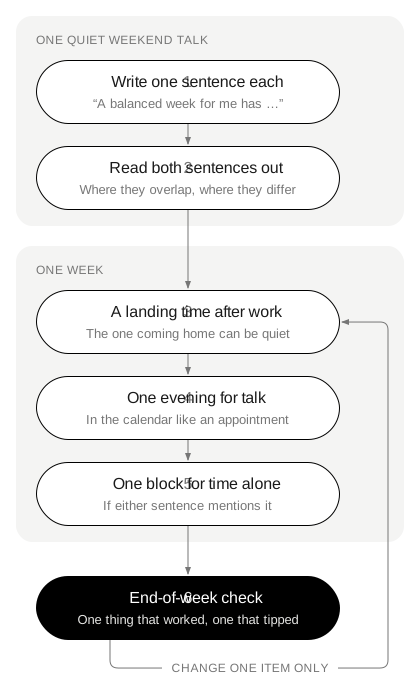
This plan needs one quiet weekend talk and a short check at the end of the week. Pick a day when neither of you has worked late.
- Each of you writes one sentence on paper that starts with “A balanced week for me has”. Don’t discuss it yet.
- Read both sentences out. Name where they overlap and where they differ.
- Agree on a landing time after work: a stretch when the one coming home can be quiet, and nobody reads it as a message.
- Pick one evening for talk and put it in the calendar like any other appointment.
- If either sentence mentions time alone, pick one block for it.
- At the end of the week, each of you names one thing that worked and one thing that tipped. Change one item only, then run the next week with that change and check again.
An evening on the word Balance
The talk evening from step 4 is where the word comes in. It needs two chairs and no preparation.
- Pick the word Balance. Use a card, the online table, or the word on a scrap of paper.
- Agree how passing works. The rules put it this way: “Before you start, decide together how passing works.”
- One of you says what the word brings up: a memory, a person, a week that felt right.
- The other asks one follow-up, then listens. “Say as much or as little as you like. The others ask, gently.”
- Swap. The second person takes the same word somewhere else.
- To finish, each of you names one thing you found out about the other today.
If you have the die, roll it after you pick the word. Its six faces are Memories, Body, People, Values, Childhood, and Future. Look at the word from that side.
Three short follow-ups fit any word:
What did that feel like? Who else was there? Has it always meant that to you?
Three words for a couple out of balance
These three cards from the Thesis deck fit a couple whose week keeps tipping toward work. Each has an everyday object on its other side, which helps on a tired evening.
Balance has Watch on its other side. Balance asks each of you to describe a week that felt level, and what was in it. Watch brings the clock into the room in a gentler way: the watch a parent wore to work, a gift for a first job, the one you check during dinner.
Work has Stone on its other side. Work can lead to what each of you learned about jobs at home: who came back late, who waited, what was said at the table. Stone is an easy start when energy is low: a stone from a beach, a garden wall, something heavy you carried for a while.
Enough has Photograph on its other side. Enough asks where each of you draws the line: enough hours, enough time together, enough time alone. Photograph can lead to a picture from a time when life felt in balance, and to what was different then.
Questions about balance for couples
If you’d rather start with a question, these ten stay close to the topic and leave room for a story:
- What did a balanced week look like in your house growing up?
- When did our life together feel most in balance, and what was different then?
- What’s the first thing you need when you get home from work?
- If you could protect one part of your week, which part would it be?
- What does a tipped week feel like for you?
- What’s one habit that keeps you level?
- What did your parents’ jobs take from the family, and what did they give?
- How much time alone feels right to you in a week?
- If work gave you back two hours, what would you do with them first?
- What does balance between us look like on a regular Wednesday?
Use one question per evening, add one follow-up, and let the answer run.
When the word lands on a sore spot
Balance can reopen an old argument about whose job comes first. If that happens, the pass agreement from step 2 covers it. Either of you can stop or turn the card to Watch. The rules say: “Say as much or as little as you like.”
If the talk turns into a negotiation over hours, move it to the planning talk and keep the word evening for stories. A schedule is easier to change once each of you has heard what the other means by balance.
Try it this week
Tonight, each of you writes one sentence that starts with “A balanced week for me has” on a piece of paper. Fold the papers and read them together on the weekend, then pick one landing time and one talk evening.
For a longer talk evening, try 36 questions for couples. The three cards have their own pages: Balance, Work, and Enough. More on playing as two is on Thesis for couples, and the research behind the deck covers the studies. To see the cards and die, read the rules and the box.