At home you were the one who made the table laugh. In Berlin, the joke forms in your head, you translate it, and by the time it’s ready the group has moved on. The teasing, the quick comeback, the sarcastic aside: that’s the part of friendship that went quiet when you moved.
Your humor didn’t disappear. Banter moves fast, and a second language slows you down at exactly that speed. This guide moves the laughs to places where you set the pace: stories, shared moments, and slow games at a table. It works in English, German or any language you’re still growing into.
Why humor goes first
A joke in conversation has to land in the moment. It needs the right word, the right reference and the right timing, all at once. A sentence about your job can wait a beat. A comeback can’t.
Language skill is part of it, and it’s the part that grows. In three experiments on English jokes, being bilingual didn’t predict how well people picked out the jokes, while English fluency did (Ezrina and Valian 2023). In one group, Russian–English bilinguals were slower than English-dominant bilinguals but more sensitive to humor. Slower isn’t the same as less funny.
Humor in a second language can be intimidating, and it’s also one of the ways friendships get built. That’s how a study of bilingual women’s funny stories frames it (Bell 2007). The pressure can feel high because banter can be one way a group shows you’re in.
Laughing together counts
Being funny with friends doesn’t have to mean being the one with the punchline. In one experiment, 96 strangers were paired up with someone of the same sex for structured tasks that either did or didn’t create a shared funny moment. The pairs with the shared funny experience felt closer to each other afterward (Fraley and Aron 2004). Part of the effect was linked to relief from the discomfort of meeting someone new.
In two other studies of people meeting for the first time, humor went together with liking and closeness (Treger et al. 2013).
In the Fraley and Aron study, the tasks created the funny moment for both people. That takes some weight off. A laugh at a burnt pizza, a wrong train or a terrible card counts. You can be part of it in any language you speak.
Six ways to be funny when the words come slower
These moves put humor where speed matters less. Pick one or two for the next evening out.
- Tell stories, skip the quick comebacks. A story gives you the floor and lets you pick the words in advance. The four bilingual women in Bell’s study told funny stories in English, mostly about other people, often cast as the fool. Stories about their own mistakes were rare.
- Translate a saying from home, word for word. Explain what it means and how your grandmother used it. The literal version can be funny on its own, and the group learns something about where you’re from.
- Be a good audience. Laugh, repeat the line that got you, and ask about it. In three studies of live conversations, people who asked more questions, particularly follow-up questions, were better liked (Huang et al. 2017).
- Use the same running joke. A callback to something from last week needs no new vocabulary. You already know it lands with this group.
- Choose slow settings. A loud bar rewards speed. A kitchen table, a walk or a game with turns gives everyone time to finish a sentence.
- Say when you missed it. “I didn’t get that one, explain it” gives the teller a second go, and now you know the reference.
Questions that bring out funny stories
Funny stories are easier to tell when someone asks for them. These work in a group of internationals and with local friends alike, and they’re sorted from light to deeper:
- What’s a phrase from your language that makes no sense in English?
- What’s the worst word you mixed up in a new language?
- What did people laugh at in your family?
- Who was the funniest person in your school?
- What’s a joke that only works back home?
- What’s something locals here find funny that you didn’t get at first?
- What’s the most embarrassing thing that happened to you in your first month here?
- Which of your friends here has seen you at your funniest?
Each answer is a story with a built-in laugh, and the teller gets as long as they need.
A game gives the joke time
A card game with turns is one slow setting that works for a mixed-language group. The Thesis rule card sets the pace: “Say as much or as little as feels right.” Nobody has to jump in, and the quiet person gets the whole floor when it’s their turn.
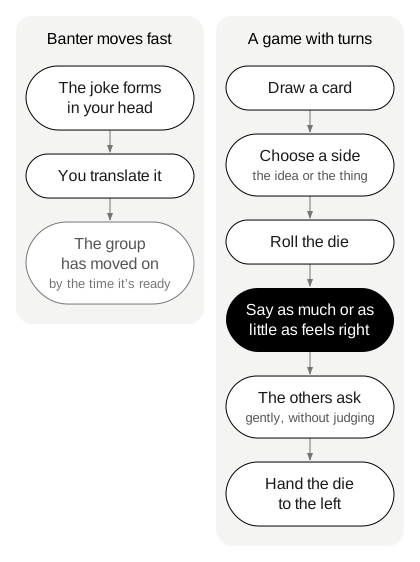
Each turn follows six steps from the rule card:
- Whoever suggested the game goes first.
- Draw a card. Choose a side: the idea or the thing.
- Roll the die.
- Look at the word from that side. Say as much or as little as feels right.
- The others ask what they’re curious about, gently, without judging.
- Hand the die to the left.
The die has six plain words: MEMORIES · BODY · PEOPLE · VALUES · CHILDHOOD · FUTURE. The only instruction is “Look at the word from that side.” The online table runs in English in a browser, so a group can play on one phone without a deck.
Agree on passing before the first card. The rules open with “Before you start, agree together how passing works.” A word that doesn’t spark anything can be passed, or turned to its other side.
Three cards that bring out the funny side
Each of these three cards reads in its own way for someone living in a second language.
Play has Laptop on its other side. The idea side brings back childhood games, the ones with rules nobody outside your country knows. Explaining them is half the comedy. The laptop side goes to work calls, typos in a second language and the email you sent to the wrong person.
Home has Spoon on its other side. Home is a heavy word for anyone abroad, and a pass is fine. The spoon side is lighter: the food you can’t find here, the kitchen habits locals find strange, the dish you tried to cook for friends and got wrong.
Belonging has Headphones on its other side. Belonging is the word under this whole guide, since banter is one way a group says you’re in. The headphones side is the easy door: the music from home you still play, and the songs you sang along to without knowing the words.
Start with one story
Before the next meetup, pick one funny story from home that you’ve told many times in your first language. Practice the first two sentences in the new one. Then wait for a slow moment, or ask one of the questions above and let someone else go first.
See the rules and the box, or open the online table. The cards above have their own pages: Play, Home and Belonging. For more on playing with a group, see Thesis for friends. For the studies behind the deck, see the research page. For practice partners who share the language gap, see what to do when a language exchange runs out of things to say.