You open a store page or stand in front of a shelf, and there’s a row of boxes for couples. Each one says it brings you closer. The photos look alike, the card counts differ, and the reviews tell you how other people felt on one evening.
This post gives you seven things to check before you choose, in an order that suits two people at home. None of them is about a brand. Each one is a question you can answer by reading the rules, looking at three sample cards, or playing one round with a word on a napkin.
Start with what your evenings look like
The best conversation cards for couples are the ones that fit the evenings you already have. Before you look at any box, answer three things together. How long do you have on a weeknight: a short gap after the kids are asleep, or a slow Sunday? Do you live together, or do you talk over a video call? Do you want light play, or are you looking for the talks you keep putting off?
A couple with a short weeknight gap needs something that starts in one sentence. A couple who’s apart for months needs something that works on two screens. Write your answers down. They decide which of the checks below carry the most weight.
1. Look at what’s printed on one card
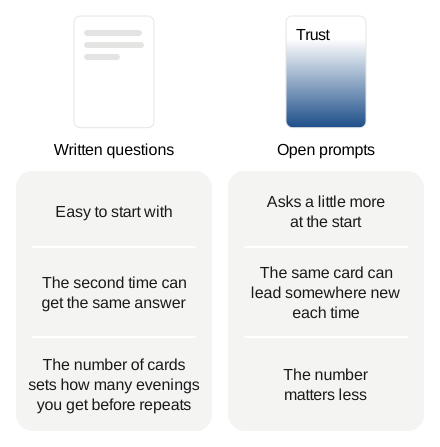
Card games for couples come in two broad formats. Some print a full question on each card. Others print a prompt that’s more open: a word, an image, or a short theme that each of you takes somewhere of your own.
Written questions are easy to start with. You read the card and answer it. Once you’ve answered a question, the second time can bring the same answer. One long-distance poster on a forum described this: they went looking for a new game because the deep questions they had kept repeating.
An open prompt asks a little more at the start, because you decide what to say about it. In return, the same card can lead somewhere new each time, since it depends on who’s holding it and on what happened that week.
2. Check how the depth is set
Deep talk works better when it builds. In a lab procedure by Aron and colleagues, pairs worked through self-disclosure tasks that grew more intense over about 45 minutes, and they felt closer afterward than pairs who did small-talk tasks (Aron et al. 1997). The study ran in a lab, not with couples at home, so the result says nothing direct about couples. It does give a reason to look at how a deck handles depth.
Some decks sort cards into levels. Others mix light and heavy cards and leave it to the draw. A third option lets each player choose the depth on every turn. Read three sample cards from the box and ask yourselves whether you’d be comfortable drawing any of them on a tired Tuesday.
3. Look for follow-ups
A card starts a conversation. The follow-up is what keeps it going. In studies by Huang and colleagues, people who asked more questions in a conversation, especially follow-up questions, were liked more by their partners. In speed-dating conversations, more follow-up questions went with more agreement to a second date (Huang et al. 2017). The studies looked at lab conversations and speed dates, and the speed-dating result is a correlation. For couples, it’s a lead.
Check whether the rules say anything about what the listener does. A short set of open follow-ups printed in the box helps when one of you runs out of things to say after the first answer.
4. Check how passing works
Any deck with depth will at some point land on a topic one of you doesn’t want to open tonight. A good rule sheet says how to pass before that happens. Look for a line that lets either player skip without a reason, or switch to a lighter card.
If the rules don’t mention passing, agree on it yourselves before the first card. It’s a short talk, and it can change how freely both of you answer.
5. Match the length and the player count
Read how long one round takes and how the game ends. Some games have a fixed number of cards per session. Others end when you decide. An open ending fits a weeknight that might run short, and a clear closing step gives the evening an end point.
Check the player count too. A deck that works for two and also for a bigger table helps if you’d like to bring it to a dinner with friends later.
6. Think about replay
Count what you’ll use twice. With written questions, the number of cards sets how many evenings you get before repeats. With open prompts, the number matters less, because a card read from a different angle can give a different talk.
Check the size if you travel. Measure the box against the bag it would go in.
7. Check whether it works at a distance
If you’re apart for weeks or months, look for a version that runs on two screens, or a format simple enough to play over a call. A deck where one person reads a card aloud and both answer works on video. Cards that rely on touching, drawing, or showing something across the table work less well.
Questions to ask each other before you choose
These eight questions help when you can’t agree on what you want from a deck:
- When did we last have a talk that surprised one of us?
- Do we want to laugh more, or talk about harder things, or both?
- How long do we have on a usual evening?
- Which topics would we rather keep off the table for now?
- Do we want it for the two of us only, or with friends as well?
- Would we use it at home, on trips, or over a call?
- Do we want rules, or a card and nothing else?
- How will we know it worked after the first evening?
How Thesis fits these checks
Thesis is one example of the open-prompt format, so you can test the checks above on it. It has 50 double-sided cards, 63 × 88 mm: an idea on one side and an everyday thing on the other. It’s for 2–6 players, 16+. A die folds from a card into a six-sided prism:
MEMORIES · BODY · PEOPLE · VALUES · CHILDHOOD · FUTURE
The rule for the die is one line: “Look at the word from that side.” Passing is agreed at the start: “Before you start, agree together how passing works.” The follow-ups come printed: What did that feel like? Who else was there? Has it always meant that to you? The game ends when you want it to: “Play for as long as it feels good.” You can try a round on the online table before deciding anything.
Three cards to test the format
If you want to see whether open prompts suit you, try these three.
Trust has Window on its other side. Trust is a heavy word for a first evening, which is why it tests the depth check well. If it feels like too much, the window is right there: a window you looked out of as a kid, the view from your first shared apartment.
Nostalgia has Key on its other side. It’s a good test of replay. Draw it once in spring and once in winter, and you may talk about different things. A key leads to a story fast: a first car, a parent’s house, a lock that no longer exists.
Play has Laptop on its other side. It fits couples who talk over a call, since the laptop can be the thing between you. Play can lead to what each of you did for fun before you met, and what you’d do with a free afternoon now.
Try one round before you choose
Tonight, write Trust on a scrap of paper. One of you says what it brings up, the other asks Has it always meant that to you?, then swap. Afterward, go back to the seven checks and note which ones mattered in that round. That list is your brief for any deck you look at next.
The box isn’t on sale yet.
We’ll email you when the box is available. You’ll get a confirmation email first. Privacy policy
For an evening built around this, see date night at home ideas. The three cards have their own pages: Trust, Nostalgia, and Play. For more on playing as two, see Thesis for couples. For the studies, see the research behind the deck. To see the cards and die, read the rules and the box. Related: conversation cards for therapists: how to choose a deck for your group. Related: A couples question app or a weekly conversation: two formats, and how to choose.