You want to talk about more than groceries, so you ask around. Someone on a marriage forum did this recently and said they’d rather hear from people than ask an AI. The top replies pointed to two things: a couples question app that sends one prompt a day, and a deck of cards for a longer evening. Both answers are fair. They’re different formats, and they fit different weeks.
This post is for couples deciding between those two shapes: a short daily question and a longer weekly conversation. It compares the formats, not products. You’ll see what each one does well, where each one can stall, and a way to combine them. Neither needs a download. A question in a text message or a word on a sticky note works.
Two formats, side by side
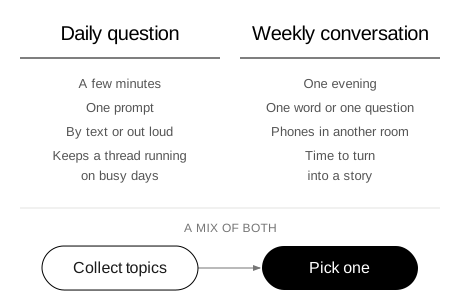
A daily question is small by design. One of you, or an app, sends a prompt in the morning. Each of you answers in a sentence or two, by text or out loud, and you talk about it at dinner if there’s time. It takes a few minutes.
A weekly conversation is one sit-down. You pick an evening, put the phones in another room, and spend most of it on one word or one question. It goes slower and further. It also takes a free evening, which some weeks don’t have.
The difference is less about depth than about rhythm. The daily question keeps a thread running between you on busy days. The weekly talk gives one topic enough time to turn into a story.
What a daily question does well
The daily question is easy to start. It asks for one sentence on a day when neither of you has energy for more. It can suit couples who work different shifts or live apart, because it fits into a lunch break.
It also gives you material. A one-line answer about a childhood friend can be the thing you ask about on Saturday. Over a few weeks the answers add up to a list of topics you didn’t know were there.
Where the daily question stalls
The daily question can turn into a chore. The prompt arrives, one of you answers in a hurry, the other reads it on the train, and nobody follows up. After a few weeks the question becomes another notification.
Typed answers also skip the part where the other person asks Who else was there? A sentence on a screen has no room for that. The follow-up is where a short answer grows, and it’s easier face to face.
What a weekly conversation does well
A longer talk lets a topic build. In a lab procedure by Aron and colleagues, pairs spent 45 minutes on self-disclosure tasks that grew more personal step by step. In the first study, they felt closer afterward than pairs who did small-talk tasks for the same time (Aron et al. 1997). The pairs were set up by the researchers in a lab, so the result shows that a slow build can create closeness, not what it does for a long marriage.
There’s also the hesitation before a deeper talk. In experiments by Kardas, Kumar, and Epley, people expected deep conversations with strangers to be more awkward than they turned out to be (Kardas et al. 2021). The same paper found that people predicted more accurately how conversations with close friends, family, or partners would go. For a couple, the harder part can be finding the evening.
Where the weekly conversation stalls
The weekly talk stalls when the week gets full. If Thursday is the evening and Thursday goes to a late meeting, the talk moves to next week, and then the one after. A second risk is the big-question problem: a heavy question at the start of a tired evening feels like a test.
A small object helps with both. One word is lighter than a question, so the evening can start slow. It also travels: if the evening falls through, the word can wait on the fridge.
How to choose
Your week picks the format more than your taste does. These questions sort it out:
- Do the two of you have one free evening most weeks?
- Do you see each other most days, or mostly through a screen?
- Does one of you prefer to answer in writing, and the other out loud?
- When you’ve tried questions before, did they run out, or did you stop following up?
If you have a free evening and see each other often, start with the weekly talk. If evenings are rare or you live apart, start with the daily question and add one follow-up by voice. If questions ran out before, a word may last longer than a list.
A mix of both
The two formats fit together. Use the daily question to collect topics and the weekly talk to pick one.
- On weekdays, send each other one short question. Answer in a sentence.
- Keep a note of answers that made either of you curious.
- On the weekly evening, pick one of them, or draw a word.
- One of you talks about it. The other asks one follow-up, then listens.
- Swap, and take the same topic somewhere else.
- End when it feels done. Each of you names one thing you found out.
That last step comes from the Thesis rules, which end a game with each player naming “one thing they discovered about someone today.” The rules also set passing before you begin: “Before you start, decide together how passing works.” Both work in a text thread as well as at a table.
For the weekly evening, the online table draws a word for you. If you want a longer guide to that part, see the weekly couples check-in.
Three words that work in both formats
These three Thesis cards fit a one-line answer on Tuesday and a longer talk on Sunday.
Kindness has Book on its other side. As a daily prompt, it can be one line: a kind thing someone did for you today. On the weekly evening, the book side opens a longer story: who read to you, a book you lent and never got back, a book you gave someone.
Hope has Teddy bear on its other side. Hope fits the weekly talk because it looks ahead, and plans need time. The teddy bear is the easy door on a tired evening: a toy you kept, one you lost, one a child in your life won’t sleep without.
Friendship has Ball on its other side. It works well for couples who’ve been together a long time, because old friendships can be the stories partners have heard least. The ball side can bring up a street, a team, or a summer.
Daily questions to start with
If you start with the daily format, these questions take one line to answer and leave room for a longer talk later:
- What made you laugh today?
- Who did you think about today, and why?
- What’s something you saw today that you’d like to show me?
- What smell reminds you of a place you lived?
- What did you want to be good at when you were 10?
- What’s a small thing you’re looking forward to this week?
- Which friend from school would you call if you could?
- What’s one thing you’d like to do together this year?
When an answer catches your attention, save it for the weekly evening and ask one of the follow-ups from the rule card: What did that feel like? or Has it always meant that to you?
Try both this week
Send one question from the list tomorrow morning. Then pick one evening this week and spend it on a word: Kindness, Hope, or Friendship. After a week, ask each other which one you’d keep.
The three words have their own pages: Kindness, Hope, and Friendship. For more on playing as two, see Thesis for couples. For the studies, see the research behind the deck. To see the cards and the die, read the rules and the box. Related: how to choose a conversation card game for couples.