You’re at a friend’s birthday, holding a drink, next to someone you’ve never met. You ask what they do. “Logistics,” they say. You nod. A moment later you’re both looking at the snacks.
The job question asks for a fact, and a fact is easy to file and hard to follow. This post gives eight swaps that ask for a small story, what to do when the story doesn’t come, and the second question that keeps a conversation going.
Why the job question stalls
“What do you do?” has a ready answer, said many times before. The other person gives a title, you give yours, and the thread ends at two labels. To keep going, one of you has to build the next question out of “logistics.”
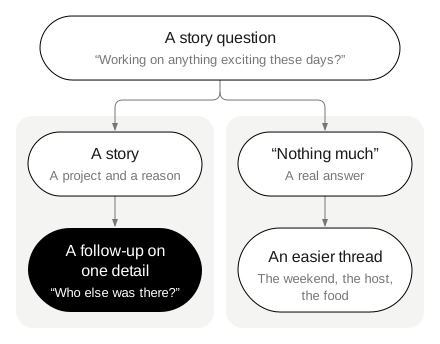
A story question hands the choice to the other person. Ask “Working on anything exciting these days?” and someone who likes their job will talk about it, with a project and a reason in it. Someone whose job is the least interesting part of their life will tell you about the boat they’re fixing. Behavioral researcher Vanessa Van Edwards suggests this swap in an interview on The Diary of a CEO: ask about something good or something coming up, and the facts you wanted, like the job or the kids, tend to come out on their own.
Eight questions to ask instead
These stay light enough for the first few minutes. Each asks about a recent moment or a plan, which is easier to answer than a summary of a life:
- Working on anything exciting these days?
- Got any fun plans coming up?
- What’s something you’re learning at the moment?
- What was the best part of your week so far?
- How do you know the host?
- How long have you lived here, and what’s the best thing about it so far?
- What’s the most surprising thing that happened to you this month?
- What are you looking forward to this weekend?
Two small patterns sit inside the list. A “how long” question followed by “the best thing” turns a number into a moment. Words like “the most surprising” or “the strangest” narrow the search, so the other person picks one story and skips the inventory.
Leave the big ones for later. “What’s your story?” or “What’s your biggest goal in life?” asks a stranger to sum up a life on the spot. Those questions can work once there’s some trust, later in the evening or on a second meeting.
When the answer is “nothing much”
A question is an invitation, and an invitation can be declined. “Nothing exciting, honestly” is a real answer. So is “It’s been a hard few months.” Pushing for a better one turns a light question into a test.
Take the answer as it comes. Say something that leaves room, like “That sounds like a lot,” and move to an easier thread: the weekend, the host, the food. Someone may open up after they’ve asked you something first, so answer their question with a small story of your own.
The second question does the work
The opener starts a story. The question after it shows you heard it. In three studies of live conversations, Huang and colleagues found that people who asked more questions, follow-up questions above all, were liked more by their partners. In speed dating, people who asked more follow-ups were more likely to get a yes to a second date. Participants didn’t expect that asking questions would make them more likable (Huang et al. 2017).
A follow-up picks up one detail from the answer. The Thesis rule card lists three that fit almost any story:
What did that feel like? Who else was there? Has it always meant that to you?
There’s a slower version too. Remember one detail and bring it back later. Later in the evening, ask whether the boat floats yet. That one line tells the person you were listening the first time.
One word on the table
At a small gathering, a single word does the same job as a swap question. Write one on a napkin or put one card in the middle of the table. Whoever wants starts and says what the word brings up. The speaker picks the angle, so a stranger can stay light and a friend can go further.
Thesis is a deck of 50 cards built this way: an idea on one side, an everyday thing on the other. The rules say: “Draw a card. Choose a side: the idea or the thing.” You can try it on the free online table before the party, or play it there with people on a call.
Work has Stone on its other side. It’s the job question turned around. Someone can talk about their first job, the job they wanted at nine, or work nobody pays them for. The stone side gives a way out: a stone from a beach, a stone in a shoe on a long walk.
Curiosity has Sewing machine on its other side. The idea leads to “what are you learning” without asking it. The sewing machine can bring up a grandmother’s flat, a costume for a school play, or a hobby someone picked up last winter.
Play has Laptop on its other side. Play is about what someone does when nothing is required of them. The laptop side may lead back to the job after all, this time on the speaker’s terms.
Try it at the next party
Pick two questions from the list: one to open with and one as a backup. Ask the first one to the next person you meet. Listen for one detail you can bring back later in the evening.
For more on the question after the opener, read follow-up questions and being liked. For small groups of friends, see Thesis for friends. The cards above have their own pages: Work, Curiosity and Play. See the rules and the box, and the research behind the deck. When someone asks you, see how to answer “What do you do?”. See also wait time: how long to stay quiet after you ask.