A bid for connection is any small attempt by one partner to get the other’s attention, approval, affection, or some other positive contact. The Gottman Institute defines it as “any attempt from one partner to another for attention, affirmation, affection, or any other positive connection” (Brittle 2015, The Gottman Institute). A sigh at the window, “Look at this,” a hand on a shoulder, and a question about a headache can all be bids.
This post is for couples who’ve heard the term and want to know what it covers in a normal week. It gives a plain definition, everyday examples, the three ways a bid can be answered, and a note on which figures come from research and which from a practitioner blog. At the end there’s a short exercise you can try tonight with one word.
The definition in one paragraph
A bid has two layers. On the surface it’s a remark, a gesture, or a request. Underneath it’s a question: are you with me right now? The Gottman Institute article says bids range from a smile or a wink to a request for advice or help, and that a bid often carries a second meaning beyond its literal words (Brittle 2015). “Did you see the sky?” is about the sky. It’s also an invitation to share a moment.
Everyday examples of bids
Bids in a long relationship can be small and easy to miss. These are typical ones from an ordinary day, grouped by what they ask for:
- Attention: “Listen to this,” reading a line from the news aloud, or holding up a phone with a photo.
- Interest: “Guess who I ran into today,” or a story about a coworker that starts mid-sentence.
- Help: “Can you look at this email before I send it?”
- Affection: a hand on the back while passing in the kitchen, or sitting closer on the sofa.
- Play: a silly voice, an old joke, a wink across the table at a family dinner.
- Comfort: “What a day,” a long exhale after a phone call, or “My back is killing me.”
None of these says “I want to feel close to you.” That’s why they’re easy to step past. The person making the bid may not know they’re making one either.
Three ways to answer a bid
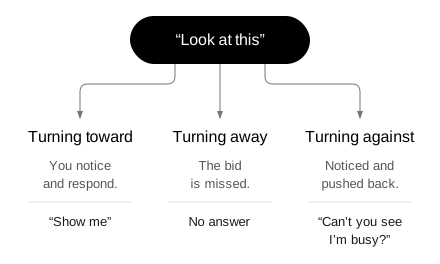
The Gottman Institute article describes three responses (Brittle 2015):
- Turning toward: you notice and respond. “Show me,” “Who?”, or a hand back on theirs. The article says turning toward starts with paying attention.
- Turning away: the bid is missed. Eyes stay on the screen, the remark gets no answer, or the reply is a single word.
- Turning against: the bid is noticed and pushed back. “Can’t you see I’m busy?” The article calls turning away more damaging than this: a rejection at least leaves room for continued engagement and repair.
Couples describe turning away in nearly the same words on relationship forums. One partner shares something from their day and gets one-word replies. Another starts a serious talk on a video call, and the partner keeps playing a game on the side. In both cases the person making the bid stops trying, and the other one may not know a bid happened.
Turning toward doesn’t take long. “Huh, show me” and a look at the photo count. A bid asks for presence, so a short, real answer does the job.
What the research says, and what comes from a blog
Two kinds of sources sit behind this topic, and they carry different weight.
The practitioner blog. The figures quoted on this topic come from the Gottman Institute’s own blog. It reports that in John Gottman’s study of newlyweds, followed up six years later, couples who stayed married had turned toward each other’s bids 86% of the time, and couples who divorced averaged 33% (Brittle 2015). The article doesn’t name the paper, the number of couples, or how bids were counted. Treat these numbers as the Institute’s summary of its own work. We couldn’t open a peer-reviewed paper that reports them.
A peer-reviewed study. Driver and Gottman observed 49 newlywed couples during a 10-minute dinnertime interaction and a 15-minute conflict discussion. The study linked playfulness and enthusiasm in everyday moments with humor and affection during conflict (Driver & Gottman 2004). The study is correlational, so it can’t say that playful dinners cause kinder arguments. We read the abstract only, and it doesn’t use the word “bids.” It supports a narrower point: ordinary moments at the table and the way a couple argues seem to be linked.
For more studies behind the deck, see the research behind Thesis.
Why bids get missed
Bids get missed for ordinary reasons. Both partners are tired. One is still in work mode. The bid is phrased as a complaint (“This printer again”) and heard as noise. A phone is in a hand at the moment the remark lands.
The common tip is “pay more attention.” It’s hard to follow, because nobody can watch for bids all evening. It works better to make one short window a day where bids are easier to see. A slower conversation with one topic on the table does that: when there’s one thing to talk about, the small “and then” or “I don’t know why that stuck with me” becomes easier to hear.
Words that invite bids
A single word can work as a prompt that invites bids from both sides. These three from the Thesis deck fit this topic.
Play has Laptop on its other side. Play ties back to the Driver and Gottman finding about playfulness at dinner. It can bring up how each of you played as kids, or the jokes that only the two of you get. Laptop is the easier start on a tired evening: the screen that can sit between you when a bid goes missed.
Kindness has Book on its other side. Kindness asks what small acts each of you notices and which ones go past. Book can lead to a book someone read to you, one a partner gave you, or one left open on a nightstand.
Trust has Window on its other side. Trust is what a turned-toward bid builds a little at a time. Window is the lighter way in: a view from a childhood room, a window you sat at waiting for someone.
Questions to notice your own bids
If you’d rather start with questions, these ones help both of you see how you reach for each other:
- What’s a small thing I do that makes you feel noticed?
- How did people in your family ask for attention when you were a kid?
- When you want company but don’t want to talk, how do you show it?
- What’s a moment this week when you wanted me to look up?
- Which of my jokes do you think is a way of reaching out?
- What do you do when a remark of yours gets no answer?
- Is there a time of day when you’re more open to talking?
- What’s a gesture from me you’d like more of?
Pick one per evening. After the answer, use one of the follow-ups from the Thesis rule card:
What did that feel like? Who else was there? Has it always meant that to you?
If a question opens something heavy, the rules have a line for it: “A short answer is a full answer. You can always ask for more.”
Try it tonight
Write Play on a scrap of paper and leave it on the kitchen table, or draw a word on the online table. After dinner, one of you says what the word brings up. The other answers with a turn toward: “Tell me more,” a question, or a laugh. Then swap. End the way a game of Thesis ends: each of you names one thing you found out about the other today.
For more on playing as two, see Thesis for couples. For the deck, see the rules and the box. The three words have their own pages: Play, Kindness, and Trust. If you use an object to take turns, see what a talking piece is.