The agenda for your German workshop ends with one word: Blitzlicht. A Blitzlicht is a round in which every person, in turn, says one or two sentences about a single prompt, and nobody comments until the round is over. The word means “camera flash”: a quick picture of where the room stands. This page explains how German schools, workshops and self-help groups run it, and how to host one in English. A word written on a sticky note is enough to start.
What a Blitzlicht looks like
The method has a short list of fixed parts. The University of Oldenburg’s method index for teachers describes it as a prompt or question, followed by one to two sentences from each person, with no comment or judgment on what anyone says (Uni Oldenburg). The teacher may write each word on the board as the round goes. The Bavarian state institute for school quality adds the practical details for facilitators (ISB Bayern):
- Time: about one minute per participant.
- Group size: small and large groups both work.
- Seating: an open circle of chairs, sometimes with a ball passed to the speaker.
- Order: set in advance or left open.
- Listening: nobody interrupts the speaker, and the others don’t judge.
Its example prompt is “Was nehme ich aus der heutigen Veranstaltung mit”, which translates as “What am I taking away from today’s session?” At the end the facilitator can sum up the general tendency, say thanks, or follow with a second method to collect criticism.
Three points in a session
A Blitzlicht can open a session, interrupt it or close it, and German materials name each one. The Oldenburg card lists the Zwischenblitzlicht, run mid-lesson to find out why a class has gone restless or passive, and the Schlussblitzlicht at the end, to reflect briefly on impressions. Self-help groups use it to open meetings too. The guide for self-help groups from SEKIS, Berlin’s self-help contact office, says many groups start their meetings with a Blitzlicht so members can “arrive” and the group can see which moods and concerns are in the room (SEKIS Berlin).
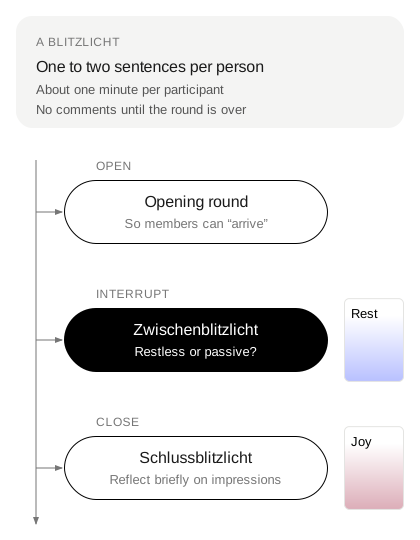
The length changes with the setting. In a classroom or workshop the turn is one or two sentences. The SEKIS guide gives each self-help group member equal time, about two to five minutes, and asks that turns aren’t commented on or discussed, because each person speaks only for themselves. It also notes that an opening round can already point to topics for the meeting. Before you run one in English, decide which of these versions you mean.
Why the round shape matters
The no-comment rule protects the round from the first strong opinion. Once one answer gets a reply, the round can turn into a discussion, and the people later in the order may speak to that discussion instead of the prompt. The SEKIS guide makes the same point for decisions: everyone present speaks before the group draws any conclusions from what was said.
There’s also research on how evenly a group shares its turns. Woolley and colleagues tested 699 people working in groups of two to five on a range of tasks. They found a shared factor that explained a group’s performance across tasks. It wasn’t strongly correlated with the average or highest individual intelligence in the group, but it was correlated with how evenly members took conversational turns (Woolley et al. 2010). That finding shows a link, not a cause, and it didn’t test any particular round format. A Blitzlicht is one plain way to give every voice a turn before the loudest one sets the topic.
How to run a Blitzlicht in English
These steps fit a workshop, a class or a team meeting with an international group:
- Name it and explain it once. Say the German word, then the rule in one line: “One or two sentences each, no comments until everyone has spoken.”
- Show the prompt in writing. Put it on a flipchart or in the chat, so people who think in another language have time to find their sentence.
- Agree on passing. The Thesis rules start the same way: “Before you start, decide together how passing works.” A pass in a Blitzlicht costs nothing and needs no reason.
- Go first and keep it short. Your answer can set the length for everyone after you. One word and one sentence is a full turn.
- Hold every reply. Write down what you want to come back to, as the ISB sheet suggests, and leave it for after the round.
- Close with one line. Name the tendency you heard, thank the group, and move on or open the discussion.
The Thesis table card has a line for step 4: “A short answer is a full answer.” In a Blitzlicht that line is the whole format.
Sentence starters and prompts
German teachers can give a sentence starter to make the first words easier. The Oldenburg card’s example is “Ich fand gut, dass”, which works in English as “I liked that”. Sentence starters and short prompts for an English round:
- What one word describes how you arrive today?
- What are you taking away from this session?
- I liked that
- What surprised you this morning?
- What would help you in the next hour?
- What is still unclear?
- What would you keep for next time?
- What one word describes this group right now?
- What are you leaving behind when you go?
A starter like “I liked that” leans positive. For a mid-session round, a neutral prompt such as “What would help you in the next hour?” gives restlessness a place to show up.
Three words for a Blitzlicht
A single word on the table gives the round one picture to look at. Each Thesis card has an idea on one side and an everyday thing on the other, so a person can pick the side that suits a one-sentence answer.
Loyalty has Camera on its back. The camera fits a round named after a flash. One person might name a photo they took this week, another the people they stay loyal to at work. Both answers fit in one sentence.
Rest has Clock on its back. It suits a Zwischenblitzlicht in a long workshop. Someone can say how rested they feel after the morning, or what time it feels like in their head. The clock also reminds everyone of the minute each turn gets.
Joy has Chair on its back. It works for a Schlussblitzlicht in a circle of chairs. People can name one moment of the session they enjoyed, or the chair they’d rather be sitting in right now.
Try one round now
The online table deals a word for the whole group. Agree on passing, then go around once with one sentence each.
The die has six faces: MEMORIES · BODY · PEOPLE · VALUES · CHILDHOOD · FUTURE. The only instruction is “Look at the word from that side.” For a Blitzlicht, roll once for the whole round, so everyone answers from the same side.
At your next session, write “Blitzlicht” on the agenda, put one word on the flipchart and go first with a single sentence. For more German group formats explained in English, see the Trauercafé guide. For workshops and classes, see Thesis for teams and classes. You can play online for free, see the rules and the box, or read the research behind the deck. Related: check-in Retrospektive Ideen: English openers for retros in Germany.