Cold calling in class has evidence on both sides. In one study, classes with more cold calling had more students volunteering over time. In another, almost every student who brought up cold calling said it raised their anxiety, and none said it lowered it. A participation policy can keep the first result and reduce the second. This post weighs the studies and turns them into a six-part policy you can paste into a syllabus. It includes a right to pass, because the call only feels fair when saying no is an option.
What the studies found
Dallimore, Hertenstein and Platt compared classes with high and low cold calling. In the high cold-calling classes, significantly more students answered questions voluntarily, and the number grew over time. Students’ comfort with participating rose in those classes and stayed flat in the others. The authors conclude that cold calling can be used fairly extensively without making students uncomfortable (Dallimore et al. 2013).
Cooper, Downing and Brownell interviewed 52 students in large college science courses. Thirty-two of them mentioned cold calling or random calling, and 31 said it increased their anxiety. Not one said it decreased it. Students described their minds going blank and losing their train of thought. The authors trace the anxiety mainly to fear of being judged negatively, such as sounding unintelligent in front of peers (Cooper et al. 2018). They also advise against hearing only from volunteers, because that practice has been linked to gender inequities.
The third study tested a middle path. Alvares, Shlichta, McFarland and Theobald surveyed 383 community college biology students across six courses. Some classes used warm random calling: students discussed a question with a partner or group first, then one of them was picked from a shuffled deck of name cards. Students in those classes were more likely to report participating. Students in classes without random calling were more likely to report coming to class with high anxiety that interfered with their learning (Alvares et al. 2023). The authors describe the study as observational, not a controlled experiment, so the results show links, not causes.
Why the results point the same way
The first study measured whether calling builds a habit of talking. The second measured how the cold moment feels: no warning, no time, no partner, the whole room watching. The third kept the call and removed most of the cold part. Of the five parts of warm calling the authors list, one is letting students pass when they need to. One student in that study described the value of passing without being made to feel like a failure.
So the policy question is narrower than “call or don’t call.” It’s what comes before the call, and what happens when a student says no.
A six-part participation policy
The six parts below follow the order of a class: what students hear on day one, what happens during a session, and how the term adds up. Each one is a sentence or two for the syllabus plus a habit in the room.
- Say on day one that you’ll call on people, and why. In the Alvares study, instructors showed every class the same slides explaining why students would be called on. A sentence in the syllabus does the same job: “I’ll call on students by name during class, so that we hear from more than the few who raise their hands first.”
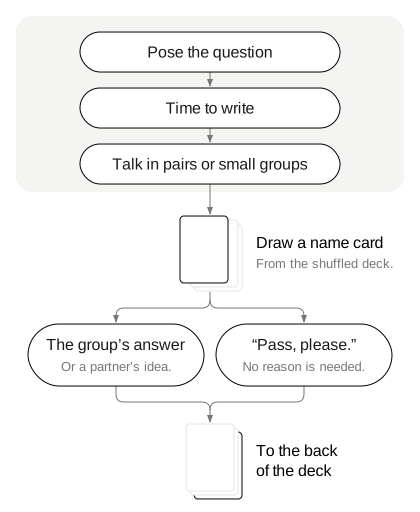
- Give think time and a partner before the call. Pose the question, give time to write, then time to talk in pairs or small groups. The call comes after that. A student who has said the answer once to a classmate has something to fall back on.
- Ask for the group’s answer. Frame the call as “What did your group come up with?” The student can report a partner’s idea, which takes the spotlight off their own. The Alvares study lists this framing as one part of warm calling.
- Make passing free, and give it a phrase. Agree on the words on day one, for example “Pass, please.” No reason is needed and no comment follows. The Thesis rules start with the same agreement: “Before you start, agree together how passing works.” In class, the instructor sets the terms and says them out loud.
- Use a deck of name cards. Shuffle index cards with names, and move each card to the back once it’s been called. Nobody is picked twice before everyone has been picked once. A visible system can make the call feel less personal, and a student who passes stays in the deck for the next cycle.
- Grade more than airtime. Count written answers, pair notes and questions handed in at the end. A student who passes early in the term can still contribute, and the grade stops measuring who speaks fastest.
Where the policy still costs something
Warm calling doesn’t remove every downside. In the Alvares study, students wrote about what got in the way of their learning. In warm random-call classes, 16.2% of those answers named frustration, against 6.3% in the other classes. Some wrote about waiting for their name and losing focus. Distress came up at similar rates in both groups: 32.1% and 27.8% of answers. These came from open answers, so they show what students chose to mention.
Two habits soften this. Tell students how many will be called per session, so the wait has an end. And thank the student for the answer before correcting any part of it, so the room sees that a wrong answer costs nothing more than a pass.
Questions for the first-day participation talk
Students can help shape the policy in a short first-day talk. These questions work in pairs or as a written exit ticket:
- When has being called on helped you think?
- What makes a question easier to answer out loud?
- How much time do you like before you speak?
- What would make passing feel normal in this room?
- Do you prefer to report your own idea or your group’s?
- What should a classmate do when someone gives a wrong answer?
- How would you like to contribute on days you don’t want to speak?
- What would you want the instructor to do after a pass?
A word round to practice the call
A first session can practice the policy before the content gets hard. A short word round in small groups gives every student a turn, a free pass and a low-stakes topic. Thesis plays with 2–6 players, so one deck or one screen per group works. Each card has an idea on one side and an everyday thing on the other, and the thing side can be an easier way in.
Fairness has Sweater on its back. On the day the policy is introduced, students might talk about a teacher who called on everyone equally, or a group project where the work wasn’t shared. The Sweater side gives anyone who’d rather keep it light another topic: a sweater handed down from a sibling, or one that never fit.
Freedom has Compass on its back. In a class with a right to pass, Freedom can read as the choice to stay quiet, a first year away from home, or picking a major. The Compass side can be a story about getting lost, which suits a room that’s still finding its way around a subject.
Trust has Window on its back. Calling on students only works when they trust that a wrong answer won’t be held against them. Someone might talk about a person they trust with a half-formed idea. Someone else might pick the window and describe the view from their desk.
With the deck or the free online table, each turn follows the same steps. A student draws a card, chooses the idea or the thing, rolls the die and looks at the word from that side. The die has six plain words: MEMORIES · BODY · PEOPLE · VALUES · CHILDHOOD · FUTURE. The only instruction is “Look at the word from that side.” The rule card adds: “A short answer is a full answer. You can always ask for more.” Groupmates can ask one short question, like the three on the rule card: What did that feel like? Who else was there? Has it always meant that to you?
Before your next class, write the six parts above as three or four syllabus sentences and decide on the passing phrase. The cards in this post have their own pages: Fairness, Freedom and Trust. For a full seminar plan with think time and pairs, see how to get students to talk in class. For more on running it with a group, see Thesis for teams and classes. For the studies behind the deck, see the research. See the rules and the box. Related: the right to pass: how to set it up so people use it.