You ask the seminar a question and wait. The room looks at its notes. The same students answer, as they did last week. You could call on someone by name, but you remember how that felt from the other side of the table. This plan sits between waiting and cold-calling. Students get time to think, a partner to test the idea on, and a call they can see coming. Each step works with a question on the board, and a short word round on the free online table covers the last part.
What the research says about calling on students
The studies point in two directions, and both are useful. Dallimore, Hertenstein and Platt compared classes with high and low cold-calling. In the high cold-calling classes, more students answered questions voluntarily, and the number grew over time. Their comfort with participating rose too, while it stayed flat in classes with little cold-calling (Dallimore et al. 2013).
Cooper, Downing and Brownell interviewed 52 students in large college science courses about active learning. Clicker questions and group work could raise or lower anxiety, depending on how the instructor ran them. Cold-calling and random calling only raised it. The authors tie this mainly to fear of being judged by others (Cooper et al. 2018).
Read together, the two findings suggest a narrower question. Calling on students can build a habit of talking. The anxiety comes from being asked cold, with no time to prepare and nothing to fall back on. The steps below keep the call and remove the cold part.
Step 1: Put the question up before you ask it
A question asked out loud can give the fastest thinkers a head start. Write it on the board or the first slide, then give everyone time to write an answer in a sentence or two. Nobody speaks while they write, including you. A student who has written something down has a line to read out. That’s a smaller ask than producing a thought in front of the whole room.
Pick questions with more than one defensible answer. “What’s the author’s main claim?” has a right answer, and the students who aren’t sure may wait for someone who is. “Which part of the argument would you push back on first?” gives everyone an entry point.
Step 2: Let students try the idea on one person first
Pairs are the cheapest rehearsal a seminar has. After the writing time, give pairs a few minutes to compare answers. Then open the discussion to the room. This is the think-pair-share format, and it changes who talks.
Guenther and Abbott recorded small discussion groups of seven to eight first-year medical students, with and without think-pair-share. A few students said little in whole-group discussion, with or without the format, but the researchers saw them talking during the pair step. Students who tended to dominate were less dominant during the share time. In two 6-minute segments, the researchers counted two student-to-student exchanges without the format and more than 30 during the share time with it. One student described the pair step as low-stakes, because they could check an answer with a partner first (Guenther and Abbott 2024). The sample was small, three groups at one school, and the authors ask for larger studies.
Step 3: Call on the pair, and say so in advance
A warm call is a cold call with notice. Before the pairs start, tell the room how sharing will work: “When the pairs are done, I’ll ask a few of them what they came up with.” Then call on a pair, not a person. The student can report what their partner said, which takes the spotlight off their own idea.
Walk the room while the pairs talk. When you hear a good point from a quiet pair, ask them quietly whether you can call on them. In the Cooper interviews, the anxiety around cold-calling came mainly from fear of being judged. A student who knows their point is good, and knows the call is coming, faces less of it.
Step 4: Give passing a set phrase
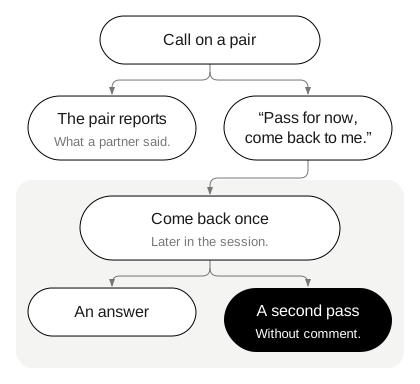
A pass with no agreed wording can feel like a failure in public. Give the class a phrase on day one, for example “Pass for now, come back to me.” Then come back to that student once, later in the session, and accept a second pass without comment.
The Thesis rules start with the same agreement: “Before you start, agree together how passing works.” In a seminar, the instructor sets the terms and states them out loud. A pass that needs no explanation keeps the call fair for the student who isn’t ready yet.
Step 5: Run small groups with a word instead of a question
Some sessions need students to talk to each other before they can talk about the reading. In the first weeks, or after a heavy topic, a short word round in small groups gives everyone a turn. Thesis plays with 2–6 players, so one deck or one screen per group works. Each card has an idea on one side and an everyday thing on the other.
Silence has Tree on its back. In a seminar, Silence can be read as the pause after the instructor’s question, a library at night, or a time someone chose not to speak. The Tree side gives anyone who’d rather keep it light an easy topic: a tree outside their window, a park, a place they used to climb.
Failure has Washing machine on its back. It suits a class where students are afraid of saying the wrong thing. Someone might talk about an exam that went badly and what came after. Someone else might pick the washing machine and talk about their first week of doing laundry alone.
Courage has Bicycle on its back. For students, Courage can read as small acts: asking a question in a lecture, moving to a new city, switching majors. The Bicycle side can be a story about learning something by falling off it, which fits a room learning to speak up.
Step 6: Grade more than talking
A participation grade based on airtime rewards the students who were already talking. Count the written answers, the pair notes and written questions handed in at the end. Tell students at the start of the term which of these count. A student who isn’t ready to speak early in the term can still contribute, and the grade stops measuring who is most outspoken.
Discussion openers that work at any depth
The questions below have no right answer and let each student set how much to say:
- Which sentence in the reading stayed with you?
- Where did you disagree with the author, even a little?
- What’s a question the reading left open?
- Which example from your own life fits this idea?
- What would change if the author’s claim were wrong?
- Which part was hardest to follow?
- What would you ask the author in one sentence?
- Where have you seen this idea outside class?
Running a word round in a seminar
With the deck or the online table, each turn follows the same steps. A student draws a card, chooses the idea or the thing, rolls the die and looks at the word from that side. The die has six plain words: MEMORIES · BODY · PEOPLE · VALUES · CHILDHOOD · FUTURE. The only instruction is “Look at the word from that side.” The rule card adds a line that helps in class: “A short answer is a full answer. You can always ask for more.” Others in the group can ask one short question, such as What did that feel like? Who else was there? Has it always meant that to you?
For your next seminar, write the first discussion question on a slide and plan a stretch of silent writing before anyone speaks. The cards above have their own pages: Silence, Failure and Courage. For groups outside the classroom, see how to get quiet group members to talk. For more on running it with a class, see Thesis for teams and classes. For the studies behind the deck, see the research page. See the rules and the box. Related: first day of class icebreakers for college: a plan that lasts past day one.