A few sessions in, some people in your group haven’t said more than their names. You ask “Anyone else?” and the same hands go up. Calling on the quiet ones by name would get an answer, and it might also be the reason they skip next week. Quiet members may talk more when the first sentence costs less: a short turn counts, there’s something outside themselves to talk about, they can try a thought on one person before the whole room, and the order of turns does the asking instead of the host. This guide gives six steps for support groups, workshops and classes.
The steps work with any prompt. The examples use the Thesis card deck. A word written on an index card works the same way.
Why “anyone else?” gets the same voices
An open question to the whole room rewards whoever decides fastest. A person who needs a moment to find words is still thinking when someone else starts. After a few rounds, the pattern looks like a personality trait, though it’s partly the format.
People in support groups describe what sits behind the silence in plain terms. Some worry about saying the wrong thing. Some couldn’t open up at first with many others in the circle. Some are embarrassed by their own circumstances. In some groups nobody wants to be the first to speak. Each of these is a cost, and each step below lowers one of them.
There’s also a gap in what speakers expect. In experiments by Kardas, Kumar and Epley, participants underestimated how interested strangers would be in what they shared about themselves, and deeper conversations with strangers felt less awkward than people predicted (Kardas et al. 2021). A quiet member may be guessing that the room isn’t interested. Their first short turn is a chance to test that guess.
Step 1: Make a short turn count as a whole turn
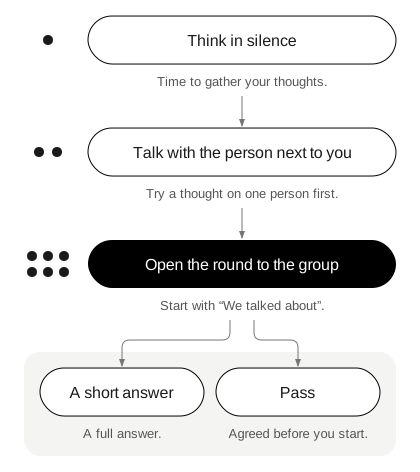
Say at the start that one sentence is enough. The Thesis table card puts it this way: “A short answer is a full answer. You can always ask for more.” A quiet member can then plan for one sentence instead of a speech.
Pair this with an agreed pass. The rule card opens with “Before you start, agree together how passing works.” A person who knows they can pass may be more willing to try a sentence, because trying no longer locks them into a long answer.
Step 2: Give them something to talk about besides themselves
A question about feelings asks a person to start from the inside. An object lets them start from the outside: a thing they owned, a room they remember, a sound. The story can reach the feeling on its own, at the speaker’s pace.
Every Thesis card has an idea on one side and an everyday thing on the other. “Draw a card. Choose a side: the idea or the thing.” A quiet member can take the thing and talk about a spoon or a pair of headphones. That turn is complete, and the group still learns something about them.
Belonging sits on the back of Headphones. For a quiet member, the headphones side is an easy door: a song they played on repeat, a commute, a time they wore headphones to be left alone. If they want to go further, Belonging is right there on the other side.
Step 3: Let people try a thought on one person first
Speaking to one person costs less than speaking to the whole room. Before a group round, give everyone time to think in silence, then a few minutes to talk with the person next to them. Only then open the round to the group.
Guenther and Abbott recorded small groups of first-year medical students, seven to eight per group, with and without this think-pair-share format. Students who usually spoke less in the whole group were more vocal during the share time, and students who tended to dominate took up less of it (Guenther and Abbott 2024). A few students spoke little either way, but the authors saw them take part in the pair part. Students said the think time helped them gather their thoughts. The study is small, and the authors call for larger ones.
In a support group, the pair step also gives a quiet member a listener who has heard their thought once already. When the round comes, they can start with “We talked about” and speak for the pair instead of for themselves.
Step 4: Let the order do the asking
Naming a person puts the whole room’s attention on them at once. A fixed order spreads that attention evenly, and no one is singled out. In Thesis, “Whoever suggested the game goes first,” and then the die moves: “Hand the die to the left.”
Go first yourself and keep your turn short. A host who answers briefly shows the length the room can expect. When the turn reaches a quiet member, the pass and the short answer from step 1 are already on the table.
Step 5: Ask small follow-ups, then let go
A quiet member’s first sentence is fragile. A follow-up question shows the room heard it. A string of follow-ups turns it into an interview. Ask one short question, and accept a short answer to it.
The Thesis rule card offers three: What did that feel like? Who else was there? Has it always meant that to you? The others ask “what they’re curious about, gently, without judging.” If the answer is “I’m not sure,” the turn moves on.
Home is on the back of Spoon. A spoon is easy to talk about: the one in a parent’s kitchen, the one someone always took to work. A follow-up such as “Who else was there?” can bring a quiet member from the spoon to the people around it, if they want to go there.
These questions are also easy to answer in one sentence, and they work well as a first round:
- What’s an object you’ve had for more than ten years?
- What did your kitchen smell like as a child?
- What’s a sound that tells you you’re home?
- What do you carry in your pocket most days?
- Which chair in your home is yours?
- What’s a small thing that made this week easier?
- What’s something you’ve learned to cook?
- What’s a place you go to be alone?
Step 6: End with a round about what they heard
A person who stayed quiet all session can still take part at the end if the last round asks about others. Thesis closes this way: “each player names one thing they discovered about someone at the table today.”
Listening was their contribution, and this round lets the room see it. It also tells a speaker that their sentence was noticed, which is the evidence the quiet member was guessing about at the start.
Curiosity is on the back of Sewing machine. It suits a closing session, because it names what the listeners have been doing all along. A quiet member might talk about a sewing machine in a grandparent’s house, or about something they were curious about in the session and didn’t ask.
Try one round with your group
Next session, pick one step and test it. The pair step is the easiest to add without changing anything else. Or open the online table on a shared screen and play one round each, with an agreed pass and short turns.
The die has six faces: MEMORIES · BODY · PEOPLE · VALUES · CHILDHOOD · FUTURE. The only instruction is “Look at the word from that side.”
You know your group, its purpose and its limits, and you decide how a game format fits into it. Thesis is a conversation format and makes no clinical claims. “What is said at the table stays at the table.”
For running the game in a session, see Thesis for therapy groups. For other formats in grief groups, see grief group activities for adults. The three cards above have their own pages: Belonging, Home and Curiosity. You can play online for free, see the rules and the box, or read the research behind the deck.