The sales board goes up on the wall on Monday. By Wednesday, two account managers have stopped passing each other leads, and one of them asks the team lead to move her desk. Nobody has said the word competition out loud, and both of them are living it. This guide shows a team lead how to run one conversation about competition at work: what each person thinks a contest is for, which contests the team keeps, and where it agrees to work as one. It works with a word written on a sticky note.
What research says competition does
Competition pushes performance in two directions at once. Kou Murayama and Andrew Elliot pooled earlier studies in a meta-analysis and found no noteworthy overall link between competition and performance. Their explanation was that two effects cancel out. Competition can make people aim to do better than others, and that goal helped performance. It can also make people aim to avoid doing worse than others, and that goal hurt it (Murayama and Elliot 2012). On the same team, one person can hear a leaderboard as a race and another as a threat.
That is why the conversation matters more than the scoreboard. The same board, the same bonus and the same ranking can land differently on each person. A team lead can’t see from the outside which of the two goals a contest sets off. People can say it, if someone asks.
What the reward structure changes
How a team is rewarded can shape what it gets good at. Bianca Beersma and colleagues ran 75 four-person teams through a simulated task and changed only the reward structure. Competitive rewards made teams faster. Cooperative rewards made them more accurate. Cooperative rewards helped most when team members scored high on extraversion or agreeableness (Beersma et al. 2003).
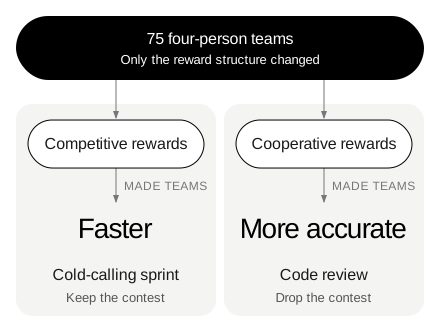
For a team lead, this turns a vague argument into a practical one. The useful question is which parts of the work need speed and which need accuracy. A cold-calling sprint and a code review are different jobs. The team can keep a contest for the first and drop it for the second.
Where rivalry comes from
Rivalry can grow between people who are alike and compete often. Gavin Kilduff, Hillary Anger Elfenbein and Barry Staw studied rivalry in US college basketball. Rivalry was stronger between teams that were similar, that had played each other more often, and whose past games were close to an even split (Kilduff et al. 2010). The authors point to the same pattern inside firms: employees who keep competing for the same bonuses or promotions can come to see each other as rivals.
On a team, that describes two people with the same title, the same manager and the same quarterly ranking. In that pattern, rivalry can come from who gets compared with whom, every quarter, in front of everyone. A conversation can name that pattern without naming the two people.
A competition conversation in five steps
The steps below fit a regular team meeting. Each one builds on the one before it, so keep the order.
- Name the purpose. Say it in one sentence: “We have a few contests running, and I want to hear how they land before the next quarter starts.”
- Agree how passing works. The Thesis rules say: “Before you start, decide together how passing works.” At work, a pass costs nothing and needs no reason. If you’re the manager, you say that.
- Go around once with one word. Write Competition on a sticky note. Each person says what it brings to mind, at whatever depth they choose. The rule line fits here: “Say as much or as little as you like. The others ask, gently.”
- List the contests. On a whiteboard, write every ranking, board, award and bonus that compares people on the team. Next to each one, write whether the work it measures needs speed or accuracy.
- Keep, change or drop. For each contest, the team agrees to keep it as it is, change it into a team target, or drop it. Write down who will raise the changes with whoever owns the bonus scheme.
Step 4 moves the talk from people to the system. Nobody has to say who they compete with. The list on the board says which contests exist, and the team decides about each one.
Three cards that fit the round
A sticky note is enough for this round. The Thesis deck gives more options: each card has an idea on one side and an everyday thing on the other. Three cards sit close to this topic.
Competition has Bench on its back. On a team, the idea side brings up sales boards, hackathons and the year two people were up for one promotion. The Bench side opens the quieter view of the same thing: the person who watched a contest from the side and decided it wasn’t for them.
Success has Notebook on its back. It helps the team see that people count success differently. One person counts closed deals. Another counts the release that went out with no bugs. The notebook can be the one where someone tracks their own numbers, away from any shared board.
Pride has Calculator on its back. It brings up the moment someone saw their name at the top of a list, or the moment they didn’t. The Calculator side is a neutral way in: a budget, a commission sheet, a math test from school.
Questions for the round
The questions below work at any depth. Each person can answer one, all of them or none:
- What’s a contest from school or sport you still remember?
- When has competing with someone made your work better?
- When has a ranking made you hold something back?
- Which part of your work needs speed, and which needs care?
- Who on this team do you get compared with, and how does that feel?
- What would you count as a win that no board measures?
- What contest here would you keep exactly as it is?
- What would change if one of our targets were shared by the whole team?
After any answer, the others can ask one short follow-up. The Thesis rules give three examples: What did that feel like? Who else was there? Has it always meant that to you? The other rule line holds at work too: “What is said at the table stays there.”
Running it as a card round
With the deck or the online table, each turn follows the same steps. Draw a card and pick a side: the idea or the thing. Roll the die. The die has six plain words: MEMORIES · BODY · PEOPLE · VALUES · CHILDHOOD · FUTURE. The only instruction is “Look at the word from that side.” Then hand the die to the left.
Before your next team meeting, list every ranking and board the team lives with, and put that list on the agenda next to the word Competition. The three cards above have their own pages: Competition, Success and Pride. For the other side of the same argument, see fairness at work. For more on running it at work, see Thesis for teams and classes. For the studies behind the deck, see the research. See the rules and the box. Related: belonging at work: how to talk about it as a team.