You read an article about conversation, and it uses words like self-disclosure, responsiveness and the liking gap as if everyone knew them. This glossary gives each term in one sentence, names the study it comes from, and shows what it looks like at a table with friends or in a class.
There are eight terms. Each entry has a definition, the finding behind it, and one plain example. Read them in order, since several build on the one before.
Self-disclosure
Definition. Self-disclosure is telling another person something about yourself: a fact, a memory, a feeling or an opinion.
Nancy Collins and Lynn Miller pooled the research on disclosure and liking in a meta-analysis. They found three links. People who disclose more intimately tend to be liked more. People disclose more to those they already like. And people come to like the person they’ve disclosed to (Collins and Miller 1994). The authors describe the three effects as parts of one interpersonal system.
At the table. Someone says where they grew up. That’s a disclosure. Someone says why they left and what they miss about it. That’s a more intimate disclosure.
Emotional and factual disclosure
Definition. Factual disclosure shares information about yourself; emotional disclosure shares how you feel about it.
Jean-Philippe Laurenceau, Lisa Feldman Barrett and Paula Pietromonaco asked people to log each social interaction right after it happened, over one or two weeks. In their second study, disclosing emotions predicted feeling intimate more strongly than disclosing facts and information (Laurenceau et al. 1998).
At the table. “I moved to Berlin in my twenties” is a fact. “I was scared the first winter” is a feeling. Both are true answers. In the diary study, the second kind predicted intimacy more strongly.
Responsiveness
Definition. Responsiveness is how a listener reacts to what someone shares; perceived partner responsiveness is how responsive the speaker rates that reaction.
The same diary study tested a model from Harry Reis and Phillip Shaver, which says intimacy grows from two parts: one person discloses, and the other responds. The results supported intimacy as a mix of self-disclosure and the partner’s disclosure in each interaction, with perceived partner responsiveness partly explaining the link (Laurenceau et al. 1998).
At the table. A friend tells a story about a hard year. The listener nods, asks about one detail, and repeats a word the friend used. The friend’s sense of being heard is what researchers rate as perceived responsiveness.
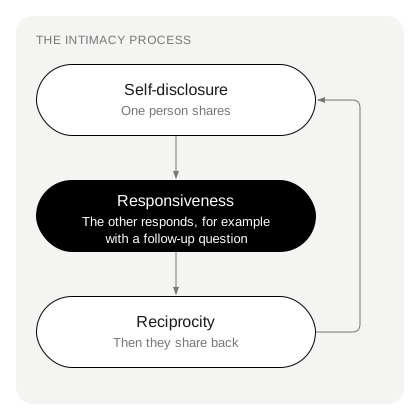
The intimacy process
Definition. The intimacy process is the sequence of disclosure, response and perceived responsiveness that makes two people feel close over many small exchanges.
The term comes from the Reis and Shaver model that Laurenceau and colleagues tested. In this view, closeness is built turn by turn inside each interaction, from what both people share and how the speaker reads the response (Laurenceau et al. 1998). For more on how sharing and closeness connect, see self-disclosure and closeness.
Follow-up question
Definition. A follow-up question asks about something the other person has said and keeps the conversation on their topic.
Karen Huang and colleagues studied question-asking in live conversations. People who asked more questions, particularly follow-up questions, were better liked by their partners. Asking more questions raised perceived responsiveness, which explained the effect on liking. In speed-dating data, people who asked more follow-ups were more likely to get agreement for a second date. Participants didn’t expect question-asking to increase liking (Huang et al. 2017).
At the table. The Thesis rule card gives three short follow-ups that fit any story: What did that feel like? Who else was there? Has it always meant that to you? Each one stays with what the speaker said. For more on this habit, see the guide to follow-up questions.
The liking gap
Definition. The liking gap is the difference between how much your conversation partner liked you and how much you think they did.
Erica Boothby, Gus Cooney, Gillian Sandstrom and Margaret Clark found that after conversations, people systematically underestimate how much their partners like them and enjoy their company. The gap showed up among strangers in the lab, first-year college dorm mates, and members of the public at a personal development workshop. Among dorm mates it lasted for several months (Boothby et al. 2018).
At the table. You walk home replaying the moment you talked too long. The other person is walking home thinking it was a good evening. For more on these studies, see the liking gap post.
Miscalibrated expectations about deep talk
Definition. Miscalibrated expectations are wrong predictions about how a conversation will go; for deep talk, people expect more awkwardness and less connection than they get.
Michael Kardas, Amit Kumar and Nicholas Epley proposed that people underestimate how caring and interested strangers will be in their intimate disclosures. In their experiments, conversations felt less awkward and more connecting than participants expected. Participants overestimated the awkwardness of deep conversations even more than that of shallow ones. In later experiments, more accurate expectations encouraged deeper conversation (Kardas et al. 2021).
At the table. A group sticks to work and weather because a deeper topic feels risky. Then one person answers a question honestly, and the room relaxes faster than anyone predicted.
The beautiful mess effect
Definition. The beautiful mess effect is the tendency to judge your own show of vulnerability more harshly than the same act by someone else.
Anna Bruk, Sabine Scholl and Herbert Bless ran seven studies on situations such as confessing love, revealing bodily imperfections and asking for help. People in the vulnerable position focused on the risks and rated the act more negatively. People judging someone else focused on the benefits and rated it more positively (Bruk et al. 2018).
At the table. Your own admission feels clumsy as you say it. The listener hears it as brave. Both views describe the same sentence.
Three cards for trying the terms out
A word on a card gives people something specific to disclose about, and the follow-ups give the listener a way to respond. These three words fit the terms above.
Honesty has a Radio on its other side. The idea side invites emotional disclosure: a time someone told the truth and paid for it. The Radio side is easier for a first round, a song from a kitchen radio or a station a parent played in the car. A light story is a full turn too.
Curiosity has a Sewing machine on its other side. The word fits the listener’s role, since a follow-up question is curiosity said out loud. The Sewing machine can bring up a grandparent, a repair or a skill someone never learned, and each of those stories leaves room for Who else was there?
Trust has a Window on its other side. The idea side can bring up who heard a story well and what they did next, which is responsiveness seen from the speaker’s chair. If the idea lands too close, the Window is a softer entry: a view from a childhood room, or a window someone waited by.
Try the terms at a table
The terms are easier to remember once you’ve watched them happen. Two to six people and one word are enough. The Thesis die adds an angle with six faces: MEMORIES · BODY · PEOPLE · VALUES · CHILDHOOD · FUTURE. “Look at the word from that side.”
Before you start, “agree together how passing works.” Then one person draws a word, chooses a side, and says as much or as little as feels right. The others ask what they’re curious about. “A short answer is a full answer. You can always ask for more.”
Tonight, pick one term from this list and watch for it in your next conversation. Notice one disclosure, one follow-up, or one moment you guessed the other person liked you less than they showed. Write down what happened.
See the rules and the box, or open the free online table. The cards above have their own pages: Honesty, Curiosity and Trust. For using these ideas in a class or a team, see Thesis for teams and classes. For the sources behind the deck, see the research page. Related: meeting science glossary: eight terms, each with its source.