Your grandmother sits at the end of the table. Someone asks how her knee is, someone else asks if she’s warm enough, and then the talk moves on to jobs, flights and a cousin’s new apartment. She listens. By dessert she has said a few sentences, and nobody at the table has heard anything about her life before any of them were born.
The stories are there. They come out when someone gives them a door: an object, a place, a plain question, and then a second question. This guide sets that up for a holiday meal. It works with the Thesis deck, the free online table, or a word written on a napkin.
Why the stories stay in
Holiday questions for older relatives can be care questions. How are you feeling, did you sleep, do you need anything. They come from love, and they get short answers, because the honest answer to “how’s the knee” is the knee.
The second reason is the pace of the table. Younger relatives may talk fast, over each other, about people the older ones don’t know. A grandparent who waits for a gap may not get one. A third reason is habit: the family has heard the war story or the farm story before and stops asking, so the other stories never get a turn.
People are more interested than you expect
Two studies on conversation found a gap between what people expect and what happens. In a series of experiments, strangers expected deep conversations to be more awkward and less connecting than they turned out to be. Better expectations led people to choose deeper topics (Kardas et al. 2021). In seven experiments, people also underestimated how much they would learn from a conversation (Atir et al. 2022).
Both studies worked with strangers, and both found the gap shrank with people you know. A grandparent sits somewhere in between. You know their face and their cooking, and their life before you were born is close to a stranger’s life. That part is where the surprise is, on both sides of the table.
There’s a reason to ask for the younger ones too. In a brief report, children and teens who knew more about their family’s history scored higher on self-esteem and family functioning measures (Duke et al. 2008). That’s a correlation in one sample, not proof that stories cause anything. It does suggest that family stories land with the kids at the table.
Set it up before the meal
A little planning keeps the evening easy. Four steps cover it:
- Tell one other relative. Pick a parent or sibling and agree that tonight you’ll ask Grandpa about his first job. Two people asking keeps it going.
- Seat them in the middle. The end of the table is the quietest seat. In the middle, a story reaches both sides.
- Bring one object. An old photograph, a recipe card in their handwriting, a key to a house that’s gone. Objects can pull out places and people.
- Pick the moment. After the main course, before dessert, when plates are cleared and nobody is cooking.
Start from a thing, then go to the idea
“Tell me about your life” is too big to answer at a table. “What was on the table at Christmas when you were ten?” has an answer. Concrete things give an older relative somewhere to stand, and the story finds the feelings on its own.
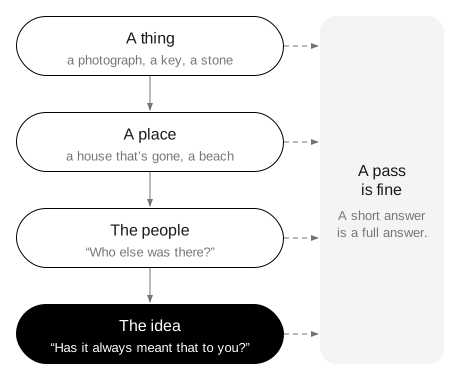
Every Thesis card has two sides for this reason. One side is an idea, the other an everyday thing. The rule card says: “Choose a side: the idea or the thing.” A grandparent who doesn’t want to talk about Work can talk about a stone they carried home from a beach, and the talk may come back to the idea anyway.
The second question is the one that matters
The first answer is short. It’s the second question that tells a grandparent you want the long version. The rule card gives three that fit every story:
What did that feel like? Who else was there? Has it always meant that to you?
“Who else was there” works well with older relatives. It brings in siblings, neighbors and friends nobody at the table has heard of. After the question, wait. An older relative may take a moment before going further, and a filled silence ends the story.
Let them hold the floor
The hard part of this evening is staying quiet while they talk. Younger relatives correct dates, jump to their own version, or check a phone to confirm a place name. Each of these hands the floor back to the fast end of the table.
Agree on one thing before you start: when a grandparent is telling a story, nobody else starts a new topic until it ends. The rule card puts it this way: “The others ask what they’re curious about, gently, without judging.” If you know the story, ask about the part you don’t: who drove, what happened the year after.
When a story turns heavy
Older relatives carry hard stories: wars, moves, people they lost. Some of these come out at a holiday table, and some shouldn’t. The rules start with “Before you start, agree together how passing works.” Say it out loud so the grandparent hears it too. A pass is fine, and so is turning the card to its other side.
“A short answer is a full answer. You can always ask for more.” If a story stops, let it stop. You can come back to it on a walk the next day, with only the two of you.
Questions for grandparents at the holiday table
If you’d rather go without cards, these questions work at a table. They’re sorted from light to deeper:
- What did this holiday look like when you were a child?
- What was the first meal you cooked for other people?
- Where did you live at my age, and what did it cost?
- What was your first job, and who was your boss?
- Who was your best friend at school?
- What did your parents argue about?
- What’s a thing you owned that you still think about?
- What did you think your life would look like at 30?
- What changed the most in your lifetime, and what stayed the same?
- What do you know now that you didn’t at my age?
Three cards for older relatives
These three cards read in their own way for a grandparent at the table.
Enough has Photograph on its other side. The idea side asks what counted as enough then, and what counts now. The photograph side is a direct way in. Hand over an old print and ask who took it.
Work has Stone on its other side. A grandparent who worked one trade for decades may never get asked about the details at family meals: the hours, the tools, the people. The stone side goes outside, to a garden wall, a quarry, a beach on a rare day off.
Nostalgia has Key on its other side. With older relatives this card brings up houses that are gone and towns that changed. The key side is concrete: the first door they had a key to, and who lived behind it.
Playing with the whole table
To make it a round for everyone, use the deck or the online table. The format takes 2–6 players, so a big family can split into two tables or take turns. The six die words are MEMORIES · BODY · PEOPLE · VALUES · CHILDHOOD · FUTURE. The only instruction is “Look at the word from that side.”
Open the online table on a phone in the middle, or see the rules and the box. For a mixed table with in-laws and new partners, see Christmas dinner conversation starters. For more on playing in a group, see Thesis for friends. For the studies behind the deck, see the research.
End with what you heard
When dessert is done, close the way every game of Thesis ends: “When the group is ready to stop, finish with one last round: each player names one thing they discovered about someone at the table today.” When the youngest ones name what they learned about their great-grandmother, she hears that someone listened.
Write down one story from tonight before you go to bed, with a name and a place. Next holiday, start with that one and ask for the part that came after. The cards above have their own pages: Enough, Work and Nostalgia.