You sit down at the kitchen table with a 16-year-old. The worksheet is in your bag, and you already know how it will go: “dunno”, a shrug, a phone screen. A card with one word on it gives the visit a different start. You put it on the table, the young person picks a side, and the talk starts wherever they take it. This guide shows how to use a single card as a direct work tool with young people aged 16 and over, from packing your bag to writing the case note.
It’s written for social workers, personal advisers and family support workers doing one-to-one direct work. Everything here works with a word written on an index card. The examples use the Thesis deck, which is rated 16+ and plays with 2–6 people, so one worker and one young person is a full game.
What the research says about tools in direct work
The tool matters less than the way it’s used. The Talking and Listening to Children project placed researchers in eight social work teams across the UK, for about six to eight weeks each, and observed visits. Some workers used drawing, Lego, arts and crafts, and more specialist tools. Where methods were used, the authors write, it was “not so much that they were used” but “how they were used” (Winter et al. 2017).
The same paper calls for workers who are “capable of having a range of activities and equipment to hand, yet prepared to abandon them” to join in with what the child is doing. Its examples involve younger children. The principle carries over to older young people: bring something, and let it go when the conversation finds its own route.
Step 1: Pack a small pile before the visit
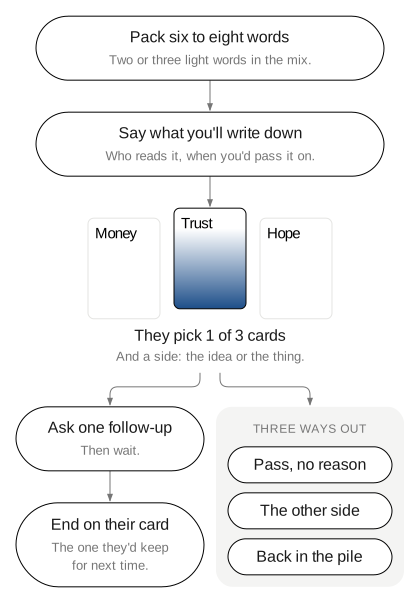
Choose six to eight words before you leave the office. Read each one with this young person in mind. Leave out any word that sits too close to a current investigation, a recent loss or a court date, unless the visit is planned around that subject.
Mix the weight. Put two or three light words in with the heavier ones. On a Thesis card, every word has an everyday thing on its back, so each card already carries a lighter option.
Step 2: Say what happens to what they say
A young person in care or on a child protection plan may know their words can end up in a file. Say how this works before the first card. Tell them what you’ll write down, who reads it, and when you’d have to pass something on.
The Thesis rules include the line “What is said at the table stays there.” A worker with safeguarding duties can’t promise that in full. Replace it with your own sentence, said plainly, such as “I’ll write that we used the cards and what you chose to tell me. If you tell me someone is hurting you, I’ll have to share that.” An honest limit gives the young person something solid to decide with.
Step 3: Hand over the choice of side
Lay out three cards and let the young person pick one. The first rule of the deck reads: “Draw a card. Pick a side: the idea or the thing.” Let them choose the side too.
The object side can be an easier start. Backpack, Window or Teddy bear asks for a description, which may feel safer than naming a feeling. Follow the talk as far as they take it and no further.
Money sits on the back of Backpack. For a 16- or 17-year-old, Money may mean a first wage, a debt, a bank card in someone else’s name or saving for driving lessons. Backpack may mean what they carry between two homes. Either side gives a practical way into planning for the next year, chosen by the young person.
Step 4: Sit side by side if you can
Where you sit can change the talk. In the same study, researchers rode with workers to and from visits. The authors describe their own talks with workers in the car as a “safe space”, “uninterrupted” and “without eye contact,” and suggest this may mirror earlier findings by Harry Ferguson on children’s talks with social workers (Winter et al. 2017). A card can set up something similar. Put it between you on a bench, a car dashboard or a café table, and both of you look at the card instead of at each other.
Step 5: Follow with short questions
After the young person speaks, ask one follow-up and wait. Thesis uses three: What did that feel like? Who else was there? Has it always meant that to you? Each one opens the answer a little without steering it.
Take a turn yourself if the young person wants you to. In the game, the die goes to the left, so the worker gets a turn too. A short, true answer from you about Window or Ball shows the level of sharing you mean. Keep your turn brief and about the object, and keep your own history out of it.
These questions suit a card-based direct work session with someone aged 16+:
- Which of these three cards would you pick up first?
- Which side do you want, the word or the thing?
- Where have you seen this thing lately?
- Who would say this word about you?
- What did this word mean when you were younger?
- What would you want this word to mean in a year?
- Who do you trust with this kind of thing?
- Is there a card you’d like me to take away?
- What should I write down from today?
Trust is on the back of Window. With a young person who has met many professionals, the word Trust names the subject of the whole relationship. The Window side lets them talk about a view from a bedroom, a window they climbed out of, or the one they look out of on the bus.
Step 6: Agree how passing works
The rules say: “Before you start, decide together how passing works.” In direct work, that agreement carries extra weight. A young person who has little say in where they live can at least say no to a word.
Offer three ways out: pass with no reason, turn the card to its other side, or put the card back in the pile. When they pass, nod and move on. A pass that costs nothing in the first session can make the cards usable in the second.
Step 7: End on their card and write it up
Stop before the young person runs out of energy. Ask which card they’d keep for next time, and write the word on the front of your notebook. The next visit can start there.
The researchers saw that social workers rarely recorded the content and quality of their conversations, and that case file forms tended to reflect “a brief record indicating that the child was seen” (Winter et al. 2017). A card gives your note something specific: which words they chose, which side, what they passed on, and what they said in their own words. That makes the young person’s choices visible in the file.
Hope is on the back of Teddy bear. It suits the end of a session or a pathway planning visit. A young person might talk about a teddy bear they kept through several moves, or about one thing they hope for after 18. Both answers belong in a plan.
Adding the die
Once the cards feel familiar, you can add the die. It has six faces: MEMORIES · BODY · PEOPLE · VALUES · CHILDHOOD · FUTURE. The only instruction is “Look at the word from that side.” In direct work, let the young person roll it or skip it.
You know the young person, the case and your agency’s policy, and you decide whether a card fits a given visit. Thesis is a conversation format and makes no clinical claims. For group settings, see Thesis for therapy groups, and for heavier words, shame in group work: a format for facilitators.
Try it before the next visit
Play one round alone on the online table to see how the two sides feel before you bring cards to a young person.
Before your next visit, write six words on index cards and put them in your bag. Draw one for yourself in the car park and answer it out loud in two sentences. If that felt easy, the pile is ready.
The three cards above have their own pages: Money, Trust and Hope. You can play online for free, see the rules and the box, or read the research behind the deck.