You write “shame” on the whiteboard and the room goes still. People look at their phones. One person starts talking about someone else’s shame. The topic is on the agenda, and nobody walks toward it. A format that works with shame lets people come at it sideways: from an everyday object, in short turns, with a pass that costs nothing. This guide gives facilitators that format in five steps, for process groups, recovery groups and peer support circles.
The format works with a word on an index card. The examples use the Thesis card deck, where Shame sits on one side of a card and a Letter on the other.
Why shame needs a side door
Shame can pull people away from the room. In a review of research on moral emotions, Tangney, Stuewig and Mashek describe shame as tied to “attempts to deny, hide, or escape the shame-inducing situation” (Tangney et al. 2007). A direct prompt like “Tell us about a time you felt ashamed” asks people to do the opposite of what the feeling pushes them to do.
The same review links shame-proneness with anger and with blaming others. So a shame session can turn sharp without warning. A group member may start criticizing a parent, a partner or the facilitator, and the subject of the turn quietly changes. The format below plans for that moment instead of hoping it won’t come.
There’s also a gap in how people judge their own openness. Across seven studies, Bruk, Scholl and Bless found that people rated showing vulnerability more negatively when they pictured themselves doing it than when they pictured someone else doing it (Bruk et al. 2018). The person deciding whether to speak may be the harshest judge in the room. A low first step makes that decision smaller.
Step 1: Agree on passing before anyone speaks
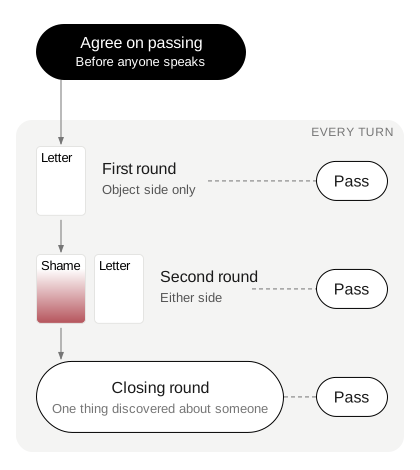
The Thesis rule card starts here: “Before you start, agree together how passing works.” For a shame session, settle three points out loud. Does a person give a reason when they pass? Can they take the other side of the card instead? Does the turn come back to them later?
Add one more line from the rules: “A short answer is a full answer. You can always ask for more.” On a heavy word, one sentence is a complete turn. Saying so at the start removes the pressure to produce a story. For more on setting limits as a group, see the boundaries activity for group therapy.
Step 2: Start from the object side
The first round uses the everyday side of the card. Each person talks about the object, and only the object. Nobody has to mention shame yet.
Shame is on the back of Letter. A letter carries a lot of the same weight, in a form people can hold. A group member might talk about a letter they never sent, a note from a teacher they hid from their parents, or a letter they still keep in a drawer. Some of those stories touch shame without naming it. The group hears them anyway, and the speaker decides how close to go.
In the second round, people can choose either side. Some turn the card to Shame. Some stay with Letter. Both count as taking part, and the facilitator doesn’t comment on the choice.
Step 3: Give each turn the same shape
A fixed turn shape lets everyone know what comes next, so nobody has to guess what a turn asks of them. The Thesis turn has four parts:
- The speaker picks a side: the idea or the thing.
- They roll the die and look at the word from that side.
- They say as much or as little as they like.
- The others ask, gently, then the die moves to the left.
The die has six faces: MEMORIES · BODY · PEOPLE · VALUES · CHILDHOOD · FUTURE. The only instruction is “Look at the word from that side.” The face narrows a large word to one angle, which can make the first sentence easier to find.
Follow-up questions stay short and open. The rule card gives three: What did that feel like? Who else was there? Has it always meant that to you? Agree that the speaker can answer a follow-up, shorten it or pass on it.
Step 4: Plan for the hard moments
Three moments are worth planning for in a shame session, and each has a short, plain response. Decide yours before the group meets.
- Someone shares something big. Thank them and let the next turn start. A long pause or a string of reactions can turn one turn into the center of the session.
- The turn becomes blame. Bring it back to the speaker’s side of the story: “What was that like for you?” Describe the act you saw, and keep labels out of it.
- Someone passes every turn. Leave it. Listening is a way to take part. The closing round in step 5 gives them a way in that asks nothing about themselves.
Anger is on the back of Ring. Given the link between shame and anger in the research above, this card can sit near Shame in the same session. A person might talk about a ring someone gave them, or about a time anger covered something else. It gives the group a word for the sharp moments when they come.
Ten questions for a shame discussion
Some groups prefer open discussion to a card round. These questions work as a list for the facilitator to choose from. Read one aloud, and let anyone answer or pass.
- What’s something you hid as a child that seems small now?
- Where in your body do you notice embarrassment first?
- Whose opinion of you still matters more than you’d like?
- What’s a letter or message you never sent?
- What did your family keep quiet about?
- When did someone’s reaction make a mistake feel smaller?
- What do you find easy to forgive in others and hard in yourself?
- What’s something you once hid and now talk about openly?
- How do you tell a mistake you made from a story about who you are?
- What would you want a younger person to hear about this?
Question 9 points at a distinction from the same review: “shame involves a negative evaluation of the global self; guilt involves a negative evaluation of a specific behavior” (Tangney et al. 2007). The question asks each person to name the behavior apart from the person, in their own words.
Step 5: Close with what people heard
A shame session can end on the group rather than on the last story. Thesis closes with a round where “each player names one thing they discovered about someone at the table today.” Everyone speaks about another person, so the round is low-risk even for someone who passed all session.
The closing round also turns attention to what listening did. In a meta-analysis by Collins and Miller, people who made intimate disclosures tended to be liked more, and people came to like those they had disclosed to (Collins and Miller 1994). The closing round lets people hear that the room received what they shared.
Regret is on the back of Lamp. It’s a quieter neighbor of Shame and a good word for a follow-up session. A lamp left on for someone, a lamp from a childhood bedroom: the object side gives the same gentle start as Letter.
You know your group, its purpose and its limits, and you decide how far a game format goes in it. Thesis is a conversation format and makes no clinical claims. Remind the group of the rule card line before you start: “What is said at the table stays at the table.”
Try it in your next session
The quickest way to test the format is one object-side round with your co-facilitator or a colleague. Open the online table, agree on passing, and draw one card each.
Before your next shame session, write the pass agreement and the three follow-up questions on one index card. Start the first round on the object side, and take the first turn yourself.
For how Thesis fits group work, see Thesis for therapy groups. For an opener that sets the tone, see check-in questions for group therapy. The three cards above have their own pages: Shame, Anger and Regret. You can play online for free, see the rules and the box, or read the research behind the deck. Related: gratitude activity for group therapy: four rounds that stay concrete.