Someone at the table asks it between courses: “If you could invite anyone to dinner, dead or alive, who would it be?” The first guest names a physicist and a painter. The next one names a long-dead king and a singer. For a while the table trades names and reasons. Then the list is done, and the talk drifts back to work.
The question is a good warm-up. It also spends the evening on people who aren’t in the room. This guide keeps the question and adds a turn: from the guests you’d dream of to the guests you have. It takes three moves, a few follow-ups and, if you like, one word on the table.
What the question does well
The dream-guest question is easy to answer. Nobody has to share anything private, and every answer says a little about taste: who you admire, what you’re curious about, which era you’d visit.
It also has a ceiling. A name and one sentence of reasons is a full answer, so the round closes fast. Guests may start to pick names that sound clever. And the famous guest is someone nobody at the table has met.
Listen for the answer that isn’t famous
Sometimes a guest breaks the pattern. They name a grandmother, a teacher, a friend who moved away, a dad they’d like to meet at 30. The table laughs, nods and moves on to the next physicist.
That answer is the way in. It’s about someone the guest knew, so there’s a story behind it that only they can tell. A famous name leads to facts anyone can look up. A grandmother leads to a kitchen, a smell, a phrase she used. Stopping on that answer turns a list of names into a conversation about the people at the table.
Three moves from dream guests to real ones
The turn doesn’t need an announcement. It works in three steps, in this order:
- Keep the question. Let everyone name their guests. It warms up the table, and nobody feels pushed.
- Follow the personal answer. When someone names a person they knew, ask one of the follow-ups from the Thesis rule card: What did that feel like? Who else was there? Has it always meant that to you?
- Turn the question around. Ask who from their own life they’d want at this table, and why. Then let each guest answer in turn.
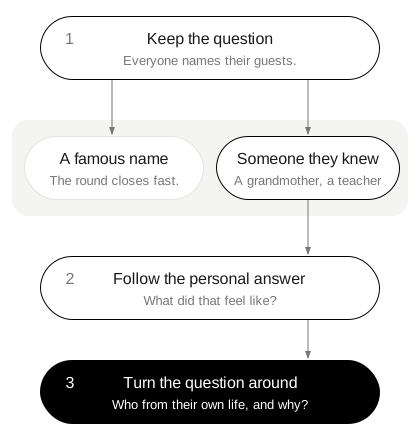
The follow-up is the step that can get skipped. A name feels like a full answer, and asking more can feel like prying. The rule card covers that worry: “A short answer is a full answer. You can always ask for more.”
Why the real guests are worth the question
The people around your table may have more to tell than the dream list suggests. Two sets of experiments point that way. In seven experiments, people expected to learn less from a conversation with a stranger than they did. The gap was smaller when they talked with someone they already knew, or when they knew in advance what the talk would cover (Atir et al. 2022).
A second set of experiments looked at deeper talk between strangers. People underestimated how interested and caring their partner would be when they shared something personal. The conversations felt less awkward and created more connection than they had expected, and the gap was largest for deep conversations (Kardas et al. 2021). A dinner table can mix old friends and new faces, so the first guest who tells a story about a grandmother may be surprised how closely the others listen.
Put one word on the table
A word gives the turned-around question a place to start. Pick one, say Kindness, and ask who it brings to mind. One guest thinks of a neighbor who fed their cat all summer. One thinks of a stranger at an airport. One says they can’t think of anyone, which is a story too.
The Thesis die adds angles to the same word. Its six faces are plain words: MEMORIES · BODY · PEOPLE · VALUES · CHILDHOOD · FUTURE. The only instruction is “Look at the word from that side.” Without the deck, write the six words on a napkin and pick one.
To try it at the table tonight, open the online table on a phone and set it in the middle. It draws, flips and rolls.
Agree on passing before the first card. The rules open with “Before you start, agree together how passing works.” A pass without a reason keeps the round light, and so does turning the card to its other side.
Questions for the guests you have
These questions keep the shape of the dream-guest question and point it at real people. They’re sorted from light to deeper:
- Who from your own life would you want at this table tonight?
- Who taught you to cook the first dish you made for friends?
- Which teacher would you invite, and what would you tell them?
- Who was at the best dinner you remember?
- Which relative would you seat next to whom, and what would happen?
- Who would you like to meet again at the age they were when you knew them?
- Who in your life has never been to a dinner like this one?
- Whose voice do you still hear when you set a table?
- Who would you invite to say thank you?
- Who from this table would you want at a dinner ten years from now?
A few of these, with follow-ups, can be enough for one evening.
Three cards for real guests
Each of these cards points the talk toward people the guests know.
Kindness has Book on its other side. The idea side can bring up specific people: someone who helped at the right moment, or someone the guest helped. The book side is the light way in. A book someone gave you, or one you borrowed and never returned, comes with a person attached.
Enough has Photograph on its other side. The idea side can go to money or work, so it may suit the second half of the evening. The photograph side is the closest thing in the deck to the dream-guest question: a picture on a fridge or in a phone, and who is in it.
Community has Mirror on its other side. It turns the question from single guests to groups: a team, a choir, a street, a group chat. The mirror side can turn to how others see you, which may bring up the people whose view mattered.
Keep one name for next time
When the evening winds down, finish the way every game of Thesis ends: “When the group is ready to stop, finish with one last round: each player names one thing they discovered about someone at the table today.” Someone may name a grandmother from the first round. That’s the guest list for the next dinner.
See the rules and the box, or play on the online table. The cards above have their own pages: Kindness, Enough and Community. For more on playing with a group, see Thesis for friends. For the studies cited here, see the research behind the deck. For more ideas at dinner, see dinner party conversation topics. Related: when the dinner conversation dies: a host’s rescue plan.