One of you emptied the dishwasher again. The other paid the electricity bill and the car insurance this month. One of you had Saturday morning off, the other had Sunday afternoon. Each of you keeps a quiet count, and the two counts don’t match.
This post is for couples who live together and have started keeping score over chores, money, or free time. It shows how to find the rule each of you uses when you call something fair, how to compare those rules in one talk, and how to spend an evening on the word Fairness once the list is off the table. You need no app and no deck. A word written on a sticky note works.
Two people, two rules for fair
Two partners can look at the same week and both feel shortchanged, because each one measures it with a different rule. A fight about the dishes can be a fight about which rule counts.
Five rules can sit behind the word fair, even when nobody names them:
- Equal shares. Half the chores, half the bills, the same number of free evenings.
- In proportion. Whoever earns more pays more. Whoever works fewer hours does more at home.
- By need. The person who’s more tired this month gets the lie-in.
- By turns. This weekend at your parents’, the next one at mine.
- By what you’re good at. One cooks, the other handles the taxes.
None of these rules is the right one. Each fits some parts of life better than others. Trouble can start when one partner runs the chores on equal shares and the other runs them on proportion, and neither has said so out loud.
Money is one place where this shows. People on marriage forums describe splitting every bill down the middle and feeling, after a few years, like a roommate who gets an invoice each month. The split is equal. To one of them, it no longer feels like a household.
What research says about feeling it’s fair
How fair the split feels is linked to how the marriage goes. Michelle Frisco and Kristi Williams used a national survey of people in dual-earner marriages. Those who saw the division of housework as unfair reported lower marital happiness, and this held for husbands and wives. Among wives, perceived unfairness was also linked to higher odds of divorce (Frisco and Williams 2003). The study shows an association. It can’t say the unfair split caused the outcome.
The link may run in both directions. Nancy Grote and Margaret Clark followed married couples across the transition to parenthood, in three waves. Conflict and wives’ dissatisfaction earlier predicted that the division of household tasks was seen as unfair later. Those perceptions of unfairness then predicted more conflict and dissatisfaction for wives at the next wave (Grote and Clark 2001). In plain terms: a hard stretch can make people start counting, and the counting can keep the hard stretch going.
A new chore chart fixes the numbers. If the counting started because the couple felt far apart, the numbers aren’t the whole problem. Both studies are about married couples and housework, so they say less about money or time. More on the studies behind the deck is on the research page.
One talk: name your rule, area by area
Pick a calm evening for this talk, away from the last argument. Take three areas, one at a time: chores, money, and free time.
- Each of you writes down, for one area, what a fair split would look like. Keep it to one sentence.
- Read the sentences aloud. Don’t argue yet.
- Name the rule behind each sentence: equal, in proportion, by need, by turns, or by skill.
- Ask where the rule came from. It may be the house one of you grew up in.
- Agree on one rule for that area, for now. Write it down.
- Move to the next area.
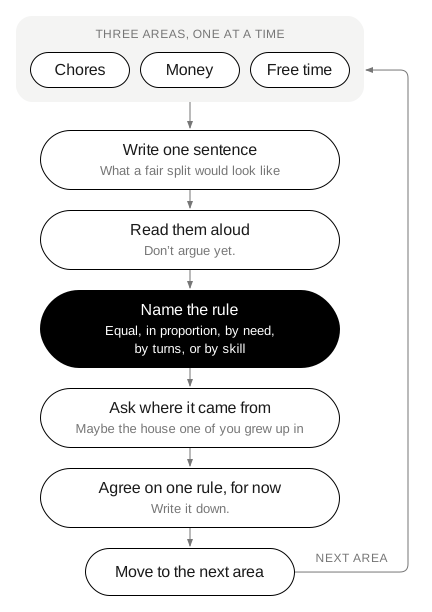
The rule you agree on can differ between areas. A couple can split money in proportion to income, chores by skill, and weekends by turns. What changes is that both of you now know which count the other one is keeping.
Step 4 can open the talk up. A partner who insists on equal shares may have watched one parent do everything. A partner who leans on proportion may have grown up where the earner was excused from the kitchen. Those stories can take longer than the talk, and they can wait for a separate evening.
An evening on the word Fairness
Once the rules are on paper, a word can carry the rest. This evening uses no list and no chart. It runs on the Thesis format:
- Pick a word, from a card, the online table, or a sticky note.
- Before you start, decide together how passing works.
- One of you says what the word brings up. “Say as much or as little as you like. The others ask, gently.”
- The other asks one follow-up, then listens. Then swap.
The die in the box has six faces: MEMORIES · BODY · PEOPLE · VALUES · CHILDHOOD · FUTURE. Look at the word from that side.
These three follow-ups from the rule card fit any word:
What did that feel like? Who else was there? Has it always meant that to you?
Three words for a fairness evening
These cards from the deck sit close to chores, money, and time. Each has an object on the other side for a lighter start.
Fairness has Sweater on its other side. Fairness in a childhood story can lead back to siblings: who got the bigger room, who had to share. Those first rules may be the ones you still use. Sweater can bring up a lost parent, because a sweater can be kept for its smell. If that’s too much for tonight, pass or turn the card.
Money has Backpack on its other side. Money brings the choice between equal and proportional splits into the open. Backpack is easier: a first school bag, what was in it, who bought it. Both sides lead to the house you grew up in and what was spent there, and on whom.
Work has Stone on its other side. Work covers the job and the work at home, and two partners can value the two differently. The word can bring up who did the unpaid work in your family. Stone can be a stone carried home from a beach, or something heavy to lift.
Questions about fairness at home
If you’d rather start with a question, these leave room for a story more than a verdict:
- Who did the dishes in the house you grew up in?
- When did you first say “that’s not fair” and mean it?
- Which chore do you mind least, and which one most?
- What did your parents argue about when it came to money?
- Do you feel more owed when you’re tired or when you’re busy?
- Which part of the week feels most like your own time?
- What’s one thing I do that you wouldn’t want to take over?
- When has a split that wasn’t equal still felt fair to you?
- What does a good Sunday look like for you, hour by hour?
- Which rule for fair did you bring from home without noticing?
Take one or two per evening. Follow each with Has it always meant that to you? and give the answer time.
When the word reopens the argument
Fairness is close to the bone for a couple that keeps score. The word can slide back into the dishwasher fight within a minute. If that happens, stop the round and put the topic on the list for the talk about rules. The evening on the word is for stories, and the talk is for rules. Keeping them apart can make both easier.
What is said at the table stays there. A childhood grudge about the bigger room, told on a quiet evening, stays out of the next fight about chores.
Try it this week
Write the word Fairness on a sticky note and put it on the fridge. On an easy evening, each of you says what the word meant in your house at age ten. Then one of you asks Who else was there? End the way a game of Thesis ends: each of you names one thing you found out about the other today.
For the money side of this talk, see money questions for couples. For playing as two, see Thesis for couples. To see the cards and the die, read the rules and the box.