You put “family” on the agenda, and the room splits before anyone speaks. One member is close to their parents. One hasn’t seen a sibling in years. One grew up with grandparents, and one calls their friends family. A single open question like “Tell us about your family” asks each of them for the same depth at once. This guide gives five rounds for one group session on family, for a therapy group, a support group or a multi-family group. Each round offers a near route and a far route, so every member picks how close to come.
Every round works with the word written on an index card. The examples use the Thesis card deck, where Family is card 06. You know your group and its purpose, and you decide how far an activity like this goes in it. Thesis is a conversation format and makes no clinical claims.
Why family stories are worth a session
Family stories can carry information a member may not say out loud: who held the household together, what was never discussed, which habits came from where. Duke, Lazarus and Fivush asked children and adolescents how much they knew about their family history. Knowing more was correlated with higher self-esteem, better family functioning and lower anxiety (Duke et al. 2008). It’s a correlation, and it doesn’t show that telling stories causes any of it. It does suggest that family stories are worth some room.
The same stories can also hurt to tell. A member with a painful family history can sit next to someone describing a warm one. The rounds below start with objects and scenes, and move toward personal stories only when the member chooses to.
Before the first round: three agreements
Three agreements come first. The Thesis rules settle passing before play: “Before you start, decide together how passing works.” Then confidentiality: “What is said at the table stays there.” Link that line to the confidentiality agreement your group already has.
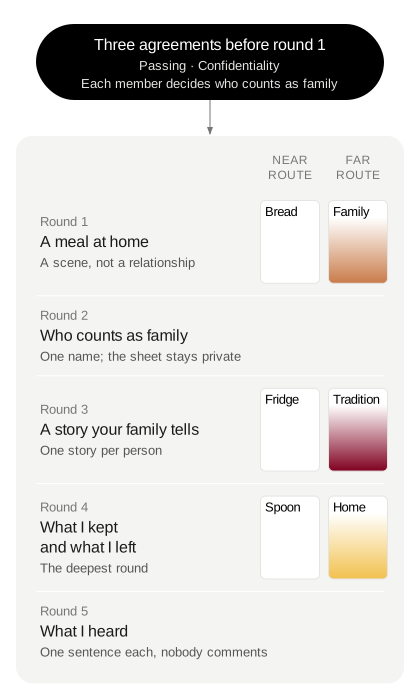
The third agreement belongs to this topic. Each member decides who counts as their family. Blood relatives, a stepparent, a foster family, chosen friends or nobody at all are all valid answers. Say it before round 1, so nobody has to defend their definition halfway through a turn.
Round 1: A meal at home
Each member describes one meal from the home they grew up in, or any home they’ve lived in. Who cooked, who sat where, what was always on the table. One sentence counts. The rules put it plainly: “Say as much or as little as you like. The others ask, gently.”
A meal is a low-cost opening, because the member describes a scene, not a relationship. Some may add who was missing from the table, and some may stay with the food. Both are full turns. The host goes first with a plain example, such as Sunday soup at a grandmother’s house.
Family sits on the back of Bread. The pair gives a member two ways in. One side asks about the people. The other side asks about a loaf, a recipe or a bakery on the way home from school. Bread brings the meal of round 1 to the table and asks for less than the word on the front.
Round 2: Who counts as family
Each member draws a small circle on a sheet of paper with their own name in the middle. Around it they write the people they count as family today, as close or as far from the center as they like. Then they share one name and why it’s where it is. They don’t show the sheet.
The drawing stays private, and only the one name goes into the room. A member with a complicated map can share the easiest name on it. Chosen family belongs on the sheet if the member puts it there, and pets do too.
These questions work for rounds 1 and 2, one per turn:
- What did dinner look like in the house you grew up in?
- Who in your family made you laugh?
- Who do you count as family today?
- What did your family do on a Sunday?
- Who in your family do you resemble?
- Which relative do you wish you’d known better?
- What’s a phrase people said in your house?
- Who outside your family felt like family?
- What was hard to talk about at home?
- What’s one thing your family got right?
Follow-ups stay short. The rule card gives three: What did that feel like? Who else was there? Has it always meant that to you? Use those and stop there.
Round 3: A story your family tells
Each member tells one story that gets repeated in their family. How two people met, a move to another city, the time someone got lost, a grandparent’s job. If no story was passed down, the member can tell what they’d like to know and never asked.
This is the round the research above points to. A story told about others in the family can be easier than a story about oneself, and it can still say a lot. The host keeps the round to one story per person and watches the time, because family stories grow.
Tradition is on the back of Fridge. In this round the word gives a member a route through habits. They can talk about a holiday their family kept, or about what hung on the fridge door at home: drawings, a calendar, a note nobody took down. The fridge side is an object, and it can carry a whole household.
Round 4: What I kept and what I left
Each member names one habit from their family they still keep, and one they’ve stopped. A way of setting the table, a phrase, how money was talked about, how arguments ended. Keep both halves concrete: an act, not a judgment of the family.
This is the deepest round, so it sits fourth, with time left to come down. Some members may talk about a habit they’re proud of, and some about one they’re working to drop. If a member gets close to criticism of a named relative, the host can bring it back to the act: “What do you do differently now?”
Home is on the back of Spoon. It lets a member move from the family they came from to the home they live in now. They can describe their kitchen today, or a spoon they inherited and still use. Either side keeps the round in the present.
In a multi-family group
When several families meet in one group, the rounds work with one change: members answer as themselves, not for their family. A parent and a teenager can give different answers to the same card, and that difference is information for both of them.
Watch for comparison. In a scoping review of 27 studies on multi-family therapy for eating disorders, families valued observing and learning from other families with similar experiences. Some also raised concerns about unhelpful comparisons, and some described the group’s intensity as both helpful and exhausting (Baudinet et al. 2021). One way to set this up is to agree that the group listens to each family’s story without ranking it.
Round 5: What I heard
Close with the last round from the Thesis rule cards: “each player names one thing they discovered about someone at the table today.” After a session on family, this round turns the attention back to the people in the room. Each member hears that something they shared stayed with someone.
Keep it to one sentence per person, and nobody comments on it. For other ways to end a session, see check-out questions for group therapy.
Run it with the online table
If the group meets online or has a shared screen, the online table deals the cards and rolls the die. Agree on passing first, then play round 1 with Family on the table.
The die has six faces: MEMORIES · BODY · PEOPLE · VALUES · CHILDHOOD · FUTURE. The only instruction is “Look at the word from that side.” A member who rolls a side they don’t want can pass on it like any other prompt.
Before your next session, write the third agreement on an index card: each member decides who counts as their family. Read it out before round 1, then tell your own meal first.
For running the game in a session, see Thesis for therapy groups. The cards above have their own pages: Family, Tradition and Home. You can play online for free, see the rules and the box, or read the research behind the deck. For a session on hope, see hope group activities. Related: honesty group therapy activities: five rounds for one session.