It’s your first December in a shared apartment. One of you grew up opening presents on Christmas Eve after dinner. The other grew up opening them on Christmas morning in pajamas. Neither of you has said a word about it, because each of you assumes the other does it the normal way.
This post is for couples who each brought a set of family traditions into one home and haven’t sorted them yet. It gives you one evening to list what each of you carries, tell the story behind a few, and decide together which ones you’ll keep, which you’ll change, and which stay with the family they came from. It ends with a way to start one tradition that belongs only to the two of you. A sheet of paper and a pen are enough.
You already have traditions of your own
A couple’s traditions don’t start with a holiday. They start with small repeated things: the same takeout on Friday, a nickname, the way you say goodnight. Carol Bruess and Judy Pearson interviewed 20 married couples and collected open-ended questionnaires from 79 more. From those answers they sorted marriage rituals into seven types, among them couple time, idiosyncratic or symbolic rituals, daily routines, intimacy expressions, and communication rituals (Bruess and Pearson 1997).
That list matters for this post. Before you sort what you inherited, it helps to see that the two of you are already making something. The Friday takeout counts. So does the song you both sing badly in the car.
Family rituals may also go with how close a couple feels. In a study of 150 married couples in Portugal, Carla Crespo and colleagues found that partners who put more into family rituals reported better relationship quality and more closeness (Crespo et al. 2008). The data were self-reports, and the study shows a link. It can’t say that rituals cause closeness.
Why couples skip this talk
Each partner’s traditions arrive feeling like the default. Presents on Christmas Eve aren’t a choice to the person who grew up with them. They’re how the holiday works. So the question “how do we do this?” can go unasked, and the plan goes to whoever moves first or cares most.
There’s a second reason. Saying “I’d rather not do that one” can sound like a judgment of your partner’s family. The talk feels risky, so it gets put off until the week of the holiday, when there’s no time left to make it calm.
Stories make the talk easier. “Why do you open presents on Christmas Eve?” can sound like a challenge. “What do you remember about Christmas Eve when you were eight?” invites a memory. The decision can come later, after both of you know what the tradition holds for the other.
One evening to sort your traditions
Do it well before the next big holiday, on a night with no plans after.
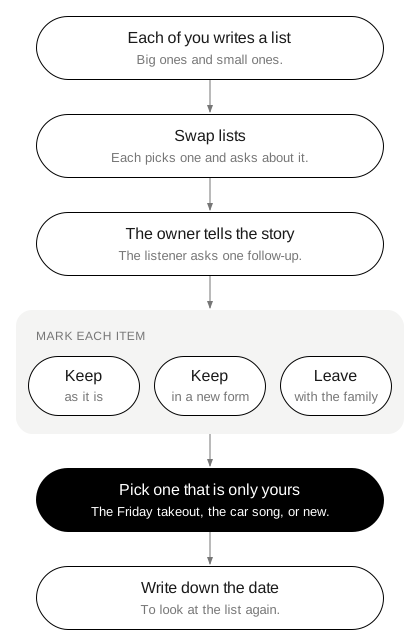
- Each of you writes a list of the traditions you grew up with. Include the big ones (holidays, birthdays) and the small ones (Sunday breakfast, how your family said goodbye at the station).
- Swap lists. Each of you picks one tradition from the other’s list and asks about it.
- The owner of that tradition tells the story: when it happened, who was there, what it felt like. The listener asks one follow-up.
- Go through both lists and mark each item. Keep it as it is, keep it in a new form, or leave it with the family it came from.
- Pick one tradition that is only yours. It can come from the Friday takeout or the car song, or it can be new.
- Write down the date you’ll look at the list again. Before next year’s holidays works.
“Leave with the family” doesn’t mean giving it up. You can still join your parents’ tradition at their house. It means the two of you won’t carry it into your own home.
The “new form” column leaves room for both families. The Christmas Eve family can open one present on the evening and the rest in the morning. A big Sunday lunch can turn into a Sunday breakfast for two.
Questions about traditions to ask each other
If the lists stall, these questions help. They start with memory and move toward what you want now:
- Which holiday from your childhood do you remember best, and why that one?
- What did your family eat on a day that mattered?
- Who in your family kept the traditions going?
- Which tradition did you dread as a kid?
- Which one do you miss now that you live away from it?
- What did your family do on an ordinary Sunday?
- Is there a tradition you’d like to do differently from how you grew up with it?
- What’s something we already do every week that you’d want to keep for years?
- If we started one new tradition this year, what season would it belong to?
One or two questions are enough for an evening. Let the answer run before you move to the next one.
Words for this conversation
A single word can start the same talk without a list. These three from the Thesis deck fit a couple sorting traditions.
Tradition has Fridge on its other side. The word itself can feel heavy, like a debate about holidays. The fridge is easier: what was always in your family’s fridge, what was off limits, which dish came out only once a year. A conversation about a fridge door covered in magnets can end up at the traditions anyway.
Family has Bread on its other side. For a couple, “family” can mean either set of parents, or the two of you. Bread leads to a table: who baked, who sliced, what was eaten together. It also shows whose kitchen each of you still thinks of as the real one.
Home has Spoon on its other side. This is the word to draw near the end, once the lists are done. Each of you can say what home meant growing up and what it means in the place you share now. The spoon keeps it light: a spoon from a grandparent’s drawer, a dessert eaten from the pot.
Thesis is played with a die that has six words: MEMORIES · BODY · PEOPLE · VALUES · CHILDHOOD · FUTURE. Look at the word from that side.
When you both want the same day
Some traditions collide. Two families, one Christmas Eve, and each of you wants to be at your parents’ table. The sorting evening won’t solve every clash, and it doesn’t need to.
What helps is hearing the story first. Ask the Thesis follow-up Has it always meant that to you? Sometimes the answer is no: the tradition mattered at ten and matters less now. Sometimes it’s yes, and then you know which day carries more weight for your partner. If a tradition opens an old hurt, the rules leave room for a brief answer: “A short answer is a full answer. You can always ask for more.”
Try it this week
Take a sheet of paper tonight and write three traditions from your childhood. Leave it on the kitchen table. Your partner adds three. On the weekend, pick one from each other’s list and ask What did that feel like? Then end the way a game of Thesis ends: each of you names one thing you found out about the other today.
If you want to take the talk to the next holiday table with your parents, see questions about family traditions. The three cards have their own pages: Tradition, Family, and Home. For playing as two, see Thesis for couples. You can draw a word at the online table, and for the studies behind the deck, see research. To see the cards and the die, read the rules and the box.