Some family holidays run on their own. The same dish, the same seat, the same walk after dinner. Nobody remembers who started it, and nobody has asked in years whether everyone still wants it.
This post gives you ten questions about family traditions to bring to the next holiday table. They help a family find out where its traditions came from, which ones still matter, and which ones could change. You can ask them out loud over dessert, write them on slips of paper, or use one word from the Thesis deck.
The short answer
A tradition is easier to talk about through stories than through opinions. “Do we still need the gift exchange?” starts a debate. “What’s your first memory of the gift exchange?” starts a story, and the opinion can show up inside it.
So the questions below move in one direction. They start with memories, move to what each person feels now, and end with what the family wants next year. By the last question, the decision to keep, change or drop a tradition comes out of what people have already said.
What one study found about holiday rituals
Researchers have looked at holiday traditions directly. Ovul Sezer, Michael Norton, Francesca Gino and Kathleen Vohs ran three studies with 1,098 participants, around Christmas and New Year’s Eve. People who did shared family rituals enjoyed the holidays more. The authors trace this to the rituals making people feel closer to their family and more involved in the day. Rituals people did on their own weren’t linked to more enjoyment (Sezer et al. 2016).
The shared part is the point for this post. A tradition only one person still cares about may do less for the whole table. Asking about traditions is a way to find out which ones are still shared.
Talking about the past at the table has a link to closeness too. In a UK national survey, Robin Dunbar found that people who eat with others more often report more friends they can depend on. Evening meals that left people feeling closer to the others involved more laughter and more reminiscing (Dunbar 2017). A holiday dinner already has the meal. The questions add the reminiscing.
Ten questions about family traditions
These questions work best one at a time, with a story for each answer. Ask the oldest person at the table first for the early questions, and the youngest first for the last ones. That way the past and the future both get a voice.
- What’s the first holiday tradition you remember from your own childhood?
- Who started the tradition we keep the longest, and do you know why?
- Which tradition did you love as a kid and stop doing as an adult?
- What does this holiday smell like to you?
- Which tradition would you miss first if we skipped it this year?
- Which one do you keep doing mostly because everyone expects it?
- What did your family do that you’ve never seen another family do?
- Is there a tradition from another family or country you’d like to borrow?
- What would you change about how we spend this day?
- What tradition would you like the next generation to keep?
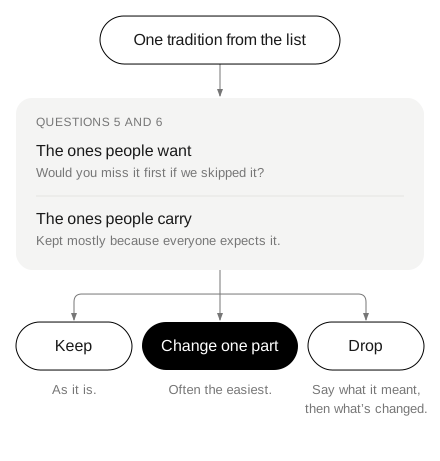
Questions 5 and 6 can carry the most weight. Asked together, they sort a family’s traditions into the ones people want and the ones people carry. Neither answer is wrong. A tradition people carry can still matter to the person who started it.
Keep, change or drop
After the questions, a family may have a short list of traditions to look at. Three choices cover them: keep it as it is, change one part of it, or let it go. Changing one part can be the easiest. The dinner stays, the gift exchange becomes a game, or the trip happens every second year.
Some advice for new parents goes the other way: don’t start a tradition you can’t picture keeping up for decades. That pressure can freeze a family’s habits before they’ve had a chance to grow. Asking question 10 each holiday keeps traditions open to change, which takes some of that weight off.
Dropping a tradition can be harder to say out loud than it looks. The person who started it may hear “we don’t want your dinner anymore.” Framing it as a story helps: say what the tradition meant to you, then what’s changed. For more on raising a topic that might sting, see asking sensitive questions.
One word for the table
A single word can open the same conversation without a list. The Thesis deck has a card for it.
Tradition has a Fridge on its other side. Choose the idea when you want to talk about the family’s rituals as a whole. Choose the Fridge when a smaller story is easier: the magnets from every trip, the drawing that stayed up for years, the leftovers that fed everyone the day after. A fridge door can be where a family’s traditions are on display without anyone calling them that.
The Thesis die has six faces: MEMORIES · BODY · PEOPLE · VALUES · CHILDHOOD · FUTURE. The only instruction is “Look at the word from that side.” Rolling it with Tradition can bring a different story each time, so everyone at the table can get their own story from one word.
Family has Bread on its other side. Bread can sit at the center of a holiday meal, and the family recipe for it is a tradition on its own. Players who find the word Family too large can start with the Bread and get to the people through the kitchen.
Home has a Spoon on its other side. For anyone who spends the holiday away from the house they grew up in, Home brings up which traditions moved with them. A Spoon story can be as small as who was allowed to stir.
Try it at the table
Two to six people is enough, and the holiday table already has them. The Thesis rules open with “Before you start, agree together how passing works.” A grandparent may want to tell every story. A teenager may want to pass on all of them. Both are fine.
The rule card gives three follow-up questions that fit every word: What did that feel like? Who else was there? Has it always meant that to you? For traditions, the third one does the most work. It turns “we’ve always done it this way” into a story with a start date.
“There are no right answers.” A family can disagree about a tradition and still keep it. The conversation is a way to hear why each person cares, or doesn’t.
What to do at the next holiday
Pick one question from the list, or write the word Tradition on a napkin. Ask it after the main course, when people have time. Let the oldest person answer first, and let someone ask one follow-up.
When the talk winds down, end the way every game of Thesis ends: each player names one thing they discovered about someone at the table today. Then write down one tradition the family decided to keep, and one it decided to change. Next year, start with that list.
See the rules and the box, or open the free online table. The cards above have their own pages: Tradition, Family and Home. For playing with a few close people, see Thesis for friends. For the studies behind the deck, see the research page.